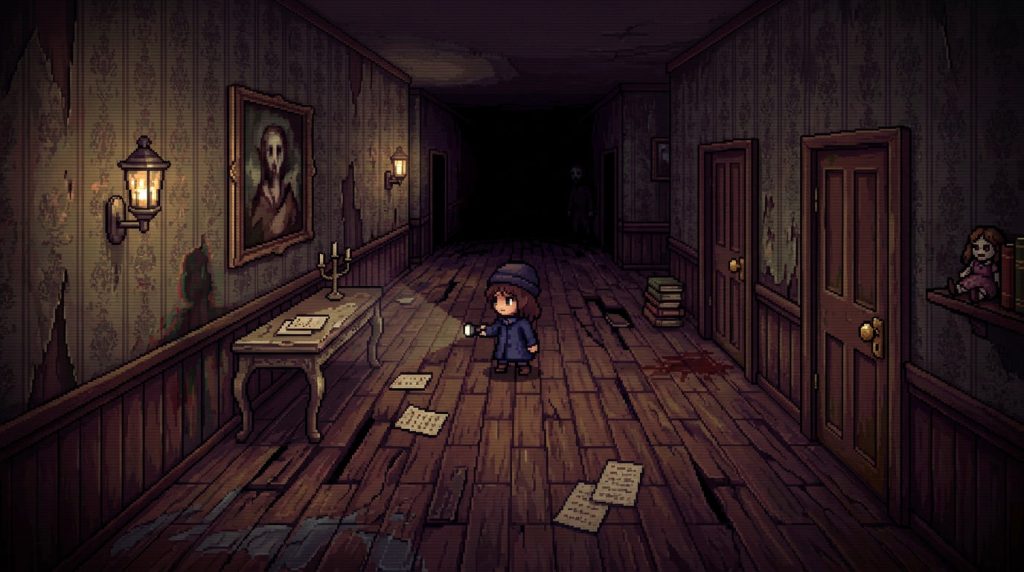
RPG Maker didn’t just make horror games cheaper to build — it accidentally created an entire subgenre. Strip away combat stats and grinding, and what’s left is a toolkit built for exploring unsettling rooms, hoarding cryptic notes, and running from things you can’t fight back. Here are 20 of the best pixel-art horror games to come out of that scene, with the actual engine each one runs on so you know what you’re downloading.
Not everything commonly filed under “RPG Maker horror” was actually built in RPG Maker. Several genre staples — including Mad Father and Misao — were made in WOLF RPG Editor, a separate free Japanese engine with a similar look and feel. We’ve labeled every title’s real engine below so you’re not misled about what tool made what.
Quick Recommendations
| Game | Subgenre | Engine | Best Platform |
|---|---|---|---|
| Ib | Puzzle / Narrative | RPG Maker 2000 | Steam (official remake) |
| The Witch’s House | Puzzle / Death Traps | RPG Maker VX | Steam (MV remake) |
| Ao Oni | Survival / Chase | RPG Maker XP | Steam (2024 remaster) |
| Yume Nikki | Surreal / Exploration | RPG Maker 2003 | Freeware / Steam (Dream Diary) |
| Corpse Party (1996 original) | Survival Horror | RPG Tsukūru Dante 98 | Historical interest only |
| Corpse Party: Blood Covered | Survival Horror | Custom engine | Steam |
| Mad Father | Narrative / Puzzle | WOLF RPG Editor | Steam / Switch remake |
| Misao | Puzzle / Narrative | WOLF RPG Editor | Steam (2024 HD Remaster) |
| Alice Mare | Puzzle / Narrative | WOLF RPG Editor | Freeware |
| The Crooked Man | Psychological | WOLF RPG Editor | Steam |
| Paranoiac | Psychological | WOLF RPG Editor | Steam |
| Fear & Hunger | Survival / Extreme Difficulty | RPG Maker MV | Steam |
| Fear & Hunger 2: Termina | Survival / Extreme Difficulty | RPG Maker MV | Steam |
| Omori | Psychological | RPG Maker MV | Steam / Switch / PS4 |
| Pocket Mirror | Psychological / Puzzle | RPG Maker VX Ace | Steam (GoldenerApfel edition) |
| Angels of Death | Psychological / Escape | RPG Maker VX Ace | Steam / Switch / PS4 |
| OneShot | Puzzle / Metafiction | RPG Maker XP | Steam / Switch |
| Your Turn to Die | Puzzle / Deduction | RPG Maker MV | Freeware / Steam |
| One Night Trilogy | Survival / Psychological | RPG Maker VX | Freeware |
| Yuppie Psycho | Survival / Satire | Custom engine | Steam / Switch |
Top RPG Maker Horror Classics
Ib
A young girl wandering an art museum with her parents gets separated when the gallery twists into a nightmare where paintings and statues hunt visitors. Ib is built almost entirely around inventory management — your “Rose” petal count functions as your health bar, and losing all of them is fatal. It’s soft-spoken and understated for most of its runtime, which makes the handful of true scares land much harder. Multiple endings hinge on small, easy-to-miss choices.
The Witch’s House
Viola wakes in a strange house guarded by a talking cat and infested with rooms designed to kill her outright — spikes, falling chandeliers, poisoned food — with almost no warning. The Witch’s House is infamous for trial-and-error deaths and one of the more talked-about twist endings in the genre, one that recontextualizes everything that came before it once you reach it.
Ao Oni
Four friends investigating a “haunted” mansion get trapped inside with a towering blue oni that hunts them room to room. Ao Oni is one of the earliest titles to build its entire structure around chase-and-hide mechanics rather than combat, and its stripped-down tension — you can hear it coming before you see it — set the template a lot of later chase-horror RPG Maker games would copy. If you’re curious how other horror games walk the line between action and dread, our breakdown of whether BioShock counts as a horror game covers a similar genre-blurring debate.
Yume Nikki
A shut-in girl named Madotsuki explores a series of dreams accessible only through her bedroom window, collecting bizarre “Effects” with almost no dialogue or explicit narrative. Yume Nikki isn’t scary in a jump-out-at-you sense — its horror comes from dread and isolation, and it directly inspired the entire “surreal dream exploration” horror subgenre, including OneShot and Omori.
Corpse Party (Blood Covered)
A group of students performing a friendship charm get pulled into Heavenly Host, a demolished elementary school haunted by the vengeful spirits of murdered children, and split apart across overlapping timelines. Worth a quick note: the 1996 original Corpse Party was genuinely built in an early RPG Maker program, but the version almost everyone actually plays — Blood Covered, released from 2008 onward — was rebuilt on a custom engine, not RPG Maker. It’s still a cornerstone of the genre’s DNA either way, sitting alongside bigger-budget survival horror touchstones like Resident Evil Veronica.
Mad Father
Aya Drevis hears her father scream from his basement laboratory and finds her mansion filled with corpses and things that shouldn’t be alive. Mad Father leans harder into body horror and gore than Ib or Witch’s House, with a gem-collecting puzzle structure gating access to its true ending. Built by the same solo developer, Sen, who made Misao — the two share a loose continuity.
Misao
A quiet classmate named Misao vanishes without a trace, and the day after, the entire school transforms into a nightmare version of itself. The objective is grim and literal: find six missing parts of Misao’s body scattered through the building. It’s Sen’s first release and a direct prequel to Mad Father.
Alice Mare
Six students wake up trapped inside a facility called Cicada’s Slope with no memory of how they got there, and have to piece together the truth through fragmented flashbacks. Quieter and more melancholic than most entries on this list, with puzzle design that rewards close reading of environmental notes.
The Crooked Man
David Hoover, a recovering alcoholic, becomes convinced a hallucination from his childhood — a tall, twisted figure — is stalking his family in the present day. It plays as a slow-burn psychological mystery more than a chase game, with an unreliable narrator angle that keeps the “is this real” question open for most of the runtime.
Paranoiac
Two siblings return to their childhood home to sort out their late parents’ estate, only to find it isn’t empty. Built around a small, contained location — the whole game largely takes place within one house — with tension that comes from repeated visits to the same rooms as things quietly change between them.
More Horror Coverage on LemonLama
Top Modern RPG Maker & Pixel-Horror Hits
Fear & Hunger
Four adventurers descend into a dungeon beneath a cursed town to rescue a missing girl, and almost none of the game’s threats are fair fights. Fear & Hunger is deliberately brutal — permanent injuries, mutilation, and sanity mechanics stack against you, and the game expects failure as part of learning it. Not for the faint of heart, and not remotely subtle about its body-horror content.
Fear & Hunger 2: Termina
A standalone sequel set in a different, larger city overrun by a supernatural apocalypse, with a much bigger cast of playable characters and branching routes. It expands the mechanical depth of the original considerably while keeping the same unforgiving, high-stakes combat philosophy.
Omori
A withdrawn teenager named Sunny slips between a vivid dream world and a real life he’s been avoiding for years, with a battle system built around emotions instead of elemental damage types. Omori deals directly with grief, trauma, and mental health, and its dream-world charm makes the moments it turns genuinely disturbing hit that much harder. Originally prototyped in RPG Maker VX Ace before the team switched to MV mid-development for better cross-platform support.
Pocket Mirror
A girl named Aria stumbles into a nightmarish version of her childhood memories, guided by an ambiguous companion whose intentions aren’t clear. Heavily inspired by Ib and Witch’s House in structure, but distinguishes itself with a more elaborate item-combination puzzle system and a much longer, more layered story. The Steam release is labeled Pocket Mirror: GoldenerApfel Edition.
Angels of Death
Rachel Gardner wakes up in the basement of a building called the Tower with no memory of how she got there, and strikes an uneasy alliance with Zack, a scythe-wielding killer, to escape floor by floor. Each floor is guarded by a different murderer with their own gimmick puzzle, giving the pacing a distinct “boss floor” rhythm. Popular enough to spawn a manga and anime adaptation.
OneShot
Niko wakes up in a dying world with a single lightbulb they must carry to a tower to restore the sun — and the game treats the player, not just Niko, as a character the world is aware of. Less traditionally “horror” than most of this list, but its metafictional dread and one-shot-only consequence system (some choices genuinely can’t be undone, even across save files) earn it a place here.
Your Turn to Die
A group of strangers is forced to participate in a deadly majority-vote game where losing a round can mean losing your life. Combines exploration and item puzzles with tense group “discussion” sequences where picking the wrong dialogue option has real consequences — closer to a visual novel than most entries here, but the horror stakes are constant.
One Night Trilogy
A set of freeware horror games (including Nightmare Frights and Fright Night) that trap the protagonist in escalating psychological scenarios over the course of a single night. Rougher around the edges than the polished commercial titles on this list, but a frequently cited example of what the freeware RPG Maker horror scene looked like before Steam distribution became common.
Yuppie Psycho
Brian Pasternack takes a corporate job at Sintracorp and is immediately assigned to hunt down a witch that’s supposedly cursed the company from within — part workplace satire, part genuine survival horror. It’s frequently grouped with RPG Maker horror because of its pixel-art style and top-down structure, but it’s worth being upfront: Yuppie Psycho was built on a home-made engine, not RPG Maker, despite the visual similarity.
Corpse Party (1996 Original)
Rounding out the list with the title that arguably started this whole genre: the original PC-98 Corpse Party from 1996, built in RPG Tsukūru Dante 98, one of the earliest RPG Maker versions ever released. It’s a genuinely historical curiosity at this point rather than something most players will actually track down, but it earns its place as the first true survival horror game built in an RPG Maker engine.
Free vs. Steam/Console Remakes
A lot of this genre started as freeware, and several titles now exist in two very different forms:
- Ib, The Witch’s House, Yume Nikki, Misao, Alice Mare, and One Night Trilogy all have original freeware versions still available through their creators’ own sites or trusted archives like Freem! and vgperson’s translation page — these are the “purest” versions but often run on older RPG Maker runtimes that need extra setup on modern Windows.
- Ib, The Witch’s House, Mad Father, Misao, and Ao Oni all have official commercial remakes on Steam (and in several cases, Switch) with quality-of-life fixes, updated resolution support, and sometimes new content — these are the safest and easiest way to play in 2026.
- Avoid third-party “download” sites that aren’t the developer’s own page, a recognized translator’s page (like vgperson), or a legitimate storefront — freeware horror games are a common vector for bundled malware on sketchy mirror sites. The same caution applies to retro ROM sites in general; see our guide on whether Vimm’s Lair is safe and what the trustworthy alternatives are for the broader picture.
Essential Beginner Tips for Playing RPG Maker Horror Games
- Use multiple save slots. Many of these games have instant-death traps or point-of-no-return branches — a single save slot can leave you stuck replaying hours of story.
- Interact with everything twice. RPG Maker horror games hide key items and lore behind objects that don’t look interactable at first glance. If a room feels like it’s missing something, re-examine the furniture.
- Don’t panic during chase sequences. Most chase mechanics in this genre are built around fixed enemy patterns or line-of-sight rules rather than pure speed — learning the pattern beats mashing movement keys.
- Read every note fully. Puzzle solutions and ending requirements are frequently buried in throwaway-looking documents rather than obvious hint systems.
Frequently Asked Questions
What are the best free RPG Maker horror games?
Ib, The Witch’s House, Yume Nikki, Misao, and Alice Mare all originated as free downloads and remain available through official or trusted translator sites, making them the best starting point if you don’t want to spend money.
Is Mad Father actually RPG Maker?
No — Mad Father was built in WOLF RPG Editor, a separate free Japanese engine that looks and plays similarly to RPG Maker but isn’t part of the same software family. The same is true of Misao, Alice Mare, The Crooked Man, and Paranoiac.
Is Fear & Hunger appropriate for RPG Maker horror beginners?
Not really — it’s widely considered one of the hardest and most graphic entries in the genre, with permanent injuries and heavy body-horror content. Ib or The Witch’s House are much gentler starting points.
Which RPG Maker horror games have official console releases?
Omori, Angels of Death, and Mad Father all have Nintendo Switch releases, and Angels of Death is also on PlayStation 4 and Xbox One. Most of the freeware-era classics remain PC-only.
Is Corpse Party an RPG Maker game?
The original 1996 version technically was, built in an early RPG Maker program called RPG Tsukūru Dante 98. However, Blood Covered — the 2008-onward version almost everyone actually plays — was rebuilt on a custom engine, not RPG Maker.
Guide checked against developer statements, Wikipedia, and official storefront listings.