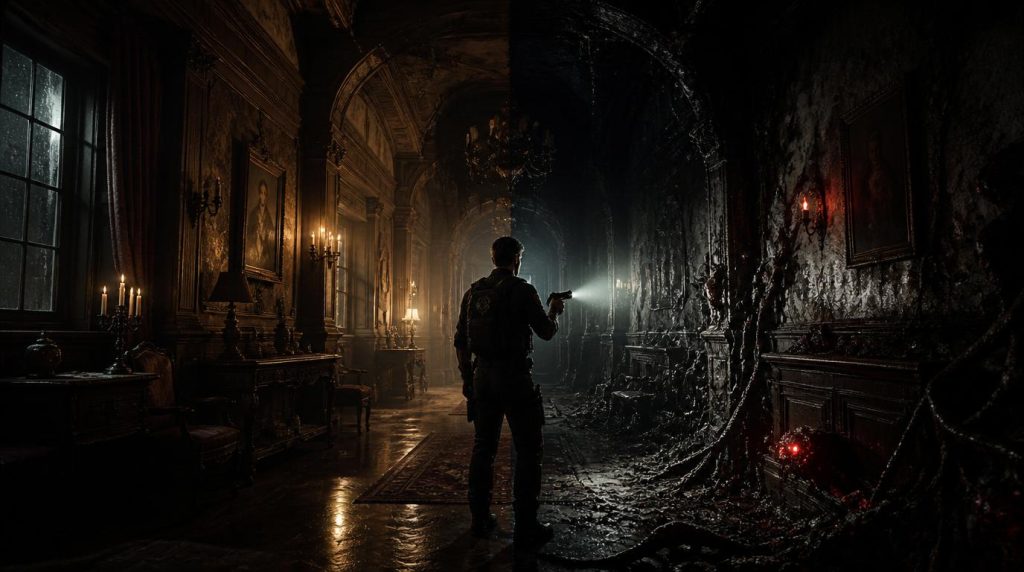
Capcom fused a claustrophobic first-person haunting with a third-person action rampage, and against every instinct that should’ve made this a mess, Requiem turns out to be the most structurally daring mainline entry since the original reinvented the genre.
Capcom didn’t have to gamble this hard. They had a formula that worked twice in a row — first-person dread, Ethan Winters shuffling through moldy hallways, Village’s gothic sprawl clicking with both critics and sales charts. They could have run it back a third time and nobody would have blinked. Instead they took a scalpel to the whole structure and cut Resident Evil Requiem into two games stitched into one disc: a rookie FBI analyst locked into a trembling first-person nightmare, and Leon S. Kennedy — thirty years removed from Raccoon City’s original outbreak — cutting through the same darkness in third-person, hatchet in hand, one-liners loaded. That’s not a safe bet. That’s the kind of decision that either becomes the new template for the series or a case study in what happens when a horror game forgets to be scared of anything.
What I want to work through here is why this dual-protagonist blueprint actually earns its keep instead of just splitting the difference. It’s not a coin flip between “scary half” and “fun half.” Grace Ashcroft’s sections and Leon’s sections are engineered — camera, pacing, resource math, all of it — to produce two completely different nervous system responses, and the game is betting your loyalty to the franchise can hold both at once. Below, I’m breaking down the perspective engineering that makes the Wrenwood Hotel feel like a coffin and the Rhodes Hill Chronic Care Center feel like a shooting gallery, digging into the hatchet-parry combat that’s quietly one of the best melee systems Capcom has built, unpacking what Raccoon City Syndrome means for where this story is headed, and running the numbers on whether your rig can actually handle it.
Dual-Perspective Engineering: Grace in First Person, Leon in Third
The single biggest swing Requiem takes isn’t the plot, it’s the decision to let players toggle between first-person and third-person freely, for both characters, at any point. But don’t mistake that flexibility for the whole design. Capcom built each character’s default camera around a specific emotional target, and playing against the grain tells you everything about how deliberate this actually is.
Toggle
Grace at the Wrenwood Hotel: Suffocation by Design
Grace’s chapters open at the condemned Wrenwood, the same building where her mother was murdered eight years prior, and the first-person default isn’t a gimmick — it’s the whole horror engine. You lose peripheral awareness. You lose the reassurance of seeing your own character react to danger from a safe outside vantage. Every creak becomes a full-body flinch because your FOV is locked to exactly where Grace happens to be looking, and the game knows it. There’s a stalking entity that can move through walls and ceilings, and the only real defense is denying it darkness, using a lighter or flashlight sparingly since illumination doubles as an invitation. Add the ink-ribbon save system on Standard and Insanity difficulties, an eight-slot inventory that forces genuinely painful decisions about what gets left behind, and a blood-crafting loop where harvested infected blood becomes ammo, healing, shivs, or one-hit stealth injectors — and you get a resource economy that punishes greed and rewards patience.
This is the lineage that made Resident Evil 7 and Village land as hard as they did, and if you’ve ever debated where the line sits between “atmospheric” and “actually horror,” it’s worth reading our breakdown of whether BioShock counts as a horror game — the same tension between environmental dread and systemic threat is exactly what Capcom is leaning on here, just with sharper teeth.
Leon at Rhodes Hill: Momentum as the Point
Cut to Leon, and the camera pulls back over his shoulder, the pacing doubles, and the entire emotional register flips. Rhodes Hill Chronic Care Center is still dressed in Requiem’s grim, wet-concrete aesthetic, but Leon moves through it like he owns the place, because narratively, he basically does — this is a man on his fourth bioterror outbreak, immune to most of the shock value that flattens Grace. Third-person here isn’t a concession to action fans, it’s load-bearing: you need to see his roundhouse kicks land, see the hatchet arc through a chainsaw-wielding zombie doctor, see the environmental geometry for crowd control. His 7×10 attaché-style inventory grid (a direct callback to RE4’s case) supports a scrap-and-gunpowder crafting loop instead of Grace’s blood economy, and a points-based upgrade store replaces her constant scarcity math with active build decisions — which guns to level, which parts to slot, which upgrades actually change how a room plays out.
The two camera philosophies aren’t cosmetic. Grace’s first-person default strips away spatial confidence; Leon’s third-person default restores it completely. Play Grace in third-person for a stretch (you can) and the horror measurably softens — you can see around corners, gauge distance to a threat, brace before contact. Play Leon in first-person and the power fantasy gets uncomfortably intimate, hatchet swings suddenly carrying real weight because you’re not watching a character take a hit, you’re the one absorbing it. That’s genuinely clever perspective engineering, not just a checkbox feature.
Capcom’s own director framing lines up with what you feel in the controller: first-person is built to maximize tension, third-person is built to maximize agency. What’s rare is that both defaults are earned by the character wearing them rather than slapped on as an option menu afterthought.
The Mechanics of Survival: Hatchets, Melee, and Resource Pipelines
Requiem’s combat identity comes down to one swapped item: Leon traded his breakable combat knife for a hatchet, and that single change restructures how aggressive you’re allowed to be for the entire back half of the game.
Grace — Investigative Loop
Evasion / Resource Denial- Eight-slot base inventory, expanded through item storage boxes and pack upgrades
- Blood-crafting: harvested infected blood becomes ammo, shivs, and one-hit stealth injectors
- Environmental distraction tools — thrown glass bottles pull the stalking threat off her trail
- Crouch, hide-under-furniture, and light-management systems built for avoidance over confrontation
- Classic puzzle-and-key-item pacing threaded through Wrenwood’s floor plan, closer to survival horror’s roots than anything since the original trilogy
Leon — Combat Loop
Momentum / Crowd Control- 7×10 attaché-case inventory with auto-sort, echoing RE4’s item Tetris
- Hatchet parry (L1/LB) with a sharpen-on-demand meter — it degrades but never fully breaks
- Gun-parry timing window: shoot at the exact right instant to dodge and counter simultaneously
- Contextual weapon theft — disarm an enemy mid-fight and turn their own tool against the crowd
- Points-based progression funding weapon upgrades instead of Grace’s pure scarcity model
The parry window is tight enough to matter on Hard — this isn’t RE4 Remake’s forgiving knife-riposte, it’s closer to a rhythm check. Miss the timing against a chainsaw-wielding doctor and you’re eating full damage with no iframes to bail you out; land it and the stagger opens a hatchet finisher that reads as pure spectacle without breaking the game’s internal logic. What sells it mechanically is that sharpening costs real time — a few seconds of vulnerability to restore full parry potential — so you’re constantly weighing “can I afford to top this off right now” against whatever’s bearing down on you. It’s resource management wearing an action-game costume, and that’s the throughline connecting both halves of Requiem even when the surface genre looks totally different.
Grace’s side plays the inverse game. Ammo for her sidearm is genuinely scarce even on Standard, and the injector system forces a real trade-off: engage an enemy to harvest blood for crafting, or avoid the fight and stay resource-poor but alive. There’s also a shared-progression thread running underneath both campaigns — choices Grace makes about which enemies to eliminate and which resources she claims echo into Leon’s later sections of the same locations, occasionally letting you walk into a room as Leon and see the aftermath of decisions you made hours earlier as Grace. It’s not as punishing a system as early marketing implied, but it’s a neat structural callback to the Zapping System from Resident Evil 2’s original design DNA.
If Leon’s attaché case and the Zapping-style callbacks have you itching to revisit where this all started, our guide to what to know about Lukie Games is a solid starting point for tracking down the PS1 and GameCube originals that Requiem keeps quoting from.
Returning to the Ruins: 2026 Raccoon City Syndrome
Requiem is set in October 2026, twenty-eight years after the missile strike that erased Raccoon City from the map, and the setup is uncomfortably plausible for a franchise built on cover-ups: survivors of the original outbreak are dying, decades later, from something the game’s internal documents label Raccoon City Syndrome. RCS reads less like a fresh disease and more like a delayed bill coming due — T-virus strains that never fully cleared from a survivor’s system finding new footholds as bodies age, immune systems weaken, and dormant mutation triggers finally get pulled. Grace’s mother, Alyssa Ashcroft, was one of the original Outbreak survivors, murdered at the Wrenwood eight years before the game’s present, and her death sits at the exact intersection of “personal cold case” and “opening symptom of a much bigger biological time bomb.”
Leon’s angle comes at RCS from the other direction — he’s tracking a pattern of deaths tied to survivors, and dealing with a mysterious illness of his own that the narrative keeps close to the chest without turning it into cheap mystery-box bait. Former Umbrella researcher Victor Gideon operates as the connective tissue between both threads, and without spoiling how deep the rabbit hole goes, his motivations tie back to Umbrella’s original architecture in a way that rewards long-time lore heads without requiring a graduate degree in Spencer-era backstory to follow the emotional beats. The writing doesn’t always resist the urge to lean on legacy cameos, but the core idea — that Raccoon City’s destruction didn’t end anything, it just delayed the consequences by three decades — is genuinely one of the sharper narrative hooks the series has found since the original game’s mansion incident stopped being enough on its own.
Technical Performance & Optimization Realities
Here’s the part that should make PC players relax: Requiem does not demand a modern rig. RE Engine’s optimization work here is genuinely impressive given how the game actually looks in motion — grimy, high-fidelity, convincingly disgusting in exactly the ways this genre wants — while running on hardware that’s several years old at minimum spec.
| Component | Minimum — 1080p (upscaled) / 30 fps | Recommended — 1080p (upscaled) / 60 fps |
|---|---|---|
| CPU | Intel Core i5-8500 / AMD Ryzen 5 3500 | Intel Core i7-8700 / AMD Ryzen 5 5500 |
| GPU | GeForce GTX 1660 (6GB) / Radeon RX 5500 XT (8GB) | GeForce RTX 2060 Super (8GB) / Radeon RX 6600 (8GB) |
| RAM | 16 GB | 16 GB |
| Storage | SSD required, ~73–74 GB install | SSD required, ~73–74 GB install |
| OS / API | Windows 11 (64-bit), DirectX 12 | Windows 11 (64-bit), DirectX 12 |
| Native render res. | ~640p, upscaled to 1080p | ~720p, upscaled to 1080p |
Notice what’s absent from that minimum column: no ray-tracing hardware requirement, and no card newer than 2019 needed to get in the door. Both listed GPUs are pushing six years old at this point, which either means Capcom left serious visual fidelity on the table or — more likely given how the game actually presents — the RE Engine’s asset streaming and frame pacing have matured to the point where they’re squeezing meaningfully more out of modest silicon than the last two mainline entries did. The catch is RAM: 16 GB is a hard floor even at minimum settings, which stings for anyone still running an older 8 GB configuration, especially with memory prices climbing the way they have recently. An SSD isn’t a suggestion here either — asset streaming for the Wrenwood’s tight corridors and Rhodes Hill’s larger combat arenas leans on fast storage, and a spinning drive will introduce the kind of texture pop-in that undercuts exactly the atmosphere Grace’s sections are built around.
In practice, expect the CPU and GPU requirements to be the easy part of this equation for most builds already in a gaming rig from the last five or six years — RAM and storage are where people actually get caught out. If you do run into stutter, driver conflicts, or crash-to-desktop issues (a handful of early post-launch reports pointed at specific Nvidia driver versions), it’s worth working through our general troubleshooting rundown on why games keep crashing on PC before assuming your hardware’s the problem — driver rollbacks alone cleared up a meaningful chunk of the early complaints.
The Verdict: Does Requiem Secure the Survival Horror Throne?
I went in expecting the split-perspective structure to fracture under its own ambition somewhere around the halfway mark. It doesn’t, mostly because Capcom refused to let either half coast on the other’s strengths. Grace’s sections aren’t a watered-down horror-lite warm-up for the “real” game with Leon, and Leon’s sections aren’t a reward lap tacked onto Grace’s suffering — both are fully realized, mechanically distinct experiences that happen to share a save file and a conspiracy. The seams show occasionally; tonal whiplash between a girl having the worst day of her life and a veteran agent cracking one-liners over a chainsaw kill is a real thing you’ll feel, and the late-game plot occasionally reaches for legacy fan service instead of trusting the strength of what it already built. But as a piece of design engineering — camera, resource pipeline, and pacing all working in service of two opposite emotional registers inside one coherent world — this is the most structurally ambitious mainline Resident Evil since the series reinvented itself with the RE Engine.
The good: Two genuinely distinct gameplay identities that both hold up on their own merits. The hatchet-parry system is one of the best melee mechanics Capcom has shipped. Raccoon City Syndrome is a legitimately smart way to keep mining this world’s history without just rehashing it.
The rough edges: Tonal whiplash between the two campaigns can undercut momentum right when either story is building toward something. Some late reveals lean on legacy fan service harder than the new story needed them to.
Bottom line: Requiem doesn’t just survive its own gamble — it makes a compelling case that Resident Evil’s future isn’t picking a lane between horror and action, it’s building the road wide enough for both.
- Is BioShock a Horror Game?The genre-line debate that underpins Grace’s first-person design.
- Why Games Keep Crashing on PCTroubleshooting steps if Requiem stutters or crashes on your rig.
- What to Know About Lukie GamesTrack down the PS1/GameCube originals Requiem keeps referencing.
- DKOldies Retailer ReviewAnother solid stop for physical retro Resident Evil hunting.