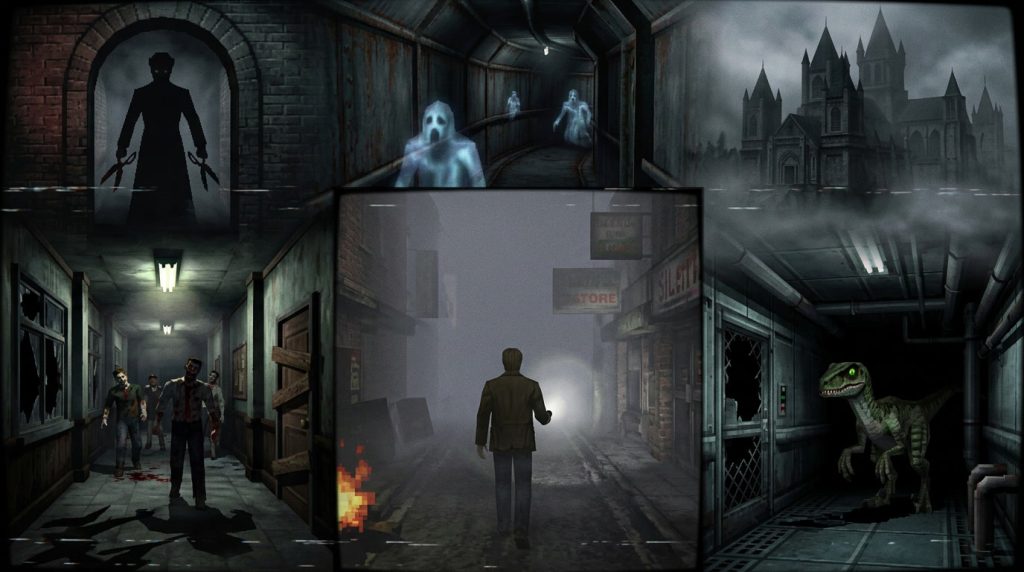
The original PlayStation could barely render a fog bank without chugging, and that’s exactly why it produced some of the most unsettling horror games ever made. Developers working against a weak GPU, a low polygon budget, and stiff, deliberate “tank” controls didn’t fight those limits — they weaponized them. Fog wasn’t a graphical concession, it was a monster’s hiding place. Fixed camera angles weren’t a technical shortcut, they were a way to hide what was waiting just off-screen. Darkness wasn’t a lighting failure, it was the entire point. This is a tour through the PS1 horror games that turned hardware weakness into genuine dread, from the genre-defining pillars every horror fan already knows to the buried, unnerving titles that deserve just as much of a reputation.
The Titans of Terror: Genre-Defining Classics
Silent Hill
Konami · 1999 · Psychological HorrorWhere Capcom built horror out of confined spaces, Team Silent built it out of atmosphere itself. Silent Hill drops Harry Mason into a fog-choked town searching for his missing daughter, and the fog isn’t just mood-setting — it’s a direct answer to the PS1’s draw-distance limitations, masking pop-in and low-poly geometry so effectively that it became the game’s defining visual signature. When the town shifts into its rusted “Otherworld” state, the darkness does the same job the fog does in daylight: it hides exactly enough to make your imagination do the heavy lifting.
Akira Yamaoka’s industrial soundtrack is doing just as much work as the visuals. Grinding metal, distorted static, and near-silence broken by sudden dissonance replace conventional horror-movie scoring entirely, and the game’s radio-static warning system turns sound design into a core survival mechanic rather than background texture. This is Silent Hill PlayStation 1 at its most influential: horror built from psychological unease and dream logic rather than jump scares, and it’s the template nearly every “walk through fog while something distant screams” indie horror game since has been chasing.
Resident Evil 2
Capcom · 1998 · Survival HorrorResident Evil 2 refined everything the original had introduced and wrapped it around one of gaming’s smartest structural gimmicks: the dual-scenario system. Playing Leon’s A-scenario changes what you find and encounter in Claire’s B-scenario and vice versa, effectively doubling the game’s content while reinforcing the sense that Raccoon City is a living, reactive space rather than a static level. That structure alone made replaying the “same” game feel genuinely different, years before branching narratives became a design expectation.
The police station itself is the real star — a hub-and-spoke layout of locked doors, item puzzles, and backtracking that turns resource management into constant tension. Every handgun round spent on a licker is a round you don’t have for Mr. X, and the map’s interconnected design means you’re always aware of what you’re leaving unexplored behind you. It’s this combination of restrictive resources and a memorizable-but-still-threatening space that makes RE2 the mechanical backbone against which every other best classic survival horror game on this list gets measured.
Dino Crisis
Capcom · 1999 · Panic HorrorCapcom’s own follow-up experiment took the RE formula and swapped its slow, shambling threat for something that could outrun you. Dino Crisis traps researcher Regina on an island facility overrun by velociraptors and other dinosaurs displaced through a dimensional rift, and the shift from zombies to raptors changes the entire rhythm of the genre. Zombie horror is about managing a threat you can predictably out-walk; “Panic Horror,” as Capcom branded it, is about a threat that can sprint through a door, flank you around a corner, and close distance faster than you can aim.
That speed forces different decision-making. Doors can be barricaded to slow a pursuing raptor, ammo conservation matters even more because misses happen under real time pressure, and the game trains you to treat every hallway intersection as a potential ambush point rather than a straight line to your objective. It’s a smaller, tighter experience than RE2, but the pure adrenaline of being hunted by something fast is a different flavor of fear that the genre wouldn’t fully revisit for years.
Hidden Gems: Obscure PS1 Horrors Worth Rediscovering
Koudelka
Sacnoth · 1999 · Gothic Tactical RPGKoudelka is the strangest hybrid on this list, and one of the most rewarding if you give it the time. It fuses a gothic ghost-story setting — a Welsh monastery crawling with the supernatural remnants of a massacre — with turn-based, grid-based tactical combat closer to a dark fantasy RPG than a conventional horror game. Exploration plays out with fixed camera angles and genuine dread; combat switches to a deliberate, chess-like pace that lets tension build between encounters rather than during them.
That contrast is the whole point. You’re free to soak in oppressive corridor design and environmental storytelling between fights, then shift into calculated, turn-based decision-making the moment something supernatural corners you. Sacnoth would go on to build the Shadow Hearts series directly on this foundation, but Koudelka’s rougher, meaner original take on “haunted RPG” still has a distinct identity worth experiencing on its own terms.
Clock Tower (1996)
Human Entertainment · Point-and-Click Survival HorrorReleased in Japan in December 1996 and arriving in the West the following year, Clock Tower is a direct sequel to the Super Famicom original, following series survivor Jennifer Simpson into a new nightmare set across a Norwegian mansion and castle. Its point-and-click structure is deceptively simple — direct Jennifer around fixed-angle rooms, solve item-based puzzles, gather clues — until Scissorman appears, and the entire game reorients around one rule: you cannot fight back.
That single design decision is what makes Clock Tower still effective decades later. There’s no health bar to manage, no ammo to conserve, because combat was never an option to begin with. Survival means recognizing Scissorman’s cues before he’s in the room, ducking into a hiding spot, or improvising an environmental distraction, and the game’s shuffled scenarios mean you genuinely never memorize exactly where he’s coming from. It’s tense in a way modern stalker-horror games — with all their combat options — often aren’t.
Echo Night
FromSoftware · 1998 · First-Person Ghost StoryLong before Dark Souls, FromSoftware was quietly building one of the PS1’s most atmospheric — and most overlooked — horror experiences. Echo Night puts you in first-person aboard a haunted ocean liner, the Orpheus, with no weapons and no combat system of any kind. Every encounter with the ship’s ghosts is solved through observation, item-gathering, and helping restless spirits resolve whatever’s keeping them tethered to the world, which reframes “horror” as a puzzle of empathy and patience rather than confrontation.
The first-person perspective does a lot of the atmospheric work here — you’re navigating cramped cabins and dim corridors without the reassurance of seeing your own character, which makes every doorway feel like a genuine unknown. It’s slow, deliberate, and closer in spirit to a haunted-house short story than a conventional survival horror game, and that restraint is exactly why it’s held up as a cult favorite among players chasing genuinely underrated PS1 hidden gems.
Quick Reference: PS1 Horror Sub-Genres & Vibe Check
| Game Title | Sub-Genre | Key Threat | Difficulty Level |
|---|---|---|---|
| Silent Hill | Psychological | The town itself / Otherworld entities | Moderate — combat is clunky by design |
| Resident Evil 2 | Survival Horror | Zombies, Lickers, Mr. X | Moderate-High — resource scarcity |
| Dino Crisis | Sci-Fi / Panic Horror | Velociraptors, T-Rex | High — speed-based threats |
| Koudelka | Gothic Tactical RPG | Undead monastery spirits | Moderate — turn-based combat |
| Clock Tower (1996) | Point-and-Click / Stalker Horror | Scissorman | High — no combat, pure evasion |
| Echo Night | Gothic / Ghost Story | Ship-bound restless spirits | Low-Moderate — puzzle-focused |
The Legacy of Low-Poly Fear
Low-poly horror is having a genuine moment again, and it isn’t nostalgia alone driving it. The same constraint-into-craft logic that shaped PS1-era horror maps directly onto the current “boomer shooter” and retro-horror indie wave — games like Fear the Spotlight, Crow Country, and countless PSX-styled itch.io releases deliberately reintroduce fog, jagged geometry, and fixed cameras because those limitations still generate real dread when used with intent. It turns out obscuring detail was never a workaround; it was a genuinely effective horror technique that better hardware quietly took away from developers.
Original discs and consoles remain the purest way to experience these games, and PS1 hardware has stayed relatively affordable compared to other retro systems — LemonLama’s breakdown of what to expect from DKOldies and our guide to Lukie Games are solid starting points for sourcing tested, working copies. Digital storefronts and official emulation (including PS Classic-style compilations) cover a handful of these titles legitimately, and standalone emulators like DuckStation handle the rest cleanly on modern hardware. If you’ve relied on abandonware sites for imports like Echo Night 2, it’s worth reading up on whether Vimm’s Lair is still safe to use before trusting it with anything.
What’s remarkable almost thirty years later is how little these games rely on raw fidelity to land their scares. A fog bank doesn’t need 4K texture work to be unsettling, and a fixed camera that hides a hallway’s far end works exactly as well on a CRT as it does streamed on a modern flatscreen. That’s the real inheritance of this era: proof that horror is a design problem, not a hardware problem, and the PS1 generation solved it with less processing power than a modern phone charger.