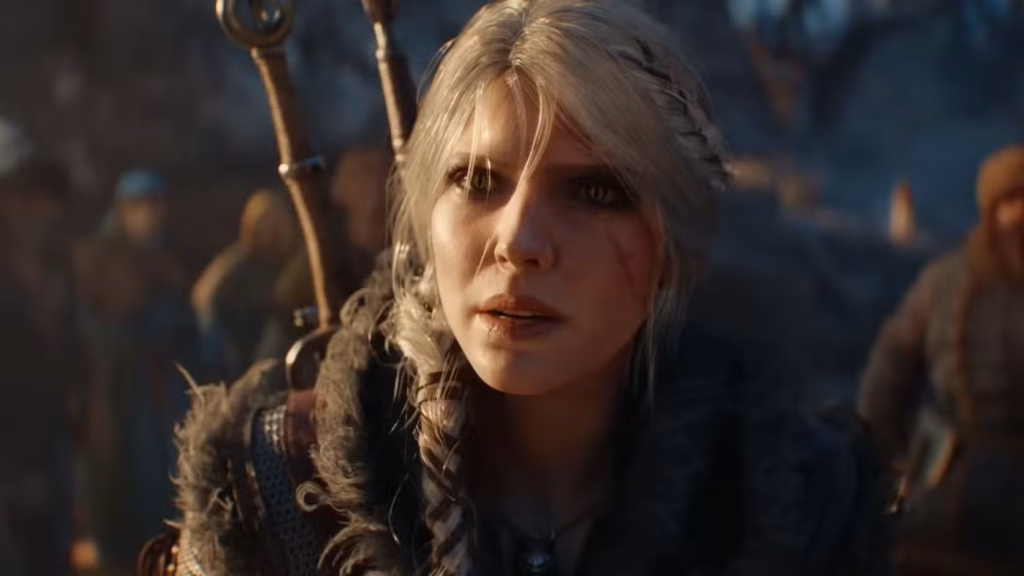
Players are openly scared to pre-order Witcher 4. After GTA 6’s $80 price tag, disc-free physical editions, and paywalled single-player content, the trust between gamers and AAA publishers has never been thinner. We read the room across Reddit, Discord, and comment sections to find out what it would actually take for CD Projekt Red to earn a day-one buy again.
On June 25, 2026, Rockstar Games opened pre-orders for Grand Theft Auto 6. The response was immediate, furious, and entirely predictable. A $79.99 base price for the standard edition. A $100 Ultimate Edition locking single-player content behind a paywall. A disc-free physical edition that was literally just a code in a box. And a pre-order strategy that skewed heavily toward the premium tier, proving that Rockstar knew exactly what it was doing.
Two weeks later, CD Projekt Red confirmed that The Witcher 4 would not appear at Gamescom 2026. The studio was “playing it safe” to avoid another Cyberpunk-level disaster. But the real news was buried in the same announcement: a 2028 release window, no physical disc likely for PS5, and a studio whose own CEO had just admitted he was “not 100 per cent convinced we went through the full redemption arc” with Cyberpunk 2077.
The gaming community did not hear a cautious, responsible development update. It heard a warning siren.
Across Reddit, Discord, ResetEra, Steam community hubs, and comment sections under every Witcher 4 news post, the same sentiment appeared with eerie consistency: “I am not pre-ordering this.” Not because the game looks bad. Not because Ciri as protagonist is controversial. Because after GTA 6, after Cyberpunk, after years of broken promises and escalating prices, the default position for informed players has shifted from “day one” to “wait and see.” And CD Projekt Red, of all studios, should understand exactly how dangerous that shift is.
What GTA 6 broke, and why Witcher 4 is catching the shrapnel
The GTA 6 pre-order fiasco was not just about one game being expensive. It was about the moment the AAA industry finally stopped pretending. For years, publishers had tested the boundaries. Deluxe editions. Season passes. Launch-day DLC. Cosmetic microtransactions in full-price games. But there was still a tacit agreement: the standard edition, at the standard price, got you the standard game.
GTA 6 shredded that agreement in public. At $79.99, the base game carried the highest standard edition price in Rockstar history. The $100 Ultimate Edition did not just add cosmetics or currency. It locked actual single-player content, story missions and gameplay perks, behind a $20 premium. The physical edition, the box you could hold in your hands, contained no disc. Just a download code and a map. As one fan put it: “Pure greed.”
GTA 6 might not technically be $100, but it’s had its cake and ate it too as pre-orders are ‘skewing more to the premium edition.’
— PC Gamer, August 2026The market noticed. Take-Two Interactive’s stock dropped 2% at market open on the day pre-orders went live. Wall Street, which usually loves monetization, was not entirely thrilled. And the community response was volcanic. The New York Post covered it. IBTimes UK called out the “disc-less box” as a strategy to kill the second-hand market. Fragster ran the headline: “Pre-Orders Are Live, And the Price, Paywalls, and Disc-Less Box Have Fans Fuming.”
But here is why this matters for Witcher 4. The GTA 6 controversy did not just damage Rockstar. It created a new psychological baseline for every major upcoming release. When the biggest game in the world launches with an $80 price tag, paywalled story content, and no physical disc, every other AAA publisher is now being measured against that standard. And the standard is: we do not trust you anymore.
| The GTA 6 Precedent | What Fans Fear for Witcher 4 |
|---|---|
| $79.99 standard edition | Same or higher base price for Witcher 4 |
| $100 Ultimate Edition | Premium tier locking quests or gear behind paywall |
| Single-player content paywalled | Side quests or Witcher contracts cut for DLC |
| Disc-free physical box | No PS5 disc, just a code and a collectible |
| Pre-orders skewing premium | CDPR using same psychological pricing tactics |
| “Pure greed” backlash | Same community fury, but with Cyberpunk baggage |
CD Projekt Red’s own CEO admits the redemption arc is incomplete
In June 2026, CD Projekt Red co-CEO Michał Nowakowski said something that no executive at a major game studio should ever have to say out loud. He admitted that “we lost the faith of some people indefinitely” with Cyberpunk 2077’s launch. He said he was “not 100 per cent convinced we went through the full redemption arc.” And he pinned his hopes for winning those people back on The Witcher 4.
I’m convinced that we lost the faith of some people indefinitely, and that’s a fair thing. I’m not 100 per cent convinced we went through the full redemption arc.
— Michał Nowakowski, CD Projekt Red co-CEO, June 2026This is not a CEO being modest. This is a CEO reading the same room everyone else is reading and admitting that his company’s last redemption attempt did not fully work. Cyberpunk 2077, after years of patches, the Edgerunners anime boost, and the 2.0 overhaul, is now a genuinely good game. Metacritic scores improved. Player counts recovered. The Phantom Liberty expansion was well received. By most objective measures, Cyberpunk completed one of the most impressive turnaround stories in modern gaming.
Subjectively, though, the damage remained. For every player who returned and loved the fixed version, there was another who never came back. Who remembered the 2020 launch, the missing features, the broken promises, the console performance so bad that Sony pulled the game from the PlayStation Store. Who saw the “redemption arc” as a studio cleaning up a mess it never should have made, not as a reason to trust the next promise.
Nowakowski’s admission was brave, accurate, and commercially devastating. Because if CDPR’s own CEO does not believe the studio has fully redeemed itself, why should any player believe it?
The 2028 reveal: what the date actually signals
When CD Projekt Red announced that The Witcher 4 was targeting a 2028 release, the immediate reaction was disappointment. Fans had hoped for 2027. Some had even dared to dream of late 2026. 2028 felt like a lifetime away.
But the date itself is not the problem. The problem is what the date represents. A 2028 release means Witcher 4 will ship eight years after Cyberpunk 2077 and a full thirteen years after The Witcher 3: Wild Hunt. It means the game is being built on an engine, Unreal Engine 5, that CDPR has never shipped a full game with before. It means the studio is taking the time it did not take with Cyberpunk, which is good, but it also means the pressure on this single release has compounded across nearly a decade of waiting.
The market’s verdict: CD Projekt Red’s market value dropped by nearly half a billion dollars after the 2028 release window was revealed. Investors, like players, were not celebrating the extra development time. They were pricing in the risk of a two-year delay and what it says about the project’s complexity.
The Gamescom 2026 no-show reinforced the anxiety. CDPR explicitly said it was skipping a full showcase to “play it safe” and avoid another Cyberpunk-level disaster. The intention was responsible. The optics were terrible. A studio that once confidently revealed games years in advance, sometimes too early, was now so gun-shy that it would not even show its most important project at one of the world’s biggest gaming events. To fans, that read less as caution and more as fear.
Then came the physical media news. In September 2026, Nowakowski confirmed that The Witcher 4 “probably isn’t coming to PS5 with a physical disc.” Fans would still get “something to open up and enjoy,” but the disc itself was likely gone. For collectors, for players with slow internet, for anyone who values game ownership over license rental, this was another GTA 6 parallel they did not want to see.
Reading the room: what Reddit, Discord, and comment sections are actually saying
I spent two weeks in August 2026 reading Witcher 4 discussions across every major platform. Not the headlines. Not the press releases. The actual conversations happening in community spaces where players talk without PR filters. The pattern was unmistakable.
Reddit: the rationalization of distrust
On r/witcher and r/cdprojektred, the dominant sentiment was not rage. It was resignation. Thread after thread featured variations of the same post: “I loved The Witcher 3. I want to be excited. But after Cyberpunk and after GTA 6, I am waiting for reviews.” The upvote counts on these comments were consistently higher than the optimistic ones. The community had learned to reward caution over hype.
The GTA 6 comparison came up constantly. Not because players expected Witcher 4 to be an open-world crime simulator, but because the GTA 6 pricing model had become a shorthand for everything wrong with AAA publishing. “If Rockstar can charge $100 for the full game, what stops CDPR from doing the same?” was a recurring question with no good answer. The fear was not that Witcher 4 would be bad. The fear was that even if it was good, the transaction surrounding it would feel exploitative.
Discord: the hardcore are the most scared
Discord servers dedicated to The Witcher, Cyberpunk 2077, and CDPR generally were more pessimistic than Reddit. These were the invested players, the ones with thousands of hours in previous games, the ones who remembered every broken Cyberpunk promise in detail. Their concern was not abstract. It was personal.
The most common fear was monetization creep. “They spent $800 million on this game. They are going to need to make it back somehow.” The rumored budget, a staggering ~$800 million combining development and marketing projections, had become a community boogeyman. Not because players begrudge a studio spending money to make a great game, but because that level of investment creates pressure for returns. And in 2026, the standard playbook for guaranteeing returns is: editions, DLC, cosmetics, and live-service hooks.
Comment sections: the death of the day-one buy
Under every Witcher 4 news article, the comment sections told the same story. The day-one buyer, once the backbone of AAA game launches, has become an endangered species. “Never pre-ordering again after Cyberpunk” was the most common refrain. “Wait for the Enhanced Edition” was the second. Players had learned the lesson that publishers taught them: the game you buy at launch is rarely the game you wish you had bought six months later.
The Three Fears Every Witcher 4 Discussion Returns To
- Price anxiety: Will the “complete” game cost $80, $100, or more?
- Content segmentation: Will quests, gear, or endings be paywalled?
- Launch quality: Will 2028 mean finished, or just “we learned to hide the bugs better”?
The $800 million question: when budgets become weapons against players
The rumored ~$800 million budget for The Witcher 4 is, if accurate, one of the largest investments in video game history. For context, that would put Witcher 4 in the same financial territory as GTA 5, Red Dead Redemption 2, and Star Citizen. It is a statement of ambition. It is also, for players, a statement of risk.
Here is what a budget that size means in practice. It means CD Projekt Red cannot afford for Witcher 4 to be merely great. It needs to be a phenomenon. It needs to sell tens of millions of copies, sustain years of DLC and expansion sales, and potentially anchor a new live-service or multiplayer component. A studio that spends $800 million on one game does not release it, patch it for three months, and move on. It builds an ecosystem around it.
And that is what fans are afraid of. Not the budget itself, but what the budget forces the business side to do. When your development costs approach a billion dollars, every decision about monetization, editions, post-launch content, and player retention gets weighted toward return on investment. The creative team may want to ship a complete single-player RPG. The finance team may need it to be something more, or something segmented, or something that keeps generating revenue long after launch.
CDPR’s CEO tried to reassure fans by saying “you cannot make a game like The Witcher 4 by being cost-driven” and that he was “100% sure” GTA 6 was being made the same way. It was meant as a statement of creative integrity. But to a community that had just watched GTA 6 charge $100 for its complete edition, the comparison was not comforting. If GTA 6 is what “not cost-driven” looks like, what does “cost-driven” look like?
The viral X post: when CDPR’s own socials turned against them
In August 2026, CD Projekt Red created a controversy without trying. An official Witcher account reply on X, responding to criticism about the game’s direction, went viral for all the wrong reasons. Within 24 hours it had over 1.7 million views. The content of the reply mattered less than the context: a studio already on thin ice with its community engaging directly with criticism in a way that felt defensive rather than receptive.
The incident was minor in isolation. A social media reply is not a game design decision. But it became symbolic of a larger problem. CD Projekt Red, despite Nowakowski’s thoughtful admissions in interviews, still sometimes communicates like a studio that believes it has already been forgiven. The X reply suggested a gap between the CEO’s humility and the company’s broader institutional reflexes. When fans are looking for any reason to distrust you, a snippy social media interaction is not just a bad look. It is confirmation.
The contrast with the Gamescom no-show was striking. CDPR can be cautious at the executive level, skipping a major showcase to avoid overpromising, while simultaneously being tone-deaf at the community level, engaging with criticism in ways that amplify rather than defuse it. This split personality, responsible in boardrooms, defensive on social media, is exactly the kind of inconsistency that makes players nervous about what the studio will actually ship.
What it would actually take for CDPR to earn a day-one buy
The question at the heart of this article is not whether Witcher 4 will be good. It is whether CD Projekt Red can do the specific things required to turn “wait and see” back into “day one.” After reading thousands of comments, hundreds of threads, and dozens of community discussions, the answer is clear. It is possible. But it requires CDPR to behave in ways that run counter to every commercial incentive the modern AAA industry is built on.
1. One price, one game, no tiers
The single most effective thing CDPR could do is announce that The Witcher 4 has one edition. One price. No Ultimate tier locking story content. No deluxe version with exclusive quests. No “complete edition” six months later that makes day-one buyers feel like beta testers. After GTA 6 proved that even Rockstar will segment single-player content by price, a genuine “one game, one purchase” stance from CDPR would be a genuine differentiator. It would also cost them hundreds of millions in potential upsell revenue. Which is exactly why players do not expect it.
2. A real, playable demo before launch
Not a vertical slice. Not a curated E3 demo that runs on a development PC with settings no consumer will ever see. A real demo, on real hardware, that shows what the game actually plays like. Cyberpunk 2077’s pre-launch coverage was filled with controlled environments, review embargoes, and footage that did not represent the console experience. A public demo, even a limited one, would signal that CDPR has nothing to hide. In an era where demos have virtually disappeared from AAA publishing, bringing one back would be a trust statement.
3. No review embargo games
CDPR needs to let reviewers play the final build, on all platforms, with enough time to publish before launch. Not a 48-hour window. Not a PC-only early access period. Not a situation where console footage is restricted and PC reviews go live first. The Cyberpunk review situation, where PC reviews were glowing and console reviews could not even be written because the game was unplayable, is still fresh in the community memory. Transparency about review conditions would cost nothing and earn enormous goodwill.
4. A public, detailed post-launch support commitment
Players do not just want to know what they are buying. They want to know what happens after. Will there be free updates? How many expansions? What is the DLC roadmap? Will there be a “complete edition” that makes early purchases feel punished? CDPR should announce its post-launch plan before launch, not after, so players can make informed decisions about whether to buy at release, wait for the GOTY edition, or skip entirely. Treating players like adults who can handle information is still surprisingly rare in AAA publishing.
5. Acknowledge the Cyberpunk debt, do not just reference it
Nowakowski’s admission was a start. But the community needs more than a CEO quote in an interview. CDPR needs to build the Witcher 4 marketing campaign around a simple, undeniable truth: we know we broke your trust, and this is how we are earning it back. Every trailer, every interview, every piece of promotional material should answer one implicit question: why should we believe you this time? If CDPR cannot answer that question convincingly, no amount of Ciri gameplay footage will matter.
The Day-One Buy Checklist
- One edition, one price, no paywalled story content
- Public demo on console and PC before launch
- Review codes for all platforms with adequate lead time
- Full post-launch roadmap announced pre-release
- Direct, repeated acknowledgment of Cyberpunk’s lessons
- No “Ultimate Edition” that makes the standard feel incomplete
- Physical disc option for players who want ownership
The uncomfortable truth: CDPR is not the villain here, but it is not the hero either
It is worth saying clearly: CD Projekt Red is not Rockstar. It is not EA. It is not Ubisoft. The studio built genuine goodwill with The Witcher 3, its free DLC program, and its consumer-friendly practices in an era when those were rare. The Cyberpunk launch was a disaster, but the years of post-launch support were genuine. The 2.0 update and Phantom Liberty expansion represented real, substantial work delivered to players who had already paid. CDPR has done more to earn back trust than most studios do after a bad launch.
But goodwill is not trust. And trust, once broken, does not regenerate on a timer.
The Witcher 4 is entering a market where GTA 6 just proved that even the most beloved franchise will squeeze every possible dollar from its audience. Where live-service failures like Marathon and 2XKO have made players skeptical of every new announcement. Where Bungie’s collapse and Amazon’s MMORPG exit have shown that no studio is too big to destroy its own reputation. And where Star Citizen’s billion-dollar development has become a cautionary tale about what happens when ambition outpaces accountability.
CDPR is asking players to pre-order a game that will not ship for two more years, probably without a physical disc, possibly with a tiered pricing structure, from a studio whose own CEO admits it has not fully redeemed itself. That is not a villainous ask. But it is not a request that deserves an automatic yes either.
The players who are scared to pre-order Witcher 4 are not trolls. They are not haters. They are the people who loved The Witcher 3 enough to be hurt by Cyberpunk. Who remember what it feels like to trust a studio and regret it. Who watched GTA 6 and saw their worst fears about the industry’s direction confirmed by the biggest game on Earth. Their fear is rational. Their caution is earned. And their decision to wait is not a rejection of CD Projekt Red. It is a rejection of an entire industry’s assumption that loyalty is automatic, forgiveness is guaranteed, and players will always come back no matter how many times they are burned.
You cannot make a game like The Witcher 4 by being cost-driven.
— Michał Nowakowski, September 2026. The community’s reply: then prove it.For players looking for RPG experiences from studios with cleaner recent track records, our best games to play this month highlights titles that delivered on their promises without the drama. And for anyone still wondering whether the AAA pricing spiral has a limit, the Ocarina of Time remake’s positioning next to GTA 6 shows that even Nintendo is not immune to the pricing anxiety infecting every major release.
Frequently Asked Questions
CD Projekt Red has announced a 2028 release window for The Witcher 4. The studio skipped a full showcase at Gamescom 2026, citing a desire to “play it safe” and avoid overpromising after the Cyberpunk 2077 launch disaster. The game will star Ciri, Geralt’s adopted daughter, as the new protagonist and is being built in Unreal Engine 5.
Fans are hesitant to pre-order due to a combination of factors: CDPR’s own CEO admitted the studio has not fully redeemed itself after Cyberpunk 2077’s broken launch; GTA 6’s recent pre-order controversy established a new baseline of distrust toward AAA pricing and edition tiers; the rumored ~$800 million budget raises concerns about monetization pressure; the likely absence of a physical PS5 disc; and the two-year wait until 2028 gives players plenty of time to see how CDPR handles marketing and communication.
GTA 6 pre-orders opened in June 2026 with a $79.99 standard edition price and a $100 Ultimate Edition that locked single-player content behind a paywall. The physical edition contained no disc, only a download code. Fans reacted with widespread anger, calling it “pure greed,” and Take-Two’s stock dropped 2% on the news. The controversy has made players wary of similar pricing strategies from other AAA publishers.
Objectively, yes. Cyberpunk 2077 is now a genuinely good game after years of patches, the 2.0 overhaul, and the well-received Phantom Liberty expansion. However, CDPR’s co-CEO Michał Nowakowski admitted in June 2026 that he is “not 100 per cent convinced we went through the full redemption arc” and believes “we lost the faith of some people indefinitely.” The fixed game impressed many return players, but could not win back everyone who was burned by the 2020 launch.
Probably not. In September 2026, Nowakowski stated that The Witcher 4 “probably isn’t coming to PS5 with a physical disc,” though fans will still receive “something to open up and enjoy.” This follows the GTA 6 model of a disc-free physical edition and has raised concerns among collectors and players who prefer physical media ownership.
Analyst estimates suggest The Witcher 4’s combined development and marketing budget could reach approximately $800 million, which would make it one of the most expensive games ever produced. While this signals ambition and scale, fans worry that such a massive investment will create pressure for aggressive monetization, multiple edition tiers, and post-launch revenue streams.
In June 2026, CDPR co-CEO Michał Nowakowski said: “I’m convinced that we lost the faith of some people indefinitely, and that’s a fair thing. I’m not 100 per cent convinced we went through the full redemption arc.” He expressed hope that The Witcher 4 would win back fans who remained skeptical after Cyberpunk 2077’s troubled launch and subsequent fixes.
Yes. The Witcher 4 is being developed in Unreal Engine 5, marking a departure from CDPR’s proprietary REDengine used for The Witcher 3 and Cyberpunk 2077. This is CDPR’s first full game built in Unreal Engine 5, which has added to both excitement about the visual potential and concern about whether the studio can deliver a polished experience on a new engine after the technical issues that plagued Cyberpunk’s launch.
Ciri, Geralt’s adopted daughter, is the protagonist of The Witcher 4. This marks a shift from the previous trilogy, which starred Geralt of Rivia. The game is set in a new region of the Continent and represents the beginning of a new saga following the events of The Witcher 3.
CDPR chose not to show The Witcher 4 at Gamescom 2026 to “play it safe” and avoid overpromising before the game is ready. The studio explicitly cited the desire to avoid another Cyberpunk-level disaster where early reveals created expectations that the launch build could not meet. While the intention was responsible, some fans interpreted the no-show as a sign that the game is further from completion than hoped.
Based on community sentiment and the current information available, most informed players are adopting a “wait and see” approach. With a 2028 release date, no confirmed pricing or edition structure, and CDPR’s own CEO admitting the studio has not fully redeemed itself, there is little practical reason to pre-order now. The consensus across Reddit, Discord, and community forums is to wait for reviews, gameplay demos, and clear information about editions and monetization before committing to a purchase.