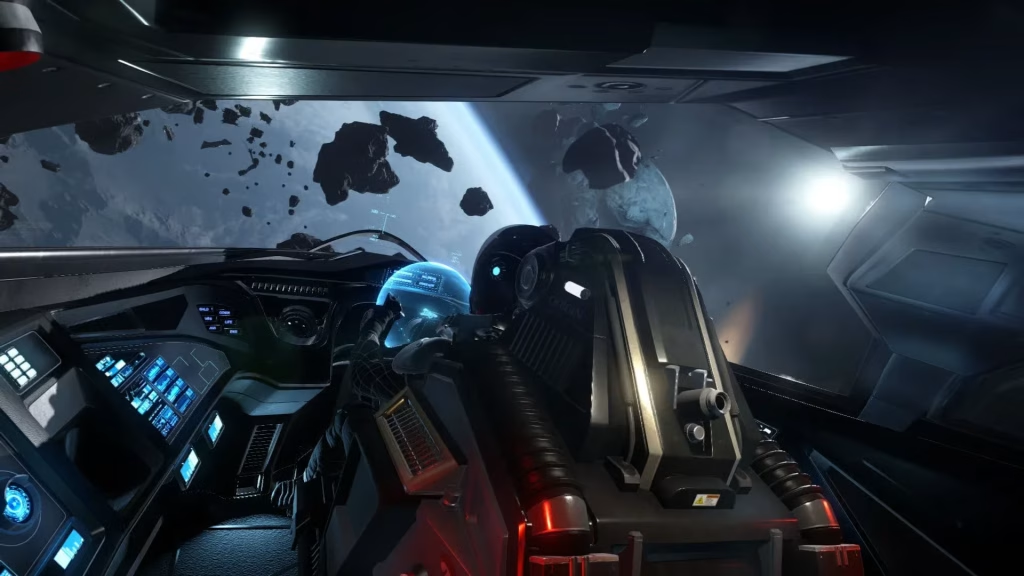
After 14 years and over $1 billion in crowdfunding, a single live stream exposed everything. The full autopsy of the most expensive unfinished game in history: every promise, every delay, and the August 2026 disaster that broke the illusion.
On August 17, 2026, Cloud Imperium Games hosted a live stream to showcase the Siege of Orison mission in Star Citizen. It was supposed to be a routine developer broadcast: load the build, fly to the mission, shoot some NPCs, demonstrate the cutting-edge space simulation that has raised over $1 billion from more than 6.5 million backers. Instead, it became a disaster so complete, so publicly humiliating, that fans called the archived recording a “hostage video.”
The stream started badly and got worse. Severe lag. Desync. Bugs that prevented mission progression. Developers visibly frustrated on camera. After more than an hour of failed attempts, the host cut the broadcast with words that have already become infamous in gaming culture: “It’s your show. Wrap it up.”
The symbolism was almost too perfect. Here was a game that had been in development since 2012, that had raised more money than any crowdfunded project in human history, that had sold virtual spaceships for thousands of dollars apiece, unable to run a single scripted mission for a live audience. Fourteen years. One billion dollars. And a boss telling his own developers to kill the stream because the product would not cooperate.
This is the full autopsy of Star Citizen: every major promise, every missed milestone, every delayed feature, and the August 2026 stream that finally made the scale of the failure impossible to ignore.
The August 17, 2026 stream: a hostage video in real time
To understand why this stream mattered so much, you have to understand what it was supposed to be. The Siege of Orison is not a procedurally generated emergent sandbox event. It is a scripted cooperative mission. CIG had control over the environment, the enemies, the player loadout, and the server conditions. This was not a player-organized fleet battle crashing the instance. This was the developer demonstrating their own content on their own terms.
And they could not make it work.
According to multiple reports, the stream was plagued from the opening minutes by severe performance issues. Frame rates dropped into single digits. Audio desynced from video. Mission triggers failed to fire. NPCs behaved erratically or failed to spawn. The developers on camera, including those attempting to play through the mission, grew increasingly visibly uncomfortable as the problems compounded.
Incredibly awkward, cringe, forced, slightly sinister feeling at times.
— Player description of the August 2026 Star Citizen streamThe host’s instruction to “wrap it up” was not a gentle suggestion. It was a termination order delivered on a live broadcast, after the development team had failed to complete their own mission for over an hour. The recording was not deleted, which somehow made it worse. It sits on YouTube as a permanent artifact of what $1 billion and 14 years produces when the cameras are on and the scripts cannot be edited.
For a normal game, a bad stream would be a bad day. For Star Citizen, it was a referendum on the entire project. Because this was not a fluke. It was the logical endpoint of a development process that has prioritized ship sales over stability, feature announcements over feature completion, and crowdfunding milestones over release criteria.
The original pitch: what backers were sold in 2012
Star Citizen’s Kickstarter launched on October 10, 2012, with a simple, powerful promise from Chris Roberts: a return to the glory days of Wing Commander and Freelancer, built with modern technology, funded by fans instead of publishers. The original funding goal was $500,000. The campaign raised over $2 million on Kickstarter alone, with additional direct pledges pushing the initial total higher.
The original pitch was ambitious but bounded. A space combat simulation with a single-player campaign (Squadron 42) and a persistent multiplayer universe (Star Citizen). The golden ticket materials given to early backers suggested a 24-month development timeline, putting release around October 2014. Roberts spoke of a game that would be delivered in modules, with backers getting early access to pieces as they were completed.
What 2012 Backers Were Promised
- A space combat sim from the creator of Wing Commander
- A single-player campaign: Squadron 42
- A persistent multiplayer universe with trading, combat, and exploration
- Modular development with early backer access
- Release approximately 24 months after funding
- Total budget estimated in the tens of millions, not billions
What backers were not promised was a perpetually expanding scope, a never-ending alpha, and a business model built on selling virtual spaceships for more than the cost of a used car. The 2012 Kickstarter did not mention server meshing, persistent entity streaming, procedural cities, or a thousand-player universe. Those came later, as the money kept flowing and the ambitions kept growing.
The feature tracker: 13% completed, 50% stagnant
One of the most damning documents in gaming development is not a leaked memo or a financial filing. It is a publicly available community tool called the Star Citizen Tracker. As of 2026, it catalogs hundreds of promised features and their current status. The numbers tell a story that $1 billion in marketing cannot obscure.
| Status | Count | Percentage |
|---|---|---|
| Completed | 73 | 13% |
| Compromised | 6 | 1% |
| In Alpha | 50 | 9% |
| Not Implemented | 103 | 18% |
| Stagnant | 273 | 50% |
| Broken | 39 | 7% |
Let those numbers sink in. After 14 years and $1 billion, half of all promised features are stagnant. Not in development. Not cancelled. Just sitting in a state of limbo, neither alive nor dead, like Schrödinger’s game mechanics. Another 18% have not been implemented at all. Only 13% are actually complete. And 7% are explicitly broken.
This is not the tracker of a game approaching release. This is the tracker of a project that has lost the ability to distinguish between what is being worked on and what has been abandoned. When half your feature list is stagnant, you are not developing a game. You are maintaining an illusion.
Every major milestone promise vs. reality
2014: The original release date
The golden ticket from the 2012 campaign suggested a 24-month development window, putting Star Citizen’s release in October 2014. By 2014, the game was not close to release. The first playable module, the Hangar Module, had launched in 2013. The Arena Commander dogfighting module arrived in 2014. But the persistent universe, the core of the promised experience, was years away. The 2014 release date passed without comment, swallowed by the expanding scope of the project.
2015: Squadron 42’s original launch window
Squadron 42, the single-player Wing Commander spiritual successor that was supposed to fund Star Citizen’s development, was originally targeted for 2015. It featured a Hollywood cast including Mark Hamill, Gary Oldman, Gillian Anderson, and Andy Serkis. The motion capture was done. The script was written. The levels were built. And then the years kept passing. In 2024, CIG announced Squadron 42 was “feature complete” and in the “polish phase.” In August 2026, Chris Roberts delayed it again to Q2 2027, blaming the “attention buzz saw of GTA 6.”
Star Citizen at this point feels far more likely to result in an industry-changing documentary than a completed video game.
— Kotaku, August 20262016: Persistent Universe alpha
The Persistent Universe alpha, later known as the PU, launched in a barebones form in December 2015 with Alpha 2.0. It contained a single star system, basic missions, and rudimentary persistence. Backers were told this was the foundation of a living universe. In reality, it was a tech demo with a subscription fee. The PU would remain in alpha for the next decade.
2017-2020: The road to server meshing
Server meshing, the technology that would allow Star Citizen to scale from 50-player instances to a seamless thousand-player universe, became the central technical promise of the mid-2010s. CIG presentations at CitizenCon showed elaborate diagrams of dynamic server allocation, object container streaming, and persistent entity state. Year after year, meshing was “making progress.” Year after year, it did not ship. When a version of server meshing finally arrived, it was a quasi-dynamic system far short of the original vision, and players were still exploiting its limitations by blocking vehicle terminals with stones.
2020-2024: Persistent Entity Streaming and Alpha 3.18
Persistent Entity Streaming (PES) launched in Alpha 3.18 and was hailed as a breakthrough. It allowed items, ships, and debris to persist in a server shard even when players left the area. It was also a disaster at launch, with players losing ships, items, and progress to database errors. The technology that was supposed to make the universe feel alive instead made it feel fragile. By 2026, players were using PES to grief others by blocking vehicle retrieval terminals with persistent stones, a flaw so absurd it reads like satire.
2024-2026: Alpha 4.7, 4.9, and the “Year of Playability”
In early 2026, CIG CTO Benoit Beauséjour gave a tech talk celebrating the one-year anniversary of server meshing and outlining progress on Alpha 4.7, which promised crafting, a transport system, and new mission frameworks. By August 2026, Alpha 4.9 was live, and players were reporting that the “Year of Playability” had produced a game where developers could not complete a scripted mission on a live stream. The monthly report for July 2026 mentioned “continued progress across a wide range of development areas.” The stream showed what that progress actually looked like under pressure.
| Promise | Original Target | Reality (August 2026) |
|---|---|---|
| Star Citizen release | October 2014 | Still in alpha, no release date |
| Squadron 42 release | 2015 | Delayed to Q2 2027 |
| Server meshing | “Coming soon” (2017-2019) | Quasi-dynamic partial implementation |
| 100 star systems | Promised at stretch goals | 1 fully implemented system |
| Full persistence | Core feature | PES launched, exploited for griefing |
| Salvage gameplay | Years overdue | Implemented but buggy |
| Engineer / repair loop | Roadmap staple | Stagnant / partially delivered |
| Base building | Promised feature | Limited implementation |
Squadron 42: the single-player game that became a mirage
If Star Citizen is the never-ending alpha, Squadron 42 is the never-ending polish phase. The single-player campaign was supposed to be the safer bet: a linear, scripted, narrative-driven experience built with Hollywood talent and existing technology. It did not need server meshing. It did not need a thousand-player persistent universe. It needed levels, cutscenes, and a stable frame rate.
In October 2024, Ars Technica noted that Squadron 42’s then-target of 2026 meant it would miss its original 2015 target by 11 years. In May 2026, Chris Roberts told Variety the game was in the “closing stages” of development. In August 2026, he delayed it to Q2 2027, claiming a fall 2026 launch would run into the “attention buzz saw of GTA 6.”
The GTA 6 excuse: Chris Roberts blamed Rockstar’s blockbuster for Squadron 42’s delay to Q2 2027. This is the same Chris Roberts who has missed every self-imposed deadline since 2014. The problem was never external competition. It was internal completion.
The excuse was immediately mocked across the industry. GTA 6 is a completely different genre on a completely different platform with a completely different audience. The idea that a narrative space combat campaign would be “drowned out” by an open-world crime game is either delusional or dishonest. What Roberts was really admitting, without saying it, is that Squadron 42 was not ready and had not been ready for years.
The cast list remains impressive: Mark Hamill, Gary Oldman, Gillian Anderson, Liam Cunningham, Andy Serkis, John Rhys-Davies. The budget consumed by this talent, and the motion capture, and the cinematic production, is unknowable but certainly enormous. What is knowable is that in 2026, after more than a decade, CIG still cannot commit to a release date less than a year away. A game in the “closing stages” should not need to dodge GTA 6. It should be pressed to disc.
The business model: selling dreams by the thousand-dollar ship
Star Citizen’s funding model is unprecedented in gaming history. It is not a game with microtransactions. It is a microtransaction that occasionally produces a game. Since 2012, CIG has raised over $1 billion by selling virtual spaceships, land claims, insurance policies, and concept art for features that do not exist. Individual ships have sold for $675, $1,000, even $2,500 or more.
The psychological architecture of this model is brilliant and predatory. Ships are sold as “concepts” during limited-time events, creating artificial scarcity for digital items that cost nothing to reproduce. War Bond editions offer discounts for fresh cash instead of store credit, ensuring that backers keep putting in new money rather than recycling old pledges. Lifetime Insurance (LTI) promises that your ship will never be permanently lost, a guarantee that matters only if the game ever actually launches.
In May 2026, CIG announced it had crossed the $1 billion threshold. The announcement was celebratory, grateful, framed as a milestone of community belief. What it actually represented was the most successful crowdfunding campaign in history producing a game that cannot run a live stream. At $1 billion, CIG has raised more money than the development budgets of GTA V, Red Dead Redemption 2, Cyberpunk 2077, and Elden Ring combined. Those games shipped. Star Citizen sells JPEGs of spaceships.
Star Citizen has topped $1 billion in funding, marking an incredible milestone for the game that’s been in early access for just under a decade.
— Dexerto, May 2026The moral question is not whether CIG is legally allowed to sell virtual ships for a game in alpha. It is whether a company that has raised $1 billion and still cannot complete a scripted mission on camera should be allowed to keep selling future promises without an external audit of deliverables. No other industry would permit this. Only gaming, with its unique combination of emotional attachment, technical opacity, and crowdfunding regulatory gaps, allows a company to monetize hope indefinitely.
What does $1 billion actually buy you?
This is the question the August 2026 stream answered, whether CIG wanted it to or not. After 14 years and $1 billion, here is what Star Citizen delivers in August 2026:
What works
The visual technology is genuinely impressive. Star Citizen’s ship models, planetary rendering, and lighting are among the best in the industry. The sense of scale, of walking around a space station and seeing your ship docked outside, is unmatched. The flight model, when it works, feels satisfying and weighty. The audio design is exceptional. There are moments, in ideal conditions, where Star Citizen delivers on the fantasy that sold the Kickstarter.
What does not work
The list is longer. Server stability remains fragile despite years of “meshing” promises. Persistence is partially implemented and easily exploited. The economy is shallow. The mission system is repetitive. Performance drops catastrophically in populated areas. The PU still consists primarily of one star system, Stanton, with other systems promised for years and delivered in fragments. The engineering loop, salvage mechanics, base building, and medical gameplay are all either incomplete, buggy, or stagnant.
Most damningly, the game cannot reliably run a scripted developer showcase. If the Siege of Orison mission, prepared for broadcast, on a controlled server, with the people who built it holding the controllers, cannot complete without lag, desync, and mission-breaking bugs, what chance does a normal player have?
Star Citizen in August 2026: The Honest Summary
- Visuals: Industry-leading, genuinely beautiful
- Flight combat: Satisfying when stable
- Persistence: Partial, exploitable, often broken
- Server stability: Fragile, especially under load
- Star systems: 1 complete, others in fragments
- Mission variety: Repetitive, limited
- Performance: Inconsistent, frequently poor
- Live stream reliability: Catastrophically failed
- Release date: None. Not even a target year.
$1 billion has bought Star Citizen the best-looking unfinished game ever made. It has bought a community of true believers who have invested so much money, time, and identity into the project that acknowledging its failure would be psychically devastating. It has bought Chris Roberts a permanent development sandbox where the goalposts move every time the money starts to slow. It has not bought a finished game. It has not bought a release date. It has not even bought the ability to complete a mission on camera.
Why Star Citizen will never be “finished”
The most uncomfortable truth about Star Citizen is that finishing the game is not in CIG’s financial interest. The company has built a billion-dollar business around the process of development, not the product of release. As long as new ships can be concept-sold, new roadmaps can be drawn, and new tech can be promised, the funding continues. A released Star Citizen, with all its compromises, bugs, and unfulfilled dreams made concrete, would be a financial dead end compared to the perpetual promise machine.
This is not a conspiracy theory. It is an economic observation. CIG’s revenue comes from selling the future. The present is always broken, always improving, always just one more patch away. If CIG ever declared Star Citizen “feature complete” and moved to a traditional live-service model, the psychological justification for thousand-dollar ship sales would evaporate. Why buy a concept for a game that is already out?
The scope creep is not an accident. It is structural. Every new feature announcement, every CitizenCon tech demo, every roadmap update serves two purposes: it advances the game incrementally, and it renews the justification for continued funding. The 2012 Kickstarter promised a space sim. By 2026, Star Citizen was promising dynamic server meshing, procedural cities, full player persistence, base building, salvage, engineering, medical gameplay, and a Hollywood single-player campaign. Each addition was reasonable in isolation. Together, they created a project with no finite endpoint.
The infinite development trap: Star Citizen cannot finish because finishing would end the funding. The business model requires perpetual promise. Every milestone reached is immediately replaced by a bigger one. The game is not being developed toward release. It is being developed toward the next funding goal.
This is why the August 2026 stream was so damaging. It did not just show that Star Citizen is buggy. Every alpha is buggy. It showed that after $1 billion, the fundamental technical and operational problems are still so severe that the developers cannot control their own demo. That is not a funding issue. That is not a scope issue. That is a project management issue so deep that no amount of money appears capable of solving it.
The community: believers, skeptics, and the trapped middle
Star Citizen’s community is not monolithic. It contains three distinct groups that have been in tension for years.
The believers are the true faithful: backers who have spent hundreds or thousands of dollars, who attend CitizenCon, who defend CIG against all criticism, who see every delay as necessary and every feature as revolutionary. For them, Star Citizen is not just a game. It is a proof of concept for crowdfunded ambition, a rejection of publisher conservatism, a dream of what gaming could be if artists were given unlimited resources and time. The August stream embarrassed them, but it will not break them. They have survived worse.
The skeptics are the vocal critics: former backers, industry observers, and gaming journalists who have watched the delays, the feature creep, and the funding totals with mounting disbelief. They post comparison screenshots, track missed deadlines, and document the gap between promise and reality. They are often accused of “hating” Star Citizen. Most do not. They hate seeing a beautiful idea consumed by a broken process.
The trapped middle is the largest and saddest group: backers who put in $50 or $100 or $500 years ago, who check in occasionally, who see a new update and think “maybe this time,” who feel too invested to write the project off but too disappointed to fully believe. They are the ones the August stream hurt most. The believers will rationalize it. The skeptics will mock it. The trapped middle will simply feel the slow erosion of hope that has defined their relationship with Star Citizen for a decade.
A Star Citizen live turns into a disaster because the many bugs.
— Instant Gaming, August 2026, headlineWhat happens now?
As of August 2026, Star Citizen sits at a peculiar intersection. It has just crossed $1 billion in funding, a milestone that should be a triumph. It has just broadcast one of the most embarrassing developer streams in gaming history, an event that should be a catastrophe. It has delayed Squadron 42 again, this time to avoid a fictional collision with GTA 6. And it has no announced release date, no announced feature-complete target, and no credible path to either.
The most likely future is more of the same. CIG will continue developing Star Citizen in alpha, releasing quarterly patches that add features, break other features, and move the goalposts further out. Squadron 42 will either release in 2027 as a compromised, dated product, or it will be delayed again. The ship sales will continue. The funding tracker will keep ticking upward. And the gap between what was promised and what exists will keep widening.
The August 2026 stream will not kill Star Citizen. Nothing kills Star Citizen, because Star Citizen is not a game trying to live. It is a promise trying not to die. As long as there are backers willing to fund the promise, the project will continue. The question is not when Star Citizen will release. The question is whether “release” was ever the point.
For players looking for space games that actually exist in a finished state, our guide to the best games to play this month includes titles that respect your time and your money. For a broader look at how other studios have burned player trust and collapsed under their own ambition, our Bungie Studio Watch traces a similar pattern at a very different company. And if you want to understand how live-service games succeed and fail in the current market, our breakdown of gaming business models puts the economics of perpetual development in context.
Frequently Asked Questions
As of May 2026, Star Citizen has raised over $1.004 billion in cumulative crowdfunding from more than 6.5 million backers. This makes it the most successful crowdfunded project in history by several orders of magnitude. The funding continues to grow through ongoing ship sales, concept pledges, and War Bond offerings.
Star Citizen was announced on October 10, 2012, at GDC, which marked the beginning of the crowdfunding campaign and active production. The original Kickstarter suggested a 24-month development timeline with a target release of October 2014. As of August 2026, the game has been in development for nearly 14 years with no announced release date.
On August 17, 2026, Cloud Imperium Games hosted a live stream to showcase the Siege of Orison mission. The broadcast was plagued by severe lag, desync, bugs, and mission-breaking issues that prevented the developers from completing their own content. After over an hour of failed attempts, the host ended the stream with the phrase “It’s your show. Wrap it up.” Fans called the archived recording a “hostage video” and the event was widely reported as a disaster across gaming media.
Squadron 42 is currently scheduled for Q2 2027, according to an August 2026 announcement by Chris Roberts. The game was originally targeted for 2015, meaning the current schedule represents a delay of approximately 12 years. Roberts blamed the latest delay on avoiding competition with GTA 6, a justification that was widely mocked by players and press.
There is no announced release date or feature-complete target for Star Citizen. The game has been in alpha since 2015. According to community tracking tools, only 13% of promised features are complete, 50% are stagnant, and 18% have not been implemented at all. The project’s scope has expanded continuously since 2012, and many observers believe the game is structurally unlikely to reach a traditional “finished” state because the crowdfunding model incentivizes perpetual development.
Server meshing is the technology that would allow Star Citizen to scale beyond small instanced servers into a seamless universe where thousands of players can interact simultaneously. It has been a central promise since the mid-2010s. A partial implementation launched in recent years, but it remains far short of the original vision. Players continue to report instance limitations, desync, and exploits related to server boundaries.
Multiple factors sustain Star Citizen’s funding: the genuine visual and technical beauty of the alpha, the emotional investment of long-term backers, the fear of missing out on limited ship sales, the desire to support an independent developer outside the publisher system, and the sunk-cost psychology that makes admitting the project’s problems feel like admitting personal failure. CIG’s marketing is also exceptionally effective at framing every patch as progress and every milestone as proof the dream is alive.
As of August 2026, Star Citizen contains a partially persistent universe centered on the Stanton star system, space combat, first-person shooting, basic trading and mining, limited salvage gameplay, some mission content, and a large selection of flyable ships. However, many promised features remain incomplete, stagnant, or broken. The game is technically playable but lacks the depth, stability, and breadth originally promised in the 2012 campaign.
Refund policies for Star Citizen have been a source of controversy for years. Early backers were able to secure refunds more easily through CIG’s customer service. As the project aged and funding grew, CIG tightened its refund policy and cited terms of service that limit refund eligibility. Some backers have pursued refunds through credit card chargebacks or legal pressure, but there is no comprehensive data on refund rates or success. Given the $1 billion total raised, refunds represent a tiny fraction of CIG’s revenue.
Star Citizen’s visual fidelity and sense of scale are unmatched in the genre. However, as a complete game experience, it lags behind titles like Elite Dangerous, No Man’s Sky (post-updates), EVE Online, and even older games like Freelancer in terms of stable gameplay loops, content breadth, and feature completeness. No Man’s Sky famously recovered from a disastrous launch to deliver on many of its promises. Star Citizen has never reached a state where “recovery” is even the right word, because it has never had a launch to recover from.
This is the most divisive question in gaming. The answer depends on intent, which is unknowable from outside CIG. What is objectively true is that Star Citizen has raised over $1 billion, been in development for 14 years, missed every original deadline by years or decades, delivered a fraction of promised features, and still has no release date. Whether this represents mismanagement, impossible ambition, or deliberate exploitation of backer hope is a matter of interpretation. What is not debatable is that the gap between what was sold and what has been delivered is without precedent in the history of the medium.