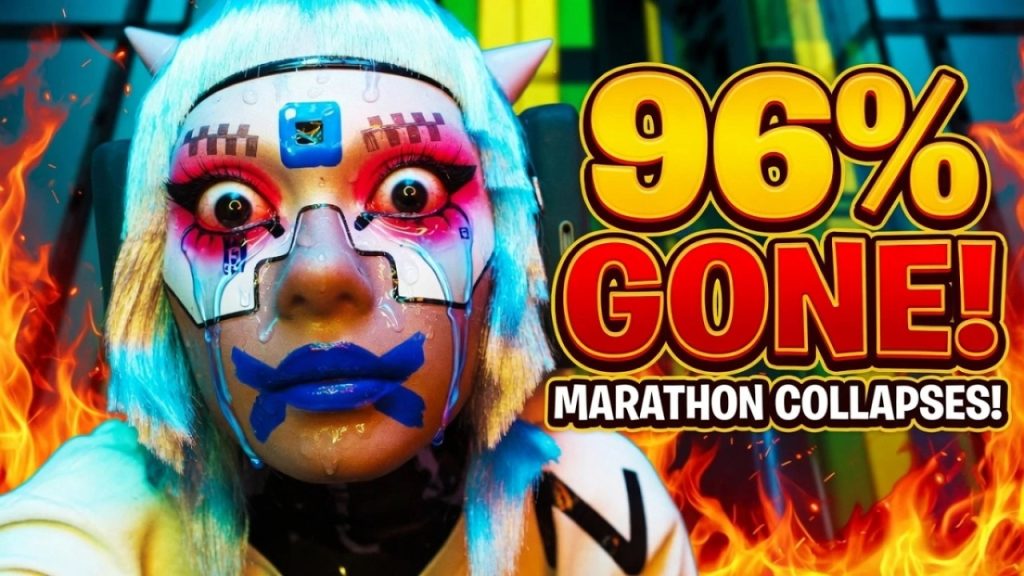
From 88,337 Steam peak players at launch to under 4,000 daily. A $250 million extraction shooter that sold 1.5 million copies and still could not keep anyone around.
On March 5, 2026, Bungie launched Marathon, its first new IP since Halo and its biggest bet since Sony acquired the studio for $3.6 billion. The extraction shooter peaked at 88,337 concurrent players on Steam within hours. Reviewers praised the gunplay and art direction. Over 1.5 million copies sold across PC and consoles. By all outward appearances, Marathon had stuck the landing.
Five months later, the 24-hour peak on Steam hovers around 3,500 players. The game has lost more than 96% of its launch audience. Season 3, launching September 22, is being framed as make-or-break. But after watching every patch, every community outcry, and every failed rebound, the real question is not whether Bungie can save Marathon. It is whether Marathon was built to be saved at all.
What is Marathon and why did Bungie bet everything on it?
Marathon is a PvP-focused extraction shooter set on the derelict colony world of Tau Ceti IV. Players drop into hostile zones as “Runners,” synthetic mercenaries scavenging for loot while fighting AI patrols and rival player crews. Die without extracting and you lose your gear. Survive and you build wealth, unlock better equipment, and push deeper into harder zones.
For Bungie, this was supposed to be the future. The studio that created Halo and then spent a decade building Destiny into a live-service empire needed a new flagship. Destiny 2 was winding down. Destiny 3 was not in active development. Sony had paid $3.6 billion for Bungie’s expertise in making shooters people never stop playing. Marathon was the proof of concept.
The game arrived with everything Bungie does well: incredible art direction, crisp gunplay, and a visual identity that looks like nothing else on the market. The blocky, 3D-printed weapon designs and neon-soaked sci-fi horror aesthetic earned genuine praise. Metacritic: 82. Steam user reviews: over 90% positive. On paper, this should have worked.
Marathon by the Numbers
- Developer: Bungie
- Publisher: Bungie / Sony Interactive Entertainment
- Launch Date: March 5, 2026
- Price: $39.99 (premium buy-to-play, not free-to-play)
- Platforms: PlayStation 5, Xbox Series X/S, Windows PC
- Reported Development Cost: Over $250 million
- Estimated Sales: ~1.5 million copies
- Estimated Revenue: ~$55 million
- Sony Write-Down: $560 million impairment on Bungie assets
How did Marathon lose 96% of its players so fast?
The collapse did not happen overnight. It was a steady, brutal bleed that no patch could fully stop. Here is how the numbers tell the story:
| Period | Steam Peak | What Happened |
|---|---|---|
| Feb 2026 (Server Slam) | 143,621 | Free preview event — higher than launch |
| March 2026 (Launch) | 88,337 | Paid launch peak |
| April 2026 | ~36,374 | First major decline, down 59% |
| May 2026 | ~17,131 | Continued slide |
| June 2026 (Season 2) | ~40,686 | Open Play Week + Season 2 bump |
| July 2026 (Vault Breaker) | ~14,809 | PvE mode caused temporary spike |
| August 2026 | ~3,000–4,000 | Briefly dipped below 1,000 |
The most damning detail? The free preview had more players than the paid launch. That tells you everything about retention. People were curious enough to try Marathon for free. They were not convinced enough to stick around after buying it.
This is a retention problem, not a sales problem
Analyst firm Alinea Analytics estimated Marathon sold roughly 1.2 million copies by late March and nearly 1.5 million by late May. About 68% of those sales were on Steam. The game found buyers. It just could not find keepers.
Former Xbox executive Peter Moore summed it up bluntly: Marathon was built at a scale and cost that the current market “simply isn’t rewarding.” With over $250 million spent and only about $55 million in estimated revenue, the math is catastrophic. Sony has already written down $560 million in impairment charges on Bungie-related assets, bringing the total downgrade of the acquisition to $765 million for the year.
What patches did Bungie release and how did players react?
Bungie has not been sitting still. Since launch, the studio has pumped out patches at a steady pace. The problem is that many of them either missed the mark or actively angered the players who were still hanging on.
Update 1.0.04 (March 2026): The AI nerf that backfired
Bungie’s first major patch reduced the health of most UESC AI enemies and lowered shield values on AI bosses. Med Cabinet and Munitions Crate spawns were increased on the Perimeter map. Starting ammo for free Sponsored Kits got buffed.
The economy changes were welcomed. The AI nerfs were not. Hardcore players, the exact audience Marathon needed to retain, saw this as Bungie dumbing down the game for casuals who had already left. Prominent community figures like Ifrostbolt and Mactics publicly criticized the move. Paul Tassi wrote: “Was not expecting blanket UESC nerfs. Feels like an instant reaction to ‘game is too hard’ complaints. Don’t love that, honestly.”
We see the feedback loud and clear that players appreciate the friction that our UESC combatants provide and we have no plans to change that direction.
— Bungie, in the same patch notes that nerfed the UESCUpdate 1.0.5.2 (March 31): Slide cancel gets destroyed
Bungie patched out a popular slide-cancel movement exploit that let players build unintended momentum. Their reasoning was philosophical: “Rapid repositioning and aggression must always have a meaningful cost.” The patch notes declared Marathon a “No Movement Freak Zone.”
The competitive community was split. Some appreciated the clarity. Others felt Bungie was removing skill expression from a game that desperately needed reasons for skilled players to stay. When your game is bleeding players, telling the remaining ones that their movement tech is “unhealthy for the pace of play” is a risky message.
Update 1.0.6 (April 14): Inventory and UI fixes
This patch overhauled the much-maligned inventory system. Stack sizes for medkits increased from 3 to 9. Ammo stacks jumped from 60 to 800. Signal Jammers became purchasable from the Armory. These were genuinely good changes that addressed real friction. But by April, many players had already left.
Season 2: Nightfall (June 2): The biggest swing yet
Season 2 brought the night version of Dire Marsh, a new Runner shell called Sentinel, new weapons, and the biggest structural change: the Cradle. This new progression system replaced the confusing seasonal upgrade tree with a streamlined skill tree across six stat groups. Faction progression was sped up. Credits came faster. The entire player economy was reset.
Reviews of Season 2 were surprisingly positive. Push Square called it “impressive” and praised the quality-of-life changes. The problem? Even the author admitted: “Will it be enough to bring players back? Honestly, I don’t think so.”
Vault Breaker (July 21): The PvE experiment
Bungie’s first major PvE mode turned Cryo Archive into a roguelite experience with no human opponents, no Runner Level requirement, and no faction unlock gates. Players used Sponsored Kits instead of risking their own gear. Steam numbers tripled from ~5,200 to ~14,771.
Then they collapsed again. Within weeks, Marathon was back to its pre-Vault Breaker baseline. The message was clear: players were interested in a lower-pressure Marathon, but not interested enough to rebuild a habit around it.
What did the community ask for versus what did Bungie actually deliver?
This is where the Marathon story gets really interesting. Bungie was not deaf. They were listening. They just could not seem to translate feedback into retention.
| What the Community Wanted | What Bungie Delivered | Did It Work? |
|---|---|---|
| Less punishing new player experience | AI nerfs, economy buffs, inventory overhaul | Partially — but core players hated the AI nerfs |
| Better progression that does not feel like a wall | The Cradle system in Season 2 | Yes — but too late for players who already quit |
| A full PvE mode without PvP pressure | Vault Breaker (temporary, limited) | Temporarily — tripled players, then they left again |
| More maps and content variety | Cryo Archive, night Dire Marsh, Perimeter rework coming | Not enough — still only a handful of zones |
| Better cosmetics and rewards worth grinding for | More skins, but still widely criticized as bland | No — cosmetic quality remained a weak point |
| Solo and duo friendly progression | Solo queue, Sponsored Kits, crew-size balancing | Partially — solo Vault Breaker helped |
| Less grind, more meaningful rewards per run | Faster faction progression, credit buffs, Cradle | Yes in Season 2, but the damage was done |
The pattern is consistent. Bungie identified real problems and implemented real solutions. But in a live service game, timing is everything. By the time the Cradle made progression feel good, the players who suffered through the original grind were already gone. By the time Vault Breaker proved PvE interest, the audience had moved on to other games.
Marathon puts unreasonably tall walls in front of its players. Marathon is simply too demanding: It requires too much time, too much wasted effort, and far too much failure.
— Nick Statt, The Verge, after 185 hours of playWhy is Marathon really bleeding players?
Beyond the patch history, there are deeper structural problems that explain why no single update could fix Marathon.
It launched into the wrong genre moment
Extraction shooters are splitting into two camps. Games like Escape from Tarkov and Gray Zone Warfare cater to hardcore PvP survivalists. Games like Arena Breakout: Infinite and the upcoming wave of PvE extraction titles cater to players who want the loot loop without getting third-partied by a three-stack the moment they find something good. Marathon bet on PvP in a market that was increasingly voting for PvE.
The difficulty curve punishes dedication
Here is a mind-boggling design choice: there is a season-long grind just to unlock the ability to purchase purple shields. A Verge editor with over 200 hours had still not completed it. The Compiler boss, Marathon’s pinnacle activity, requires six vault keys from six different maps, each contested by other players, followed by a puzzle room that broadcasts your location, followed by the boss itself requiring a rare consumable keycard on every single attempt. High-skill players were literally selling Compiler carries on eBay.
The seasonal wipe destroys attachment
Every few months, Marathon wipes almost everything: your loot, your faction levels, your Runner upgrades. Only cosmetics carry over. In a game where the entire emotional hook is the gear you fought to extract, telling players their work disappears seasonally is a hard sell. Destiny gets away with this because it has raids, stories, and social spaces that create lasting memories. Marathon has runs. When the runs reset, what exactly are you holding onto?
Not enough content for the price
At launch, Marathon had three maps and one mode. The $40 price tag felt steep next to free alternatives like Arena Breakout: Infinite, which offered significantly more to do at no cost. Even after Cryo Archive and night Dire Marsh, the zone pool feels thin for a premium live service game. If you are dropping money on a gaming headset or gear to immerse yourself, you want a world that justifies the investment.
The “skill-based death spiral”
As Verge described it, Marathon suffers from a compounding problem: the less you play, the worse your odds of survival. Players who grind daily accumulate better stats, better guns, and more funds for consumables. Latecomers face an uphill battle against better-equipped veterans in a game where one mistake costs you everything. Every player who quits makes matchmaking worse for everyone left. It is a spiral that only accelerates.
Can Marathon Season 3 save the game or is this Concord 2.0?
Season 3 launches September 22, 2026. Bungie is calling in every chip for this one. Here is what is confirmed:
Season 3 Confirmed Features
- Full PvE mode: A permanent PvE experience, not a limited event like Vault Breaker
- Perimeter rework: New areas, encounters, and early-game flow redesign
- Early-game overhaul: Better onboarding, tutorials, and new player experience
- New Runner shell: Following Sentinel from Season 2
- New weapons and equipment: Fresh arsenal additions
- Contract system changes: Less repetitive quest design
- “Other content and surprises”: Bungie’s words, not ours
The full PvE mode is the big bet. Vault Breaker proved there is latent demand. A permanent, fleshed-out PvE experience could give solo players, casual crews, and lapsed buyers a reason to reinstall. If Bungie builds something with real progression, real rewards, and real variety, Season 3 could stop the bleeding.
But here is the hard truth: no seasonal update has produced a sustained player recovery yet. Season 2’s Open Play Week spiked numbers to ~40,000, then they collapsed. Vault Breaker tripled concurrency, then it collapsed. Marathon has repeatedly proven it can get people to try it again. It has never proven it can make them stay.
The Concord comparison
Concord, Sony’s hero shooter, was shut down after roughly two weeks. The comparison has haunted Marathon since launch. But there are important differences:
| Factor | Concord | Marathon |
|---|---|---|
| Lifespan before trouble | ~2 weeks | 5+ months and counting |
| Sony’s position | Pulled the plug immediately | Publicly committed to supporting it |
| Player sentiment | Mostly negative | Over 90% positive on Steam |
| Critical reception | Mixed to poor | 82 Metacritic |
| Core engagement | Very low | “Highly engaged” core per Sony |
| Recovery attempts | None | Multiple major updates |
Sony CFO Lin Tao explicitly told investors that unlike Concord, Marathon has “highly engaged core users” and that Sony aims to retain them through additional content and gameplay improvements. That is not a studio preparing to pull the plug. That is a studio trying to justify a $3.6 billion acquisition that has already been written down by over three-quarters of a billion dollars.
The real danger is not a Concord-style shutdown. It is a slow, expensive fade into maintenance mode. A game that stays online but stops mattering. A live service that is technically alive but creatively dead. Marathon does not need to avoid Concord’s fate. It needs to avoid becoming something worse: a cautionary tale that lingers for years.
What happens if Season 3 fails?
If Season 3 does not move the needle in a meaningful, sustained way, the options for Bungie and Sony get uncomfortable fast.
Bungie has already laid off staff, including senior Marathon roles. The Destiny 2 sunset announcement means the studio has no other major live service to fall back on. If Marathon cannot find an audience after a full PvE pivot, a Perimeter rework, and an early-game overhaul, what else is left to try?
Go free-to-play? That undermines the buy-to-play model and angers existing owners. Pivot to a full campaign? That is years of work. Sell cosmetic battle passes in a game whose cosmetics have been widely criticized as bland? Good luck.
The most likely outcome if Season 3 flops is not an immediate shutdown. It is a reduced team, slower updates, and a game that exists in the same way Destiny 1 exists now: playable, technically supported, but not truly alive. For a studio that was supposed to be Sony’s live-service crown jewel, that would be a devastating result.
If you are weighing whether to jump in, check out what else is worth your time among the best games releasing this month or explore some solid co-op alternatives if you want team-based action without the extraction stress.
Frequently Asked Questions
As of late August 2026, Marathon’s 24-hour peak on Steam is roughly 3,500 concurrent players, with off-peak numbers dipping as low as 1,100–1,900. The all-time Steam peak was 88,337 on March 6, 2026, representing a loss of over 96%. Console player numbers are not publicly available.
Not in the immediate future. Sony has publicly committed to supporting Marathon, unlike Concord which was shut down within two weeks. Sony CFO Lin Tao told investors that Marathon has “highly engaged core users” and that the company will continue improving the game through content and gameplay updates. However, if Season 3 fails to improve retention, long-term support could be reduced.
Season 3 launches on September 22, 2026. Confirmed features include a full PvE mode, a major Perimeter map rework, an early-game and onboarding overhaul, a new Runner shell, new weapons and equipment, contract system changes, and additional unannounced content. It is widely seen as a make-or-break update for the game’s future.
Multiple factors: the game was too punishing for new players, progression felt like a grindy wall, the $40 price tag felt steep for the amount of launch content, the seasonal wipe system destroyed player attachment to their gear, and the hardcore PvP focus alienated players who wanted a lower-pressure extraction experience. The “skill-based death spiral” also made latecomers feel perpetually behind.
Temporarily, yes. Vault Breaker tripled Steam concurrent players from roughly 5,200 to about 14,771. However, the numbers declined back toward baseline within weeks. It proved there is interest in a PvE Marathon, but the limited event format was not enough to rebuild long-term player habits. Season 3’s full PvE mode will test whether a permanent version can do better.
If you genuinely enjoy hardcore PvP extraction shooters and love Bungie’s gunplay, there is a polished, well-reviewed game here with fantastic art direction. However, be aware that matchmaking is strained by low population, the learning curve is brutal, and the future beyond Season 3 is uncertain. If you prefer PvE or casual experiences, waiting to see how Season 3’s permanent PvE mode turns out may be the smarter move.
Season 2: Nightfall introduced a night version of the Dire Marsh map, the Sentinel Runner shell, new weapons, the Cradle progression system, faster faction progression, streamlined UI, and the ability to reallocate stat points without penalty. It also added experimental game modes including rotating Duos, Sponsored Survival, and Vault Breaker to test different player preferences.
Reports suggest Marathon cost over $250 million to develop. With roughly 1.5 million copies sold at ~$40 each, estimated revenue is around $55 million after discounts and platform cuts. Sony has recorded $765 million in total impairment charges related to the Bungie acquisition, including a $560 million write-down specifically tied to underperforming assets. The game is not profitable.
Coined by The Verge’s Nick Statt, this describes how Marathon becomes harder the less you play. Daily players accumulate better gear, stats, and funds, while returning or casual players face an uphill battle against better-equipped veterans. Each player who quits worsens matchmaking and increases the gap for those remaining, creating a self-reinforcing cycle of decline.