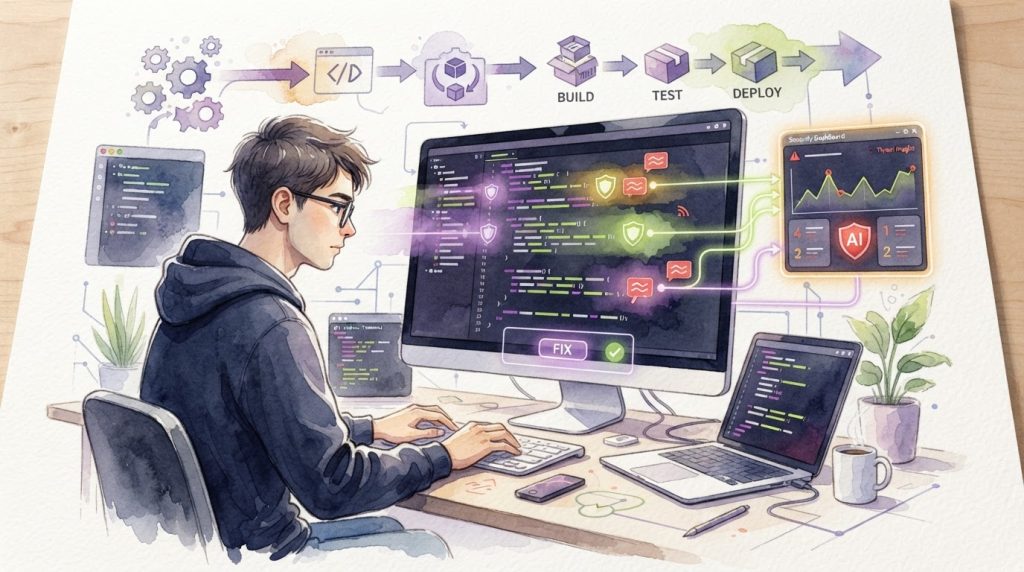
“Snyk Code is a developer-first security tool that scans source code for vulnerabilities before they reach production.”
AI coding assistants write a lot of code fast — but nobody’s checking whether that code is actually safe until something breaks. Snyk Code is one of the bigger names trying to close that gap, scanning code in real time and auto-fixing the security holes before they ship. Here’s what Snyk Code actually does, how it fits into a dev workflow, and what’s changed at the company behind it recently.
What is Snyk Code AI?
Snyk Code is a developer-first static application security testing (SAST) tool — meaning it scans your source code itself, not the app while it’s running, looking for security vulnerabilities before they ever reach production. It’s built by Snyk, a developer security company founded in 2015 out of London and Tel Aviv by Guy Podjarny, Assaf Hefetz, and Danny Grander, now headquartered in Boston. Snyk Code layers AI on top of traditional static analysis: instead of just flagging every possible match against a rule list, it uses a hybrid of symbolic and generative AI, trained on millions of real, permissively licensed open-source projects, to cut down on false positives and explain issues the way an experienced security engineer would.
How does Snyk Code actually find vulnerabilities?
Snyk Code combines a few different analysis techniques rather than relying on one method. It runs control flow analysis to catch things like null dereferences and race conditions, and data flow (taint) analysis to trace how data moves from an untrusted source to a sensitive “sink” in the code, which is how a lot of real-world security bugs like SQL injection actually happen. Layered on top of that, its AI engine — internally called DeepCode AI — has been trained on over 25 million data flow cases across 19+ programming languages, which the company says helps it flag issues with meaningfully fewer false positives than older-generation SAST tools.
Snyk Code isn’t a separate app you have to remember to run — it plugs directly into IDEs like VS Code and IntelliJ, shows up as comments on pull requests, and gates builds in CI/CD pipelines like GitHub Actions. The idea is to catch problems while a developer is still writing the code, not weeks later in a security audit.
Can Snyk Code fix vulnerabilities automatically?
Yes — this is the part Snyk leans on most in its AI-era pitch. Its auto-fix feature, called Agent Fix, uses what the company describes as dynamic few-shot prompting: it feeds frontier AI models real, human-written security examples at the exact moment code is being generated or fixed, effectively turning a general-purpose model into something closer to a security specialist for that specific fix. Snyk reports its autofixes are roughly 80-85% accurate, and that using Snyk Code and Agent Fix together has reduced mean time to remediate (MTTR) by 84% or more for some customers.
A newer and increasingly central use case is securing AI-generated code itself — scanning and fixing code written by tools like GitHub Copilot or autonomous coding agents, not just code written by humans, since Snyk has found that a large share of AI coding activity happens outside what security teams can currently see.
Snyk’s longtime CEO, Peter McKay, announced in February 2026 that he would step down once the board found a successor with deeper AI product expertise. CFO Kenneth MacAskill has been serving as interim CEO since McKay’s departure. Worth knowing if you’re evaluating Snyk as a long-term vendor, since leadership changes can affect product direction and roadmap priorities.
How much does Snyk Code cost?
Snyk offers a free web-based code checker with limited features, plus paid plans that scale with team size and usage. Because enterprise security tooling pricing tends to be quote-based and shifts with plan tiers, check Snyk’s own pricing page directly for current numbers rather than relying on a figure that could already be out of date.
How is Snyk Code different from traditional SAST tools?
Older-generation SAST tools are notorious among developers for burying real vulnerabilities under a mountain of false positives, which is a big reason a lot of teams historically treated security scanning as a chore rather than something genuinely useful. Snyk’s pitch is that combining symbolic analysis (the traditional, rule-based approach) with AI trained specifically on security-relevant code patterns produces meaningfully fewer false alarms, while also generating fixes instead of just flagging problems and leaving developers to figure out the solution themselves. Competitors in this space include Checkmarx, Veracode, and Contrast Security.
| Detail | Snyk Code |
|---|---|
| Parent company founded | 2015, London / Tel Aviv |
| Founders | Guy Podjarny, Assaf Hefetz, Danny Grander |
| Headquarters | Boston, Massachusetts |
| Category | AI-powered SAST (static code security scanning) |
| Integrates with | VS Code, IntelliJ, GitHub, GitLab, CI/CD pipelines |
| Autofix accuracy (company-reported) | ~80–85% |
| Current interim CEO | Kenneth MacAskill (as of mid-2026) |
Would a game studio or indie developer actually use something like this?
Game studios write a lot of code most gamers never think about — backend live-ops services, matchmaking servers, in-app purchase handling, account systems — and that backend code is exactly the kind of thing SAST tools are built to protect. With more developers, including game studios, now leaning on AI coding assistants to move faster, a tool that specifically scans and fixes AI-generated code for security holes is increasingly relevant rather than a nice-to-have. It’s a similar logic to why teams doing high-volume creative work adopt AI production tools like Layer AI — using AI to keep pace with AI-accelerated output, just applied to code instead of art.
What stands out
- Real-time scanning inside the IDE, not just at build or deploy time
- AI-generated autofixes, not just flags, cutting remediation time significantly
- Purpose-built to also scan AI- and agent-generated code, not just human-written code
- Broad language support (19+) and deep integration with existing dev tools
Worth knowing
- Enterprise-focused pricing; free tier is limited
- Company is mid-leadership-transition as of 2026, worth watching for roadmap shifts
- No AI security tool is perfect — flagged issues and autofixes still warrant human review
- Best password managers for teams in 2026 — more security tooling picks for growing teams
- Gumloop AI automation: pricing and features — another AI platform built to speed up business workflows
- Spellbook AI — a different kind of professional AI copilot, built for lawyers instead of developers
- Seek AI: what happened after the IBM acquisition — another enterprise AI platform’s story worth knowing
- Why do games keep crashing on PC? — a look at the technical side of what can go wrong under the hood
Frequently Asked Questions
Is Snyk Code free to use?
Snyk offers a free, web-based version of its code checker with limited functionality. Full features, including IDE integration and Agent Fix, typically require a paid plan.
What is the difference between Snyk Code and Snyk overall?
Snyk Code is one product within the broader Snyk platform, which also covers open-source dependency scanning, container security, and infrastructure-as-code scanning. Snyk Code specifically focuses on scanning the application’s own source code.
Does Snyk Code work with AI coding assistants like Copilot?
Yes. Snyk Code scans and can auto-fix code regardless of whether it was written by a human or generated by an AI coding assistant or autonomous agent, which the company has increasingly emphasized as AI-generated code becomes more common.
Who is the current CEO of Snyk?
As of mid-2026, CFO Kenneth MacAskill is serving as interim CEO after Peter McKay announced his departure in February 2026. The board has been searching for a permanent successor with deeper AI product expertise.
What programming languages does Snyk Code support?
Snyk Code supports more than 19 programming languages, according to the company.