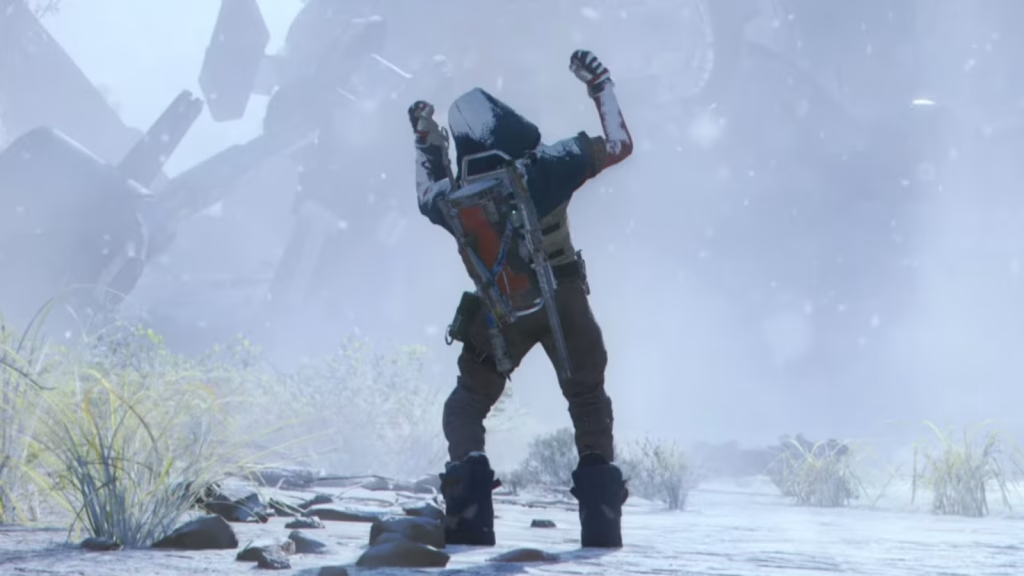
How Embark Studios’ breakout extraction shooter went from a 482,000-player Steam peak to a cautionary tale about content drought, ratting, and the brutal math of live service survival.
On October 30, 2025, ARC Raiders did something almost nobody expected from a new IP in a crowded genre. The free-to-play extraction shooter from Embark Studios, a team founded by former DICE developers, peaked at 482,000 concurrent players on Steam. Reviewers praised its fluid movement, gorgeous Rust Belt aesthetic, and accessible take on a genre dominated by hardcore masochists like Escape from Tarkov. Streamers like Shroud, TimTheTatman, and Nadeshot pushed it to millions. For a moment, it looked like Embark had cracked the code.
By April 2026, just 3.5 months after its January highs, the Steam concurrent count had fallen to roughly 90,000. By August, the 24-hour peak hovers around 29,000. The game has lost roughly 94% of its peak audience. And here is the cruel twist: ARC Raiders still holds an 83% “Very Positive” rating on Steam. Players who left did not hate the game. They just ran out of reasons to stay. This is the story of how a genuinely good extraction shooter got dismantled not by bad design, but by the slow suffocation of content drought, exploitative player behavior, and a live service model that could not keep pace with its own success.
What is ARC Raiders and why did it blow up at launch?
ARC Raiders is a third-person extraction shooter set in a post-apocalyptic 22nd century Earth. Humanity shelters underground while hostile sentient machines called ARC roam the surface. Players form squads, dive into the Rust Belt to scavenge gear and resources, fight ARC patrols, and contend with rival raiders, then extract before they are overrun. Think Escape from Tarkov with better movement, less punishing onboarding, and a sci-fi coat of paint that actually looks original.
Embark Studios was founded by Patrick Söderlund and other former DICE veterans, which gave the project immediate credibility. These were the people who understood large-scale multiplayer combat at a fundamental level. When ARC Raiders launched into early access and then fully released, it arrived with a rare combination of qualities:
Why ARC Raiders Worked at Launch
- Accessible extraction: Easier to learn than Tarkov, more rewarding than most looter-shooters.
- Fluid movement: Parkour-style traversal that made every raid feel kinetic and tense.
- Stunning art direction: The Rust Belt was immediately iconic, a decaying industrial wasteland with real personality.
- Strong PvE foundation: Fighting ARC machines was genuinely fun, not just a preamble to PvP.
- Free-to-play: Zero barrier to entry in a genre where competitors cost $40-50.
- Streamer adoption: Shroud, TimTheTatman, NickMercs, Nadeshot, and Cloakzy all played regularly.
- Free loadout system: New players could contribute without bringing in expensive gear.
The Steam peak of 482,000 made it one of the biggest launches of 2025. Cross-platform, estimates suggest over 960,000 concurrent players at peak. By February 2026, the game had reportedly sold over 14 million copies across platforms, an extraordinary number for a new IP in a niche genre. The early retention was so strong that articles were written comparing it favorably to Battlefield 6, which was hemorrhaging players while ARC Raiders seemed to hold steady. That comparison did not age well.
How did ARC Raiders lose 80% of its players in 3.5 months?
The decline was not a single cliff. It was a staircase, each step documented in Steam charts and Reddit threads. Here is how the numbers tell the story:
| Period | Steam Peak | What Happened |
|---|---|---|
| Oct 2025 (Launch) | ~260,000+ | Strong launch day, immediate momentum |
| Nov 2025 | ~482,000 | All-time Steam peak reached |
| Jan 2026 | ~466,000 | Sustained highs, seemingly invincible |
| Feb 2026 | ~375,000 | Shrouded Sky update brings nerfs and backlash |
| Mar 2026 | ~252,000 | Slide accelerates, cheating complaints spike |
| Apr 2026 | ~90,000 | Down 80% from January; Paul Tassi calls it out |
| May 2026 | ~122,000 | Embark ends monthly updates, switches to twice-yearly |
| Jun 2026 | ~68,000 | Riven Tides update fails to move the needle |
| Aug 2026 | ~29,000-41,000 | Expeditions shut down until early 2027 |
The first warning sign came in February 2026. The Shrouded Sky update introduced new map conditions, new ARC enemy types, and balance changes. On paper, this was solid content. In practice, it nerfed popular crafting recipes, most notably the Wolfpack and Deadline, by adding rare components to their build requirements. Players who had invested hours learning the economy woke up to find their favorite loadouts suddenly gated behind harder-to-find materials. Meanwhile, the IL Toro shotgun, widely considered overpowered in PvP, was left untouched. The community noticed.
By March, the conversation had shifted from balance complaints to something more existential. High-profile streamers started pulling back. Ninja publicly called the game “unplayable” due to cheaters and stream snipers. TheBurntPeanut, arguably the biggest ARC Raiders creator, began playing less even while acknowledging it cost him viewers. When your most visible evangelists start quietly leaving, the ripple effect through matchmaking and community morale is devastating.
April was the month the industry really started paying attention. Forbes’ Paul Tassi published his autopsy: 80% down in 3.5 months. Not from launch, from January. The game had already proven it could retain players. Then it just stopped.
What patches did Embark release and how did players react?
Embark Studios shipped updates consistently in the early months. The problem was not volume. It was impact, timing, and a growing sense that the studio was fighting fires instead of building a future.
Update 1.13.0 (January 27, 2026): Quiet changes, growing controversy
This update introduced a new matchmaking option alongside adjustments to activities, maps, enemies, loot tables, quests, and audio. It sounded routine. But players quickly noticed that the loot economy had been quietly shifted in ways that made progression feel slower and less rewarding. In a game where the core loop is “risk gear to get better gear,” any nudge toward scarcity is felt immediately. The community began to sour on the idea that Embark knew what its economy should feel like.
Shrouded Sky Update (February 24, 2026): The nerf that broke trust
This was the first major content drop after the holiday peak, and it should have reignited momentum. It brought two new ARC enemies, a new map condition, and much-needed nerfs to the Kettle, Stitcher, and Venator, weapons that had dominated PvP. Those changes were welcomed.
What was not welcomed were the crafting recipe changes. The Wolfpack now required a Rocketeer Driver to craft. The Deadline needed a Comet Igniter. Both components dropped from specific new ARC types, meaning players could no longer reliably build the loadouts they had previously counted on. Embark’s explanation was measured: the items “offered a lot for their cost” and the studio wanted to “bring the ratio of cost vs effectiveness more in line with the trend of other items.” Players heard: we are making your favorite toys harder to build because you were having too much fun.
At the same time, the IL Toro shotgun, a PvP monster, went unaddressed. Embark eventually confirmed changes were “underway,” but the delay between recognizing a problem and fixing it became a pattern. In a live service, perception is reality. If players believe you are nerfing the wrong things and ignoring the right ones, they stop trusting your judgment.
Riven Tides Update (April 2026): Too little, too familiar
April’s big update added a new ARC and a new map, the kind of content that should have drawn players back. It did not. By this point, the “ratting” epidemic had taken hold, cheating was rampant, and the seasonal wipe cycle had begun to feel like a chore rather than a fresh start. A single new map cannot fix a broken social contract.
Live Update 1.39.0 (July 28, 2026): Matchmaking experiments
This patch tried to address PvP matchmaking by testing “Defensive PvP” options and fixing inconsistent damage from the Seeker and Wolfpack. Trinkets from 1.33.0 could now stack. These were sensible fixes, but they were fixes for a game whose problems had moved far beyond balance tweaks. When your concurrent count has fallen from 466,000 to 50,000, a trinket stacking change is not going to bring anyone back.
Live Update 1.42.0 (August 18, 2026): Anti-cheat and Phantom Targets
The most recent major patch focused heavily on fair play, cracking down on cheaters, economy exploits, and teaming. It also advanced the Phantom Targets event storyline and introduced regional map condition scheduling. This was arguably the right priority, finally. But again, the timing was brutal. The patch arrived after months of players begging for anti-cheat action, and after many had already quit. You cannot anti-cheat your way back to a 400,000-player peak.
What is ratting and why did it kill ARC Raiders?
If there is one word that explains ARC Raiders’ collapse better than any other, it is ratting. In extraction shooter parlance, a “rat” is a player who loads into a raid with minimal gear, hides in corners or camps extraction zones, and ambushes fully geared squads as they try to leave. They avoid risk, avoid fights, avoid objectives, and still walk away with the best loot on the map.
The ratting loop: Load in cheap. Hide for 20-30 minutes. Let someone else do the hard work of killing ARC bosses and gathering valuables. Shoot them in the back at the elevator. Extract with their entire kit. Repeat.
In ARC Raiders, this behavior reached epidemic proportions. The game’s design inadvertently rewarded it. The extraction zones, elevators and trains, were natural chokepoints. The PvE-focused casual audience Embark had attracted was less likely to check corners aggressively. And because the game had leaned into accessibility, many players simply did not have the tactical paranoia that hardcore extraction fans develop.
The result was a community-wide morale collapse. Players who engaged with the game properly, fought ARCs, explored the map, completed objectives, and risked their gear, were punished. Players who did nothing until the final 30 seconds were rewarded. Every raid became a coin flip: either you get out clean, or a rat who contributed nothing to the match takes everything you worked for.
This is not unique to ARC Raiders. Tarkov has rats. Hunt: Showdown has bush wookies. But in ARC Raiders, the problem metastasized faster because the player base was larger, more casual, and less equipped to deal with it. When your core loop feels unfair, players do not grind through it. They uninstall. If you want to understand why extraction loops fail, our look at Marathon’s collapse shows a similar pattern of core-loop betrayal in a different genre.
By June 2026, community forums were filled with posts declaring the game “literally unplayable” not because of bugs, but because of the social environment. When the player behavior itself becomes the reason to quit, no patch can fix it quickly.
What did the community want versus what did Embark deliver?
The gap between player expectations and studio delivery is where ARC Raiders’ story becomes a tragedy. Embark was not ignoring feedback. They just could not act fast enough, or decisively enough, on the things that mattered most.
| What the Community Wanted | What Embark Delivered | Did It Work? |
|---|---|---|
| Anti-cheat that actually worked | Gradual improvements, August 2026 crackdown | No — too late, trust already broken |
| Ratting countermeasures | Minimal changes to extraction design | No — the core problem persists |
| More maps, more often | One new map every few months | No — not enough to sustain interest |
| Meaningful endgame beyond wipes | Expeditions, then Expeditions shut down | No — endgame was empty |
| Fair crafting economy | Recipe nerfs that made good gear harder to build | No — punished invested players |
| IL Toro shotgun nerf | “Work is underway” for months | No — perception of inaction |
| Faster, more impactful updates | Monthly updates ended, switched to twice-yearly | No — killed momentum entirely |
| Fresh ARC enemy types and behaviors | Some new enemies, but not enough variety | Partially — PvE remained a strength |
The endgame problem was particularly acute. Players who invested a couple hundred hours quickly maxed out their Raider Den, hit the skill point ceiling, and unlocked all the blueprints that mattered. At that point, there was nothing left to discover. The seasonal wipe, which should have felt like a fresh start, instead felt like a reset into boredom. Without new maps, new systems, or new reasons to care about the wipe, the loop became: grind, max out, wait, wipe, grind again, wonder why.
That’s our goal. I think we need to figure out what drives the players to come back, what they really want, and what’s enough for them to come back. We always do tough decisions with the players in mind.
— Aleksander Grøndal, Executive Producer, ARC Raiders, August 2026The honesty is admirable. But when your executive producer is still trying to figure out what drives players to come back ten months after launch, something has gone very wrong at the planning stage.
What was the exact moment player trust broke?
ARC Raiders had multiple inflection points. Unlike Battlefield 6’s XP Booster saga or Marathon’s slide-cancel patch, ARC Raiders’ collapse was more diffuse. But if you are looking for the moment the narrative shifted from “this game is a hit” to “this game has problems,” there are three clear candidates.
Candidate 1: The Shrouded Sky crafting nerfs (February 24, 2026)
This was the first time a major update made the game demonstrably less fun for a large swath of the player base. Nerfing crafting recipes for popular items while leaving an overpowered PvP shotgun untouched sent a clear message: Embark’s balance priorities did not align with player enjoyment. The trust fracture began here.
Candidate 2: Ninja calls the game “unplayable” (March 2026)
When one of the biggest streamers in the world publicly steps back from your game because of cheaters and stream snipers, the damage is exponential. It is not just the loss of one player. It is the loss of millions of impressions. It is a signal to every potential new player that the game is not worth their time. TheBurntPeanut pulling back shortly after was arguably even more damaging, because he was the ARC Raiders guy. When your dedicated content creator starts playing something else, the community notices.
Candidate 3: The end of monthly updates (May 2026)
Embark’s announcement that monthly updates were ending, replaced by twice-yearly major drops, was rational from a development perspective. Aleksander Grøndal explained that the monthly cycle “limits how impactful these updates can be.” Players heard: we are slowing down right when we need to speed up. In a live service, slowing your cadence while bleeding players is like deciding to bail water less frequently as the ship takes on more. The Frozen Trail update, promised for October, suddenly felt very far away.
The real answer is that ARC Raiders died from accumulation. Each problem, ratting, cheating, slow updates, empty endgame, crafting nerfs, IL Toro inaction, added weight. Extraction shooters are uniquely fragile because the core loop is built on trust: trust that your time will be rewarded, trust that risk will be fair, trust that the developers understand what makes their own game fun. ARC Raiders broke all three.
Why did ARC Raiders hold strong at first while other live services collapsed?
For about three months, ARC Raiders was the counterexample everyone pointed to. While Battlefield 6 lost players immediately and Marathon cratered within weeks, ARC Raiders seemed immune. From October 2025 through January 2026, it held or even grew its player base. Why?
The novelty was genuine. The Rust Belt was a fresh setting. The ARC enemy designs were visually distinct. The movement felt better than any competitor. For casual players curious about extraction shooters but intimidated by Tarkov, ARC Raiders was the perfect gateway drug.
The PvE focus broadened the audience. By making PvP less brutally dominant and giving players satisfying co-op combat against ARC machines, Embark attracted a audience that traditional extraction shooters never could. This was a deliberate design choice that paid off at launch.
Streamer momentum was real. Shroud’s comment that Peanut (TheBurntPeanut) was “carrying” the game with hundreds of thousands of normie viewers was only half a joke. Creator-driven discovery is incredibly powerful for free-to-play games. ARC Raiders had it in spades.
The free-to-play model removed friction. No $40 buy-in. No $70 premium edition. Just download and play. In a cost-conscious market, that matters enormously.
The problem was that all of these strengths were launch strengths. They brought people in. They did not keep them. Retention in live services is about what happens at hour 50, hour 100, hour 200. ARC Raiders had a brilliant hour 1. It did not have a brilliant hour 100.
What happens now? Can Frozen Trail save ARC Raiders?
Embark’s Hail Mary is Frozen Trail, scheduled for October 8, 2026. The studio has called it the biggest update since launch. It promises a sprawling new map outside the Rust Belt, the most ambitious ARC operation yet, new progression systems, an improved skill tree, new weapons and cosmetics, and the beginning of an answer to the game’s central mystery: what are the ARC, and where do they come from?
On paper, this is exactly what the game needs. A new map addresses the content drought. New progression addresses the empty endgame. Story content addresses the lack of narrative purpose. If Embark delivers on all of this, ARC Raiders could stabilize as a mid-tier live service with a dedicated core.
But there are enormous risks:
The October timing is brutal. GTA 6 launches in November 2026. Trying to recapture a dwindling player base one month before the biggest game release in history is either brave or foolish. Frozen Trail needs to be so good that it convinces players to stay in the Rust Belt instead of migrating to Los Santos.
Expeditions are shut down until 2027. In August 2026, Embark announced that the fifth Expedition would be the last one until early 2027. Expeditions were a core part of the endgame loop. Removing them, even temporarily, means the game has even less to offer high-investment players between now and Frozen Trail. It is a necessary sacrifice for rework, but it also means the remaining players have less reason to log in.
The player base is too small to sustain matchmaking quality. At 29,000 concurrent Steam players, spread across multiple regions and squad sizes, matchmaking is already suffering. Longer queues mean more frustrated players, which means more quitters, which means worse matchmaking. It is a negative feedback loop that no single update can easily break.
Ratting and cheating are cultural problems now. Even if Frozen Trail introduces anti-ratting mechanics and better anti-cheat, the reputation damage is done. New players who Google ARC Raiders in October will find months of “dead game” posts, cheating compilations, and ratting horror stories. First impressions are hard to change.
If you are looking for other multiplayer options while waiting to see if ARC Raiders recovers, check out the best games to play this month or explore some solid co-op experiences if you want team-based action without the extraction drama. For those still raiding, our guide to ARC Raiders mushroom farming routes might help maximize what is left of the loop.
What can the industry learn from ARC Raiders’ collapse?
For a free-to-play game that peaked at nearly a million concurrent players and still holds an 83% positive rating, calling ARC Raiders a failure feels harsh. But in live service terms, losing 94% of your peak audience in under a year is a catastrophe. Here is what other developers should learn:
Accessibility without depth is a launch strategy, not a retention strategy. ARC Raiders made extraction shooters welcoming to newcomers. That was brilliant for week one. But casual players brought in by accessibility need somewhere to go at hour 50. Without endgame depth, they leave. Without hardcore systems to master, they have no reason to stay. Embark built the perfect onboarding ramp and forgot to build the building.
Extraction shooters are uniquely vulnerable to social breakdown. In a battle royale, dying to a cheater costs you one match. In an extraction shooter, it can cost you hours of progress. In ARC Raiders, dying to a rat costs you your emotional investment in the loop. The genre demands fairness and social health more than any other. If you cannot protect that, your game dies from the inside out.
Content cadence is a promise you cannot break. Monthly updates became twice-yearly updates. The community was asked to wait six months for meaningful new content in a genre where competitors ship every few weeks. That is not a sustainable ask. If you want to understand how other games handle player trust and money in competitive spaces, our breakdown of how gaming businesses make money puts this in broader context.
Streamers are accelerants, not foundations. Creator-driven growth is explosive and temporary. When Ninja and TheBurntPeanut moved on, they took their audiences with them. A live service cannot rely on streamers to substitute for actual game health. If the core loop is not compelling without a content creator narrating it, the loop is broken.
Free-to-play removes the buy-in barrier but not the trust barrier. ARC Raiders was free, which meant every player who left cost Embark nothing in refunds. But it also meant every player who left cost Embark everything in momentum. When your business model depends on volume, retention is not a nice-to-have. It is the entire business.
Frequently Asked Questions
As of August 2026, ARC Raiders’ 24-hour peak on Steam is roughly 29,000-41,000 concurrent players, with current active counts often in the low 20,000s. The all-time Steam peak was approximately 482,000 in November 2025. Cross-platform peak estimates suggest around 960,000 concurrent players at launch.
Yes, ARC Raiders is free-to-play on PC (Steam), PlayStation 5, and Xbox Series X/S. It uses an in-game store for cosmetics and optional purchases, but the core extraction shooter experience is available without payment.
Multiple interconnected factors: a severe content drought after Embark ended monthly updates in May 2026, an epidemic of “ratting” (passive extraction camping) that made the core loop feel unfair, widespread cheating and stream sniping that drove away creators, repetitive endgame with nothing to do after maxing out progression, crafting recipe nerfs that punished invested players, and slow balance changes for overpowered weapons like the IL Toro shotgun.
“Ratting” is a passive exploitative playstyle where players load into raids with minimal gear, hide in corners or camp extraction zones like elevators and trains, and ambush fully geared squads as they try to leave. It allows players to obtain high-value loot without engaging with the game’s core PvE or PvP mechanics, and it became so prevalent in ARC Raiders that many players described the game as “unplayable” due to the frustration.
ARC Raiders is significantly more accessible, with smoother movement, better onboarding, and a more forgiving learning curve. Tarkov remains the deeper, more hardcore experience with more complex systems and a longer content history. ARC Raiders was praised as a “Tarkov for people who do not hate themselves,” but its live service execution has struggled where Tarkov’s ongoing development has remained more consistent for its dedicated audience.
Frozen Trail is ARC Raiders’ next major content update, scheduled for October 8, 2026. Embark has described it as the biggest update since launch, featuring a new large map outside the Rust Belt, new ARC enemy types with unique behaviors, new progression systems, an improved skill tree, new weapons and items, and story content exploring the origin of the ARC. It represents Embark’s best chance to reverse the player decline.
Yes. In May 2026, Embark announced it was ending its monthly update cadence for ARC Raiders, switching to two major updates per year. Executive Producer Aleksander Grøndal stated that the monthly cycle “isn’t sustainable, or compatible with the bigger ambitions we have for this game” and that larger, more transformative updates were needed. Regular live updates, balance fixes, and bug fixes continue, but major content now arrives on a six-month cycle.
Not technically. The game still maintains a core player base in the tens of thousands, holds an 83% “Very Positive” Steam rating, and receives regular patches. However, it has lost roughly 94% of its peak concurrent player count, and Expeditions, a key endgame feature, are shut down until early 2027. Whether it recovers depends almost entirely on the Frozen Trail update and Embark’s ability to address ratting, cheating, and endgame emptiness.
ARC Raiders is available on Windows PC (via Steam), PlayStation 5, and Xbox Series X/S. It supports crossplay and cross-platform progression, allowing players to squad up across different systems.
Embark Studios is a Swedish game development studio founded by Patrick Söderlund and other former DICE veterans. Söderlund was previously CEO of DICE and an executive at EA, where he oversaw the Battlefield franchise. Embark’s first major release was ARC Raiders in October 2025, followed by continued live service support. The studio is backed by Nexon.
Embark has committed to the twice-yearly major update cadence, meaning another large update should follow Frozen Trail in 2027. However, Expeditions will remain shut down until early 2027 while the studio reworks them. The long-term roadmap depends heavily on whether Frozen Trail successfully brings players back and whether the retooled Expedition system solves the endgame problems that drove players away.