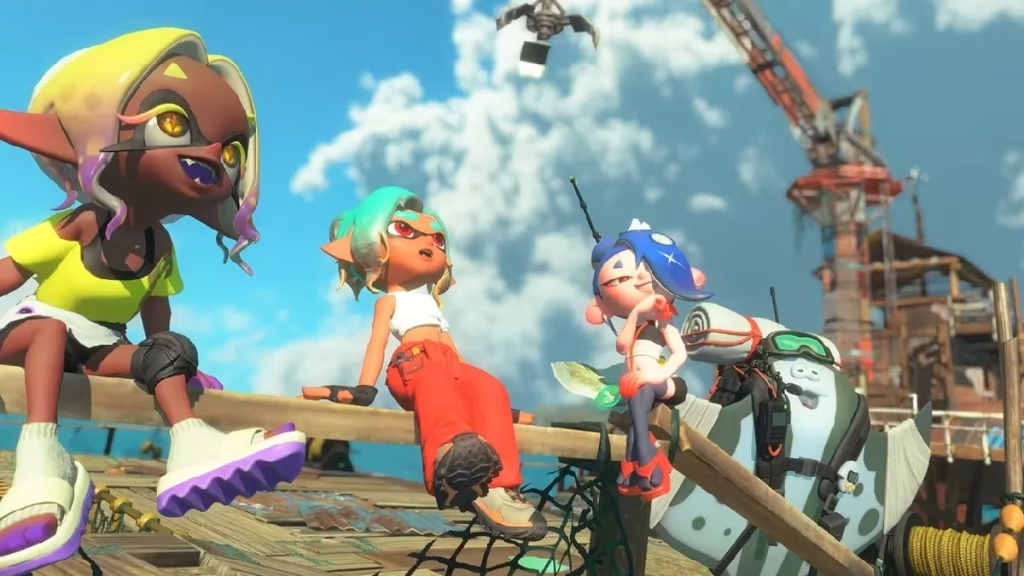
Splatoon Raiders is out now on Switch 2, and it’s a genuinely different beast from anything the ink-shooter series has done before. It’s the first true single-player entry in the franchise, trading turf wars for a level-based solo campaign that borrows heavily from Splatoon 3’s Salmon Run and leans closer to a looter shooter than the dungeon crawler its early trailers implied. Announced back in May and launched today, July 23, here’s everything you need to jump in with confidence.
What’s Actually New Here
Raiders breaks from tradition at the systems level. Sub-weapons — now called gadgets — are no longer tied to your main weapon, so you’re free to mix and match them however you like. Your loadout is built around an ink tank in one of three classes: Speed, Power, and Tactical, each with its own gadgets, stats, and skill upgrades bought with tokens. More than 100 weapons drop from enemies as you play, and mods earned on runs sharpen your gadgets further. A robot companion — voiced by Shiver, Frye, or Big Man — fights alongside you and doubles as a launchpad. Early impressions have compared the feel to a Nintendo-flavored looter shooter, in the best way, and these ten tips will get you raiding.
- Use your gadget the second a fight starts, then again on every cooldown. Gadgets mark enemies, distract them, and carve out space to reposition — steady use is what keeps a wave from swarming you in solo play.
- Ink the ground as you move. Swimming through your own ink beats running, especially in the busier late stages, and always spray over purple Salmonid ink — it slows you and chips your health.
- Summon your companion bot when you need it. Pressing X drops it onto nearby enemies to deal damage and pull aggro off you, though it taps out for a few seconds after enough hits.
- Use the bot as a launchpad. It’s built for reaching high platforms, but springing off it mid-fight lets you pick targets from above and drift back down, inking Salmonids who can’t reach you.
- Play to your weapon’s range. Shooters and Dualies want close-to-mid distance for their fast fire rate, while Sloshers and Chargers reward patience and spacing — pair each weapon with a gadget that suits its style.
- Experiment freely. There’s no penalty for switching weapons or tanks, so try everything and settle on what clicks — only mods take a bit of grinding to swap.
- Don’t stress about grabbing every item. Loot you can’t reach or paths you skip get folded into your total haul at the end of the run anyway.
- Spend skill points on your current tank without hesitation. Upgrades like extra mod slots carry across every gadget tank you own, so you never pay the same points twice.
- Review your gear and mods after every run. A 10% bump to range or damage sounds minor — until thirty Salmonids are bearing down on you.
- Let the game auto-select mods if you’re stuck. Once the options pile up, Raiders’ auto-pick system is tuned well enough that skipping the decision costs you nothing.
How a Run Actually Plays Out
Missions range from linear treasure hunts to open maps where you gather a set number of Power Eggs, plus weapon-challenge levels that hand you a fixed loadout and teach a new tool in context. Raids are the timed mode — floor-by-floor runs where you splat enough enemies and bank enough Eggs to advance. Going after bigger Salmonids like Steel Eels and Stingers pays out more, but you’ll still need to thin the smaller herds and keep the ground inked so you don’t get cornered. Sitting on top of it all are three ultimate attacks tied to the band Deep Cut, one of which calls in a shark that tears through enemies in a line.
🦑 Playing With Others
Up to four players can raid together, and a Help feature lets you drop into someone else’s game to lend a hand for rewards. Nintendo frames Raiders as single-player first, so there’s no Salmon Run-style endless grind — but the co-op is clearly where the short, build-heavy levels are meant to shine. If four-player raids sound appealing, our roundup of the best co-op games is worth a look for what to queue up next.
How It’s Landing With Critics
The campaign holds up under scrutiny. Splatoon Raiders opened to first critic reviews in the low-to-mid 80s, sitting at 80 on Metacritic and 81 on OpenCritic, with about 71% of critics recommending it — just a touch behind the mainline Splatoon games, which sit between 81 and 83. Praise centers on the shooting, the co-op, and the progression loop, while the missing Turf War mode is the recurring knock. One notable gap from early previews: customization leans on full outfits rather than individual clothing pieces, which feels thin for a series where assembling a look has always been half the fun.
👍 What clicks
Buildcrafting across weapons, tanks, and mods is deep enough to lose an evening to, and the shooting still feels distinctly Splatoon.
⏱️ Where to be cautious
The timed Raid mode leans on countdown pressure — great for some players, stressful for anyone who plays for movement over adrenaline.
🎮 Best played
The short, build-heavy levels read like they were designed for two to four players trading complementary loadouts on the couch.
Ten Years in the Making
The timing is fitting — Raiders arrives around Splatoon’s 10th anniversary, a decade after Nintendo built the original by ignoring shooter conventions and starting from whatever felt fun, right down to swapping early tofu-block and rabbit prototypes for squids that could swim through their own ink.
That same instinct carries into Raiders, which reworks the formula instead of repeating it, and it’s landing at a strong moment for the platform. Circana data confirms the Switch 2 closed its first year on the US market at 5.9 million units sold — the second-fastest console start in US tracked history, behind only the Game Boy Advance. Nintendo is pitching Raiders as a compact, standalone Splatoon experience rather than a live-service grind, and the buildcrafting here is strong enough that it would be a genuine surprise if a future mainline entry left these systems behind.