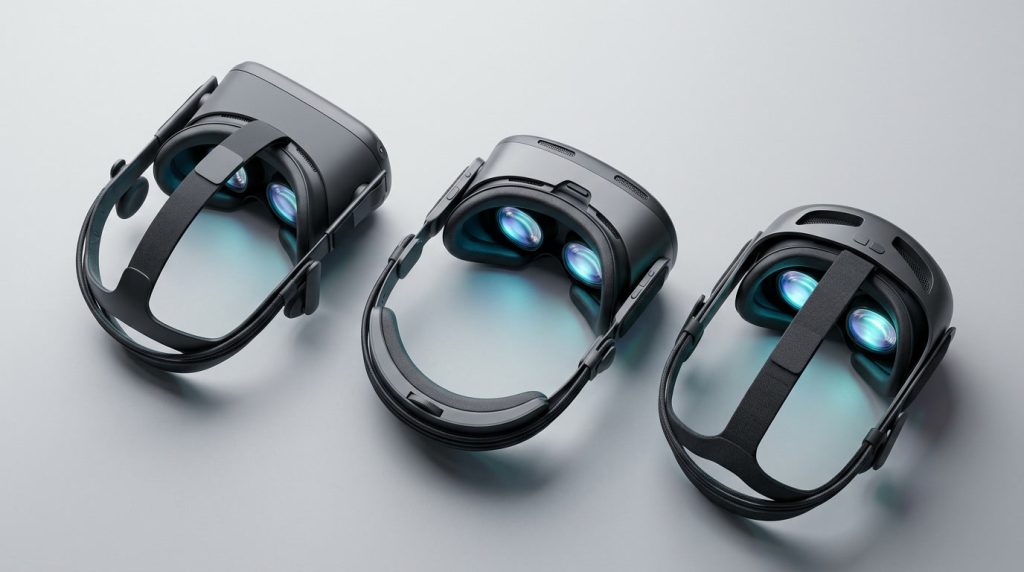
If you’re trying to sort through which VR headset actually makes sense for gaming in 2026 — not just the spec sheets, but the real-world experience — you’re in the right place. The market has matured significantly, a handful of companies genuinely own it, and there’s now a clear answer for almost every type of player. Here’s who’s building what, and whether it’s actually worth your money.
A couple of years ago, virtual reality still felt like something you tried at a friend’s place and forgot about. In 2026, that’s flipped. Standalone headsets don’t require a gaming PC. Display quality has crossed a threshold where it stops being the limiting factor. And the software library — especially on Meta’s platform — finally has enough depth to justify the hardware investment.
This breakdown covers the four main players defining the VR gaming space right now: Meta, Sony, ByteDance’s Pico, and the enthusiast-tier market anchored by Valve and Pimax. We’ve included a comparison table and a buying guide at the end if you want to skip straight to the recommendation for your situation. And if you game across platforms — VR isn’t your only thing — our guide to 2-player co-op games is worth a read alongside this one.
Who Actually Controls the VR Gaming Market in 2026
Four brands account for the overwhelming majority of gaming VR headsets sold globally. Meta holds somewhere around 60–65% of the consumer standalone market. Sony owns the console VR lane outright. Pico has carved out a legitimate alternative position in Europe and Asia, particularly for wireless PC VR. And then there’s the enthusiast fringe — Pimax, and the long-anticipated Valve standalone — for people who treat VR like a hobby in itself, not just a gaming accessory.
The interesting story isn’t who’s winning. It’s how different each ecosystem feels once you’re inside it. Choosing a headset in 2026 is really choosing a platform — the same way picking a PS5 over an Xbox locks in certain exclusive experiences. That context matters for everything below.
Meta — The Platform Play
Worth knowing: Meta’s ecosystem requires a Meta account (not Facebook, since 2023), and the social/store integrations lean heavily into Meta’s platform. If privacy is a concern, that’s a factor worth weighing. It doesn’t affect the hardware quality — just how comfortable you are with the broader platform.
Sony — The Console VR Benchmark
PlayStation VR2: OLED, Eye Tracking, and Real Exclusives
If you own a PS5, the PSVR2 is genuinely the most visually impressive consumer VR headset you can buy for gaming. Sony uses OLED displays — one per eye — at 2000×2040 resolution with a 120Hz refresh rate. The difference in black levels and color depth compared to LCD-based headsets is immediately obvious. In a game like Horizon Call of the Mountain or Gran Turismo 7 VR, the display quality alone justifies the price for anyone who cares about visual fidelity.
Eye tracking and foveated rendering are the features most people don’t fully appreciate until they use them. The headset tracks where your eyes are looking and renders that area in full detail while dropping resolution in the periphery — which is exactly how human vision actually works. The result is better performance without a visible quality drop, particularly in demanding open-world titles.
Sony also released a PC VR adapter in 2024, which opened up the PSVR2’s hardware to Steam VR titles. It’s not a perfect solution — some PS5-specific features like adaptive triggers and haptic feedback lose functionality on PC — but it meaningfully expands the headset’s value if you game on both platforms. The headset itself is still tethered (single USB-C cable to the PS5), which is a real ergonomic tradeoff compared to the wireless Quest 3.
The exclusive software lineup is where Sony earns its position. Horizon Call of the Mountain is a first-party showcase title that still holds up as one of the best VR experiences made specifically for the medium, not ported from flat gaming. For players who want VR gaming to feel like a genuine Sony first-party product — polished, curated, exclusive — PSVR2 delivers that in a way Meta’s open platform can’t quite match.
ByteDance / Pico — The PC VR Alternative
Pico 4 Ultra: Ergonomics, Pancake Lenses, Wireless PC VR
The Pico 4 Ultra is the headset that Meta users wish the Quest 3 was, ergonomically. Pico uses a rear-weighted battery design — the battery sits at the back of the head rather than the front — which distributes weight more evenly and reduces neck strain during long sessions considerably. If you’ve ever taken a Quest 3 off after two hours with a sore neck, this design philosophy is immediately appreciated.
The display spec is competitive with the Quest 3 using the same Snapdragon XR2 Gen 2 chipset and pancake lenses. Wireless PC VR streaming via Pico’s proprietary streaming solution is genuinely high quality, arguably slightly ahead of Meta’s Air Link in terms of compression artifacts. The standalone library, however, is significantly smaller — Pico’s Appstore has improved, but it’s not close to Meta’s catalog in depth or breadth.
Pico 4 Ultra is the better choice if PC VR streaming is your primary use case and you care about wearing the headset for long sessions. It’s roughly the same price as the Quest 3, so you’re trading standalone library depth for ergonomics and wireless PC VR streaming quality. For studio professionals or anyone who uses VR for extended work sessions alongside gaming, Pico is worth serious consideration.
The ByteDance ownership does raise similar platform dependency questions as Meta — Pico is a Chinese-owned platform with its own data handling policies. That’s a known consideration in the B2B and enterprise market especially.
Valve & The Enthusiast Tier
Steam Frame Anticipation and Pimax Crystal Light
The enthusiast VR market in 2026 is in a genuinely interesting holding pattern. Pimax has been building a reputation with their Crystal line — the Crystal Light at around $599 offers strong display clarity (local dimming LCD, 2880×2880 per eye) for PC VR users who primarily care about visual fidelity over ergonomics or wireless convenience. The Pimax Crystal Super pushes further with micro-OLED technology, targeting sim racers and flight sim players who run VR on high-end RTX 4090 rigs where the display is the actual bottleneck.
The real story at the enthusiast level is Valve. The rumored Valve Steam Frame — a standalone headset running SteamOS with direct access to a Steam library — has been circulating in hardware circles seriously since late 2024. If it launches in 2026, it would be the single most significant entry into the standalone VR market since the original Quest. A Steam-native standalone device from Valve, with the full Steam catalog, would compete with Meta’s ecosystem directly in a way no other manufacturer currently does. At the time of writing, Valve has not officially confirmed specs or pricing, so take the anticipation for what it is — but the developer ecosystem interest is real.
For most players, Pimax’s software ecosystem remains a friction point. Setup complexity and driver compatibility issues on Windows still make it a product for enthusiasts who are willing to troubleshoot, not for people who want plug-and-play gaming. If you enjoy that kind of hardware tinkering — and you’re already deep into PC gaming — it’s a legitimate option. If not, stick with Meta or Sony.
A note on PC VR stability: High-end PC VR gaming (Pimax, PSVR2 on PC, Quest via Air Link) can surface driver and performance issues that feel like game crashes but are actually hardware or connection related. If you’re troubleshooting that situation, our guide on why games keep crashing on PC covers many of the same root causes.
VR Gaming Headset Comparison — 2026
| Model | Primary Use Case | Display Tech | Lenses | Price (USD) | Wireless |
|---|---|---|---|---|---|
| Meta Quest 3 | Standalone + PC VR | LCD, 2064×2208/eye | Pancake | ~$499 | Yes |
| Meta Quest 3S | Standalone | LCD, 1832×1920/eye | Fresnel | ~$299 | Yes |
| PlayStation VR2 | Console + PC | OLED, 2000×2040/eye | Fresnel | ~$549 | No (tethered) |
| Pico 4 Ultra | Standalone + PC VR | LCD, 2160×2160/eye | Pancake | ~$499–549 | Yes |
| Pimax Crystal Light | PC VR | LCD (local dimming), 2880×2880/eye | Pancake | ~$599 | No |
| Pimax Crystal Super | PC VR | Micro-OLED, 3840×3840/eye | Pancake | ~$1,399 | No |
| Valve Steam Frame | Standalone (rumored) | TBC | TBC | TBC | Expected: Yes |
Which Headset Should You Actually Buy?
The honest answer depends almost entirely on what you already own and how you prefer to game. Here’s how to think about it:
Best display quality in its price class. First-party exclusives that are actually good. No PC required.
Deepest standalone library. Quest 3S if budget matters. Quest 3 if you want the best standalone experience available.
Better ergonomics than Quest 3 for long sessions. Solid wireless PC VR streaming. Worth it if Meta’s platform bothers you.
Best pixel density at a relatively reasonable price for dedicated sim use. Requires a powerful PC and willingness to deal with setup complexity.
Micro-OLED at sim-grade resolution. You’ll need an RTX 4090 to run it properly. For collectors and serious enthusiasts only.
If Valve delivers on the Steam standalone rumors, it could be the best reason to wait since the original Quest launched.
One thing worth knowing regardless of which headset you choose: VR gaming pairs naturally with co-op. The social dimension of shared VR experiences — whether that’s multiplayer shooters, escape rooms, or co-op puzzle games — is a genuine differentiator from flat gaming. Check out our 2-player co-op guide for games that translate well across platforms, including VR-adjacent multiplayer titles. And if you’re gaming with friends across different regions, our look at the best multiplayer games in Australia right now has relevant crossover for anything latency-sensitive.
The VR gaming market in 2026 is genuinely mature enough that “should I buy a headset?” has a clear answer for most players: yes, if your budget covers it and you have any interest in the format at all. The question is really which ecosystem to commit to. Hopefully the breakdown above makes that decision a little clearer.