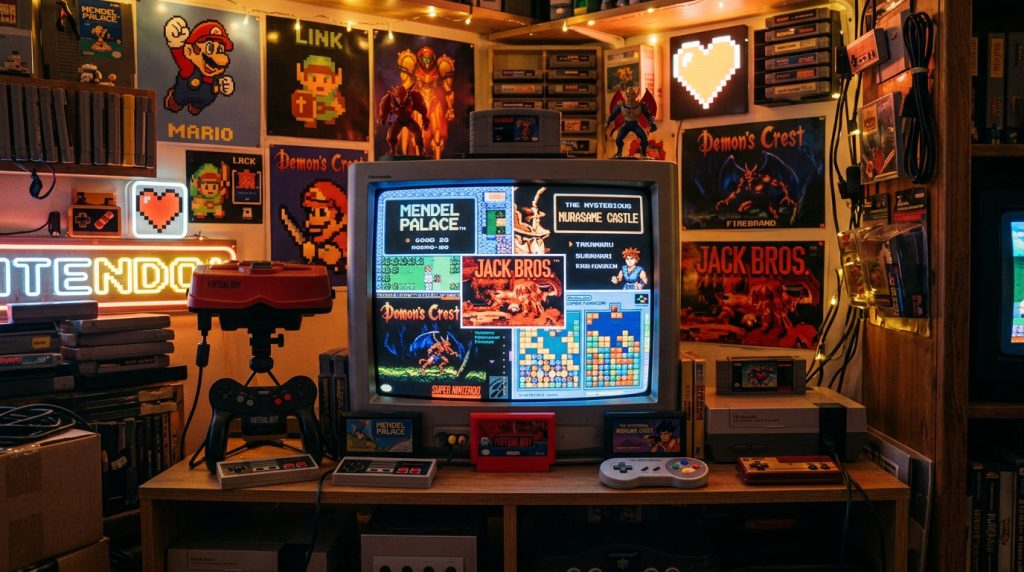
Every retro collector has a moment where they realize the “classics” section of gaming history is really just the highlight reel. Mario, Zelda, Metroid — those games earned their legacy, but they also crowded out dozens of titles that deserved just as much attention. Regional locks kept entire libraries trapped in Japan, late console-lifecycle releases got buried under next-gen hype, and some genuinely brilliant games simply launched on hardware nobody bought. This list digs into five forgotten Nintendo retro games that fell through those cracks — and thanks to modern emulation and an expanding Nintendo Switch Online library, every one of them is more accessible right now than it’s been in decades.
5 Forgotten Retro Masterpieces You Can’t Miss
01 Mendel Palace
NES · 1989/1990Gameplay Concept
You play Bon-Bon, flipping floor tiles in grid-based rooms to knock enemy dolls into walls and destroy them. It sounds simple until the roster escalates — heavier enemies shove back harder, some can only be hit from specific angles, and one enemy type draws chalk sketches that manifest into new threats. Two players can flip tiles side by side, and the game rewards reading the whole board rather than just reacting to whatever’s closest.
Why It Was Forgotten
Timing killed it. Mendel Palace landed in North America in 1990, right as the NES was aging out and SNES buzz was building, so it got lost in the shuffle against louder, flashier releases. It also carried zero brand recognition — nobody knew who made it, and the studio behind it wouldn’t become a household name for another six years.
Why It Holds Up Today
This is Game Freak’s debut title, built by the same team that would go on to create Pokémon, and you can already see their knack for systemic enemy design here. The physics feel tight, the two-player mode is genuinely fun rather than tacked on, and the puzzle-action hybrid holds together far better than most 1989 experiments. It finally landed on the Nintendo Switch Online NES library in 2026, making it one of the easiest entries on this list to try immediately.
02 Jack Bros.
Virtual Boy · 1995Gameplay Concept
Playing as one of three brothers — Jack Frost, Jack Lantern, or Jack Skelton — you descend through dungeon floors collecting keys against a hard midnight deadline, battling demons pulled straight from the Shin Megami Tensei universe. The stereoscopic 3D display actually earns its keep here, giving the floor layouts real depth that helps you judge enemy distance and plan routes under time pressure.
Why It Was Forgotten
It shipped on the Virtual Boy, a console that sold fewer than 800,000 units before Nintendo pulled the plug within a year. No amount of quality could save a game stapled to hardware nobody bought, and Jack Bros. became a genuinely rare, expensive cartridge that most players never had a chance to even see running.
Why It Holds Up Today
As the first Megami Tensei game ever released outside Japan, this is a real piece of series history, not just a curiosity. The floor-clearing loop is tense and well-paced, and Atlus clearly understood how to use the hardware’s strengths instead of fighting them. Nintendo added it to the Switch Online Expansion Pack’s Virtual Boy library in 2026, so for the first time in three decades it’s legitimately playable without hunting down a battered original unit.
03 The Mysterious Murasame Castle
Famicom Disk System · 1986Gameplay Concept
Built on the same engine as the original Legend of Zelda, this one strips out the exploration and puzzle-solving in favor of pure speed. You control the samurai Takamaru across five castles, throwing shuriken and slashing through waves of enemies in a top-down layout that plays closer to a bullet-hell shooter than anything else Nintendo made in the 8-bit era.
Why It Was Forgotten
It never left Japan during its original release. As a Famicom Disk System exclusive, it was locked to hardware that didn’t exist outside Japan at all, and by the time Nintendo finally brought it West via 3DS Virtual Console in 2014, the moment for it to build an audience had long passed.
Why It Holds Up Today
Miyamoto himself has pointed to this as the Zelda team testing how fast and aggressive their engine could get, and the result is one of the snappiest action games on the whole system — no exaggeration, since Nintendo Life’s own retrospective called out just how sharp the controls still feel decades later. Directors like Suda51 have publicly said they’d love to see it rebooted. It’s currently sitting in the NES library on Nintendo Switch Online, fully playable despite the total lack of an official translation — the game barely uses text to begin with, so that’s a non-issue.
04 Demon’s Crest
SNES · 1994Gameplay Concept
You play Firebrand, the gargoyle antagonist pulled out of the Ghosts ‘n Goblins universe, hunting down elemental crests across an interconnected world map. Collecting crests unlocks new demon forms with distinct movesets — one lets you hover indefinitely, another breaks through specific obstacles — turning the game into a loose Metroidvania built years before that structure had a name.
Why It Was Forgotten
Capcom’s own numbers tell the story: it was an outright commercial failure at launch, reportedly posting negative sales in at least one week according to contemporary Nintendo Power reporting. A spin-off of a spin-off, starring a villain instead of a hero, released late into the SNES lifecycle — it had almost nothing working in its favor at retail.
Why It Holds Up Today
The critical response at the time was strong, and history has only been kinder — outlets like IGN and GamesRadar have repeatedly slotted it into “best SNES games” retrospectives. The elemental-form progression gives it real mechanical depth, and Capcom’s moody, gothic art direction still looks distinct next to almost anything else on the console. It’s on the Switch Online SNES library, and Capcom also made it freely playable in-browser through Capcom Town.
05 Sutte Hakkun
Super Famicom · 1997Gameplay Concept
You control a bouncing sponge-like creature that absorbs colored paint, and every color grants a different traversal ability — one lets you climb walls, another changes how you interact with hazards. Puzzles are built around swapping colors mid-level to chain abilities together, turning platforming sections into short logic problems disguised as jumps.
Why It Was Forgotten
It’s a Japan-exclusive Super Famicom release that arrived in 1997, well after the Nintendo 64 had already taken over as Nintendo’s flagship platform in the West. Without a North American release or an English localization, it simply had no path to a wider audience and stayed a footnote even among import-focused collectors.
Why It Holds Up Today
The color-absorption mechanic is legitimately clever, using a genre most players think they’ve already seen everything from and finding a fresh angle inside it. It’s colorful, tightly designed, and short enough that a single sitting gets you through a meaningful chunk of the puzzle set. Sutte Hakkun joined the Nintendo Switch Online SNES library in 2025, still untranslated but very playable, making it one of the more surprising NES hidden gems-adjacent finds for players willing to look one system over.
Quick Comparison: Platforms & Where to Play Them
| Game Title | Original Platform | Genre | Modern Availability |
|---|---|---|---|
| Mendel Palace | NES | Action-Puzzle | Nintendo Switch Online (NES library) |
| Jack Bros. | Virtual Boy | Action Dungeon Crawler | NSO Expansion Pack (Virtual Boy library, accessory required) |
| Murasame Castle | Famicom Disk System | Top-Down Action | Nintendo Switch Online (NES library) |
| Demon’s Crest | SNES | Action-Platformer | NSO (SNES library) + free via Capcom Town |
| Sutte Hakkun | Super Famicom | Puzzle-Platformer | NSO (SNES library, Japan-exclusive, untranslated) |
Why These Retro Gems Deserve a Second Chance
What’s changed isn’t the games — it’s access. For most of these titles, the only route in used to be a battered original cartridge, an expensive import, or a shady ROM site. That’s no longer true. Nintendo Switch Online has quietly become one of the best tools for recovering underrated retro games that regional locks buried decades ago, and 2025–2026 alone has added Sutte Hakkun, Mendel Palace, and — most surprisingly — an entire wave of Virtual Boy titles including Jack Bros.
If you’re chasing obscure classic games beyond this list, an active NSO or NSO + Expansion Pack subscription now covers a surprising percentage of them directly. For anything still missing from the service, community fan translation patches have made Japan-exclusive titles like Sutte Hakkun fully readable in English on emulator, and physical retro retailers remain a solid option for collectors who want the cartridge experience. LemonLama’s breakdown of what to know about Lukie Games and our DKOldies retailer review are good starting points if you’d rather own the real thing.
Emulation remains the fastest way to try before you commit to a purchase, but not every source is worth trusting. If you’ve relied on abandonware sites in the past, it’s worth reading up on whether Vimm’s Lair is still safe to use before pointing your browser at it. And if this list has you thinking about how retro genres evolved into what we play today, LemonLama’s piece on the evolution of point-and-click games covers a parallel story of a genre that also spent years overshadowed by louder competition.