Reviews dropped. Twitter melted. The conversation about Insomniac’s Logan game has been hijacked by red scent trails and jokes about handholding. We played past the memes. The truth is more complicated than the backlash, and more damning than the defenders want to admit. Wolverine is not a bad game. It is a good game made by a great studio that no longer trusts its players enough to let them think.
On September 10, 2026, the review embargo lifted for Marvel’s Wolverine, and within hours, the conversation had been reduced to a single visual effect. A red, wispy trail that emanates from Wolverine when he uses his heightened senses to track targets. The internet called it “fart gas.” The discourse called it everything: handholding, condescension, the death of player agency, proof that Insomniac had lost the plot. By September 11, Insomniac’s community director was on social media explaining that the scent trail could be turned off in the accessibility menu. By September 12, Forbes was running explainers about why the “fart gas trails” existed in the first place.
This is what we talk about now. Not whether the combat has depth. Not whether the story earns its violence. Not whether a studio that made three of the best superhero games ever made has delivered a worthy follow-up. We talk about whether a red visual effect is condescending.
We played Wolverine for twenty hours. We finished the campaign. We hunted every collectible, tested every difficulty, turned the scent trail on and off, and played the same encounters both ways. And the conclusion is this: the fart gas debate is a symptom of something real, but the disease is not the scent trail. The disease is a design philosophy that treats players like they need help breathing.
What the scent trail actually is, and why it broke the internet
First, the facts. Wolverine’s scent tracking is a core mechanic. When Logan enters his focused senses mode, the world desaturates and scents appear as colored trails: red for enemies, yellow for objectives, other colors for interactive objects. This is not new. Batman: Arkham Asylum did detective vision in 2009. The Last of Us did listen mode in 2013. Tomb Raider did survival instinct in 2013. Witcher Sense did the same thing in 2015. Scent tracking as a visual mechanic is older than some of the people tweeting about it.
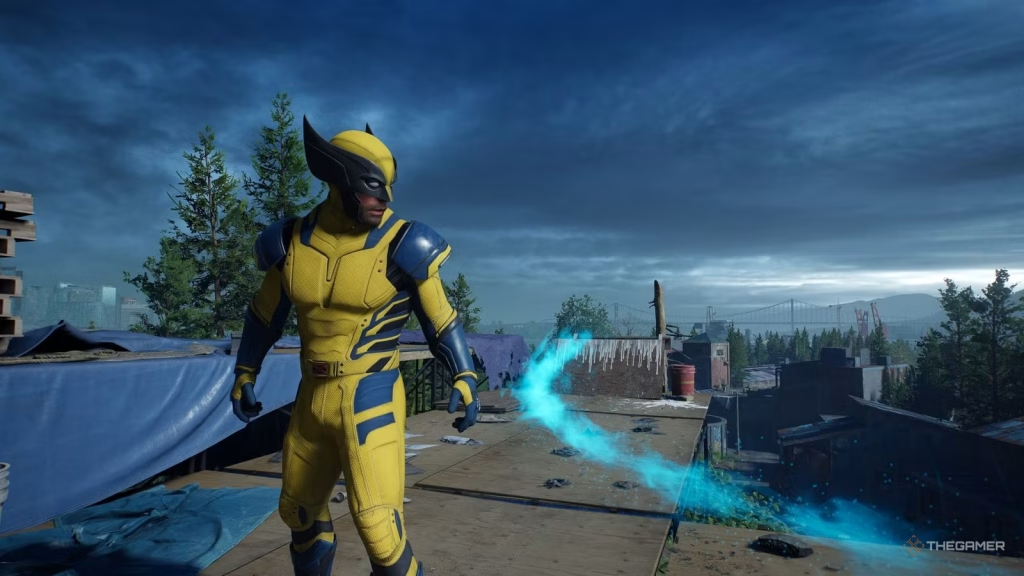
What made Wolverine’s version controversial was the aesthetic. The trail is not a subtle highlight or a faint pulse. It is a thick, swirling, particle-heavy ribbon of red vapor that pours off Wolverine’s body and snakes through the environment like he is leaking cherry-flavored smoke. In a game that otherwise goes for gritty realism, where claws slice through flesh with anatomical precision and Logan’s healing factor visibly knits wounds in real-time, the scent trail looks like a Fortnite effect. It reads as silly. It photographs poorly. It became a meme before it became a criticism.
The PS5 blockbuster has been criticized for being too inrails and afraid to trust players.
— Ethan Gach, Kotaku, September 10, 2026The “inrails” criticism, a portmanteau of “in” and “on-rails” that Twitter invented in real-time, is the more substantive complaint. Wolverine is not literally on-rails. You can walk where you want, explore modestly sized hub areas, and choose the order of some objectives. But the game constantly directs you. The scent trail points the way. Objective markers hover in the HUD. Interactive objects glow. The path forward is never in doubt. And when you reach certain story beats, the game seizes control entirely: walk here, watch this, press X to continue the cutscene.
The defenders say this is fine. They say Wolverine is a narrative-driven action game, not an immersive sim. They say God of War 2018 did the same thing and nobody complained. They say the scent trail is optional, that you can turn it off, that accessibility matters, that not every game needs to be Dark Souls. And they are not wrong, exactly. But they are answering a different question than the one the critics are asking.
We played it both ways: scent on, scent off, and the truth in between
We ran the first six hours of Wolverine twice. Once with the scent trail on default settings, once with it turned off entirely. The difference is instructive.
With the scent trail on, Wolverine plays like a guided experience. You enter a space, trigger senses, follow the red ribbon, encounter enemies, repeat. The game never leaves you wondering what to do next. The trail removes ambiguity, which removes frustration, which also removes discovery. There is no moment of accidentally finding a hidden path because you were paying attention. There is no satisfaction in noticing a faint blood spatter and deducing where the target went. The game does the noticing for you, then draws a line through it.
With the scent trail off, something interesting happens. The game does not collapse. The level design is more coherent than the discourse suggests. Environments have natural logic. A broken window suggests an entry point. Blood on the floor suggests a direction. A knocked-over chair suggests a struggle. These environmental tells exist whether the scent trail is on or off. The difference is that with the trail off, you have to look for them. You have to engage with the space as a space, not as a corridor with a glowing path through it.
Here is the crucial finding: Wolverine is a better game with the scent trail off. Not because the trail is evil. Because turning it off forces the level design to do the work that the particle effect was doing instead. And the level design, mostly, can do the work. Not always. There are moments, particularly in the later industrial zones where the environment becomes visually noisy, where a subtle blood trail is genuinely hard to spot without the scent effect. Those moments suggest that the trail was not just a concession to casual players. It was a crutch for environments that were not designed clearly enough to read without assistance.
This is the real issue. The scent trail is not the disease. The disease is a design pipeline that builds spaces, then adds a glowing breadcrumb because the spaces do not communicate well enough on their own. The trail is a fix for a problem that should have been solved in layout, lighting, and environmental storytelling. It is cheaper to add a particle effect than to rebuild a level. So they added the particle effect.
The combat: better than the discourse, worse than the studio’s best
If you have only read Twitter, you might think Wolverine’s combat is a QTE-ridden slog where Logan auto-pilot’s through enemies while the player presses X to continue the slaughter. This is not true. The combat has genuine mechanical depth. It is just not the depth that Insomniac’s Marvel track record had led people to expect.
Wolverine’s fighting system is built around three resources: health, rage, and momentum. Health is straightforward, though the healing factor adds a twist: Logan regenerates lost health segments if he avoids damage for a few seconds, but if a segment is fully drained, it becomes “trauma” damage that only heals at checkpoints. This creates a fascinating risk-reward dynamic where staying in the fight can restore you, but taking one bad hit can permanently cost you a segment for the rest of the encounter. It is the best mechanical expression of Wolverine’s healing factor in any game.
Rage builds as you deal and take damage. At full rage, Logan enters a berserk state where damage increases, healing accelerates, and new brutal takedown animations unlock. Momentum builds through perfect dodges and parries, enabling special claw combos and environmental takedowns. The interplay between these three systems, managing health regeneration windows, deciding when to spend rage versus save it, building momentum through defensive play, creates a combat loop that rewards aggression tempered by timing.
The problem is not the systems. The problem is the encounter design. Wolverine’s enemies are divided into a handful of archetypes: basic grunts, shielded enemies, heavies, and specialized types like Sentinels or Purifiers with area-denial attacks. The game introduces these types gradually, then remixes them across encounters. But the remixing is conservative. Most fights can be solved with the same pattern: dodge the telegraphed heavy attack, counter, build rage, berserk, clean up. The game rarely forces you to engage with the deeper systems because the encounter design does not demand it.
The God of War comparison is half-right. Wolverine’s structure, a linear narrative punctuated by combat arenas and light exploration, clearly draws from God of War 2018. But God of War’s encounters were puzzles disguised as fights. Each enemy type had specific behaviors that demanded different approaches. Wolverine’s encounters are closer to Batman: Arkham Asylum without the predator rooms, or Spider-Man without the aerial mobility. They are competent. They are not exceptional.
The boss fights fare better. The Mr. Sinister encounter in the third act is genuinely excellent, a multi-phase battle that tests every system the game has taught you. The Sabretooth fights, plural, have weight and history behind them that the choreography earns. But these highlights stand out because the standard encounters are so routine. Insomniac made a combat system with depth, then built a campaign that rarely asks you to use it.
The story: where Wolverine actually works
If the gameplay discourse has been unfair to Wolverine’s combat, it has been almost entirely silent about the one thing the game unquestionably succeeds at: Logan himself.
Liam McIntyre’s performance as Wolverine is not an impression. It is a reinterpretation. This is not the gruff one-liner machine from the Fox films, nor the anime-haired rebel from the 90s cartoon. This Logan is exhausted. He has been fighting for decades, has buried people he loved, and has arrived at a place where his healing factor feels less like a gift and more like a sentence. He cannot die, which means he cannot stop. The game understands that Wolverine’s tragedy is not that he hurts people. It is that he keeps surviving the hurt.
The narrative structure is smart. Rather than adapting a specific comic arc, Insomniac built an original story that draws from multiple eras: the Weapon X program, the Japan saga, the Madripoor years. The game moves between these periods through flashbacks triggered by trauma, a device that justifies both the nonlinear storytelling and the gameplay mechanic where Logan’s memories unlock new abilities. It is elegant. It is also emotionally grounded in a way that superhero games rarely attempt.
The supporting cast helps. Jean Grey appears not as a love interest to be rescued but as a complicated figure from Logan’s past who challenges his self-image. Sabretooth is not a cackling villain but a mirror, a version of Logan who embraced the animal instead of fighting it. Even minor characters, a bartender in Madripoor, a former Weapon X scientist wracked with guilt, are written with specificity that suggests actual writers were involved, not just lore-keepers.
This is why the “fart gas” discourse is so frustrating. Wolverine has one of the best-written superhero stories in gaming. It treats its protagonist as a person rather than a power set. And the conversation about it has been dominated by a visual effect that occupies maybe 5% of the screen time. The game deserves better. But also, and this is important, the game brought it on itself. If you build a story about a man struggling with his own violence and then wrap it in particle effects that look like a Saturday morning cartoon, you cannot be surprised when people talk about the particles.
The review score split: why critics gave it 5/10 and 10/10
Wolverine’s Metacritic score of 78 hides a wild divergence in critical opinion. The game received everything from 5/10 to perfect scores. Understanding why requires looking at what different critics value.
| Outlet | Score | Core Complaint |
|---|---|---|
| PCMag | 5/10 | “Hollow, linear slog that forgets to let players actually have fun” |
| Polygon | Low | “Biggest disappointment of the PS5 era”; copies God of War poorly |
| The Guardian | Mixed | “Gloriously conflicted lead is let down by crude, boring battling” |
| VGC | Mixed | “Uninspired gameplay leaves Logan feeling declawed” |
| Wccftech | High | “Linear, rage-fueled slaughterhouse, and it mostly works” |
| Kotaku | Mixed-Positive | “Refreshingly straightforward… mostly” |
The negative reviews share a common thread: they expected more from Insomniac. This is the studio that made Spider-Man 2018, Miles Morales, and Spider-Man 2, three of the most mechanically rich, visually spectacular, and narratively confident superhero games ever made. Wolverine is a deliberate step in a different direction, smaller in scope, more focused, more linear. For critics who wanted Insomniac to push forward, this feels like a retreat. For critics who appreciate focused narrative experiences, the streamlining is a feature, not a bug.
The positive reviews tend to emphasize the same things: Liam McIntyre’s performance, the story’s emotional weight, the combat’s visceral satisfaction, the restraint shown in not making another open-world checklist. These are real virtues. They just happen to coexist with real problems that the positive reviews often acknowledge in passing: repetitive encounters, excessive handholding, and a structure that sometimes feels more like a guided tour than a game.
The 78 Metacritic score is, in a way, perfectly accurate. Wolverine is not a bad game. It is a good game with enough friction points that its flaws are impossible to ignore, and enough quality that its virtues are impossible to deny. The problem is that “good but flawed” is a dangerous place to land when you are Insomniac, when your last three games were great, and when you are asking players to spend $70 on a PlayStation 5 exclusive in September 2026.
The design philosophy: what Insomniac lost and what they kept
There is a broader conversation to be had here about PlayStation’s first-party design philosophy in 2026. Wolverine arrives in the same month that Sony canceled PHYSINT, the same year that Marathon is in development hell and Bungie has been gutted. PlayStation’s first-party output is in a strange place where the studios are still talented but the creative direction seems uncertain.
Wolverine embodies this uncertainty. It is a game made by people who know how to make great games, choosing to make a smaller, safer one. The linear structure is not inherently bad. God of War proved that linear can be masterful. But God of War’s linearity was confident. It trusted players to figure out its puzzles, to read its environments, to engage with its systems without constant guidance. Wolverine’s linearity is anxious. It adds markers, and trails, and glowing objects because it is afraid you might miss something, or get lost, or put the controller down.
This anxiety is the disease. The scent trail is a symptom. The constant objective markers are a symptom. The inability to let players explore a space without pointing at every interactive object is a symptom. They all say the same thing: we do not trust you to find the fun. We will show you where it is.
And here is the tragedy: the fun is actually there. When you turn off the scent trail and engage with the level design on its own terms, when you push the combat system to its limits on higher difficulties, when you let the story breathe without waiting for the next HUD prompt, Wolverine reveals itself as a genuinely good game with a great story and a solid combat foundation. It is not Insomniac’s best. It may not even be in their top three. But it is better than the discourse suggests, and more troubled than the defenders admit.
The fart gas will be patched, or toggled, or memed into irrelevance. Insomniac is already “cooking hard” on adjustments, according to their community team. But the patch will not fix the design philosophy that made the trail necessary in the first place. That requires something harder than a toggle in the options menu. It requires a studio to remember that players do not need to be led by the nose to find the good stuff. Sometimes, if you build it well enough, they will find it themselves.
Frequently Asked Questions
The “fart gas” is a nickname the internet gave to Wolverine’s scent tracking visual effect. When Logan uses his heightened senses, colored trails (red for enemies, yellow for objectives) appear as swirling particle effects that some players found visually silly or overly prominent. The nickname emerged on Twitter and Reddit within hours of gameplay footage appearing online, and became the dominant meme about the game even before release.
Yes. Insomniac confirmed that the scent trail can be turned off in the accessibility options menu. Playing without it changes the experience significantly, forcing players to rely on environmental cues like blood spatters, broken objects, and natural level design to navigate. Our testing found the game is actually more engaging with the trail disabled, though some later industrial environments become harder to read without the visual assistance.
“Inrails” is a portmanteau of “in” and “on-rails” coined on Twitter to describe Wolverine’s heavily guided design. The game is not literally on-rails, players can move freely, but constant objective markers, glowing interactive objects, scent trails, and frequent scripted sequences make it feel like the game is always pointing the way. Critics argue this represents excessive handholding that undermines player agency.
Wolverine is deliberately different from the Spider-Man games. Where Spider-Man was open-world, vertically liberated, and mechanically dense, Wolverine is linear, grounded, and streamlined. The combat has depth but the encounter design is more conservative. The story is more intimate and character-focused. Metacritically, Wolverine sits at 78, well below Spider-Man (87), Spider-Man: Miles Morales (85), and Spider-Man 2 (90). Whether this represents a step down or a successful pivot depends on whether you value focused narrative experiences or mechanical complexity.
The combat system itself is solid, with a three-resource framework (health, rage, momentum) that creates interesting decisions around regeneration, berserk states, and defensive play. The healing factor is mechanically well-realized. The problem is encounter design that rarely forces players to engage with the system’s deeper layers. Most fights can be completed with basic patterns, and only higher difficulties and certain boss encounters demand mastery. It is good. It is not exceptional.
Yes. The story is Wolverine’s strongest element. Liam McIntyre delivers a nuanced performance as a Logan who is exhausted by his own longevity. The original narrative weaves together Weapon X, Japan, and Madripoor storylines through trauma-triggered flashbacks. The supporting cast, particularly Jean Grey and Sabretooth, are written with uncommon depth for a superhero game. If you value narrative in action games, Wolverine delivers.
Reviews range from 5/10 to 10/10 because critics are weighing different things. Negative reviews emphasize repetitive combat, excessive handholding, and disappointment that Insomniac made a smaller, safer game after three exceptional Spider-Man titles. Positive reviews emphasize the strong story, visceral combat satisfaction, and appreciation for a focused linear experience in an era of bloated open worlds. The 78 Metacritic average reflects genuine disagreement about what the game is trying to be and whether it succeeds.
Insomniac’s community director has stated the team is “cooking hard” on adjustments following the feedback. The trail is already toggleable in accessibility options, so a patch would likely focus on making the effect subtler by default, adding more granular opacity controls, or adjusting the visual design to be less cartoonish. No specific patch date has been announced, but the studio has acknowledged the feedback directly.
If you are a Wolverine fan, a PlayStation first-party enthusiast, or someone who values story in action games, yes. The narrative and character work are genuinely excellent. If you are expecting Spider-Man with claws, or a deep, systems-rich combat experience that constantly tests your mastery, you may be disappointed. At $70, it is a qualified recommendation: a good game from a great studio that plays it safer than its pedigree suggests. Turn off the scent trail in the options menu before you start. Trust the level design. It mostly earns that trust.
Marvel’s Wolverine officially launched on September 15, 2026, for PlayStation 5. Review embargoes lifted on September 10, 2026, five days before launch. The game is a PlayStation 5 exclusive, published by Sony Interactive Entertainment and developed by Insomniac Games.