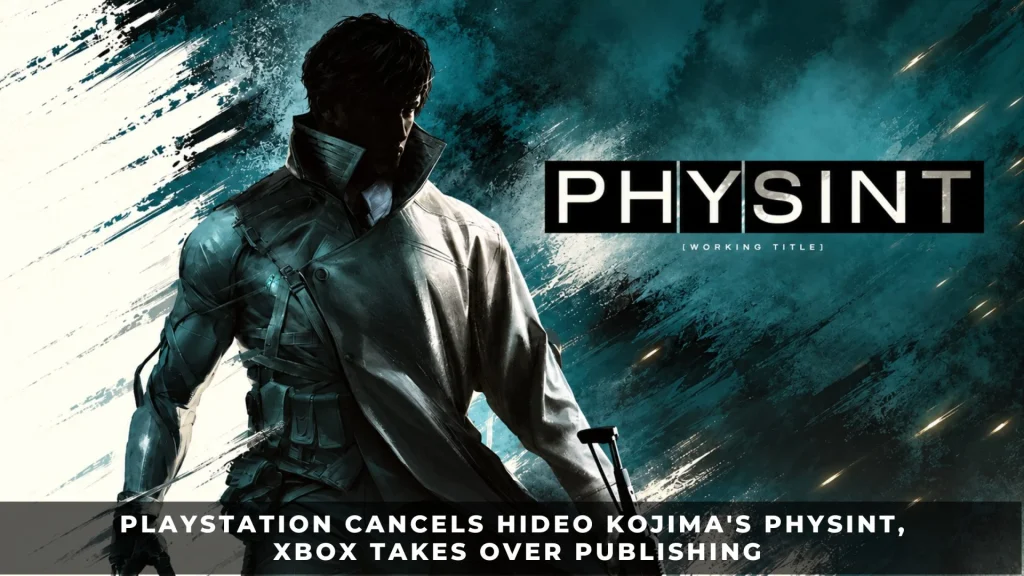
In January 2024, Sony stood on a stage and called Hideo Kojima’s return to stealth action the future of PlayStation. In June 2026, they canceled it by email. Three months later, Xbox announced they had picked it up. The story of how PlayStation lost one of the most celebrated creators in gaming history is a story about fear, spreadsheets, and a $400 million lesson named Concord.
On January 31, 2024, Hideo Kojima walked onto a virtual stage during Sony’s State of Play and announced PHYSINT. The creator of Metal Gear Solid, the man who essentially invented the cinematic stealth genre, was coming home. PHYSINT would be an action-espionage game, a “culmination” of his career, a next-generation title developed in partnership with Sony Interactive Entertainment and Sony Pictures. It was the game Metal Gear fans had been waiting for since Kojima left Konami in 2015. It was supposed to be a PlayStation exclusive. It was supposed to be the future.
On September 9, 2026, Xbox announced it was publishing PHYSINT instead.
The gap between those two dates is where this story lives. In the middle of 2026, Kojima Productions “unexpectedly received notice of project cancellation from Sony,” as Kojima himself put it. The studio spent three months shopping for a new partner. Xbox, already working with Kojima on the horror project OD, stepped in. And just like that, the most iconic Japanese game designer of his generation went from being a PlayStation partner to being an Xbox partner, on the game that was supposed to be his triumphant return to the genre that made him famous.
PlayStation did not lose PHYSINT because Kojima wanted to leave. They lost it because they got scared. And the reasons they got scared say more about the state of Sony Interactive Entertainment in 2026 than any earnings call ever could.
What PHYSINT was supposed to be
When Kojima announced PHYSINT in 2024, he did not call it a game. He called it a “new medium” that would blend games and film, the culmination of his entire career, and a next-generation project that would push the boundaries of what interactive entertainment could be. Sony’s Herman Hulst joined him on stage to celebrate the partnership. The messaging was clear: this was not just another publishing deal. This was a statement of identity. PlayStation was the home for visionary auteurs, for creators who could not be contained by conventional game development, for the people who defined the medium itself.
Kojima explained that the project was inspired by years of fans asking him to return to Metal Gear-style stealth action. “In the last eight years, every day on social media, people have asked me to create another Metal Gear and stuff like that,” he said. PHYSINT was his answer. It would not be Metal Gear, because Konami still owns that, but it would be the spiritual successor. Tactical espionage action. Cinematic storytelling. Auteur-driven design. Everything that had been missing from the genre since Kojima’s departure.
The announcement was also significant because it represented a deepening of the Sony-Kojima relationship that had begun with Death Stranding. That game, released in 2019 as a PlayStation 4 exclusive before coming to PC, had been a genuine creative partnership. Sony funded it, marketed it, and positioned Kojima as a flagship external creator. PHYSINT was supposed to be the next evolution of that relationship: bigger, more ambitious, and explicitly positioned as a next-generation title that might even span the PlayStation 5 and PlayStation 6 eras.
I realized that people die. I thought I should change my priorities a bit. I still want to do new things, but I decided to make an action espionage game.
— Hideo Kojima, on the personal motivation behind PHYSINT, February 2024The personal dimension mattered too. Kojima had spoken openly about a health scare that reframed his priorities. PHYSINT was not just a commercial project. It was a legacy project, the thing he wanted to make before mortality caught up with him. Sony was supposed to be the company that enabled that legacy. Instead, they became the company that tried to kill it.
“We unexpectedly received notice”: how Sony broke the news
On September 9, 2026, Hideo Kojima posted a statement that landed like a bomb. “In mid-June of this year, we unexpectedly received notice of project cancellation from Sony,” he wrote. The wording is important. “Unexpectedly.” This was not a mutual parting of ways. This was not a project that had run its course. This was a phone call or an email in the middle of the year that told one of the most famous game directors alive that his next game was no longer happening, at least not with the partner he had been working with for two and a half years.
Kojima Productions spent the next three months looking for a new publisher. That is not a trivial timeline. Three months of meetings, negotiations, contract reviews, and uncertainty, all while the team that had been building PHYSINT waited to know whether their work would ever see the light of day. In September, Xbox announced that Kojima Productions had found that partner. “Creators have choices about where and how they bring their ideas to life,” Xbox’s announcement read. “We’re honored that Kojima-san has chosen Xbox to work with on PHYSINT.”
The subtext of that statement is impossible to miss. Xbox was not just announcing a publishing deal. They were announcing a rescue. The word “honored” is doing real work there. Xbox knows what this looks like. They know that Sony just let Hideo Kojima walk out the door with the Metal Gear successor in his pocket. They know that “creators have choices” is a direct commentary on Sony’s decision. And they know that the gaming world will remember who picked up what the other guy dropped.
Sony, for its part, confirmed to outlets including VGC that it had decided to “step away” from the game. The euphemism is almost funny. You “step away” from a dinner party. You “step away” from a committee. You do not “step away” from a multi-year, next-generation partnership with Hideo Kojima unless something has gone very wrong internally, and the wrong thing is almost always money.
The Bloomberg report: why Sony actually did it
Two days after the initial announcement, Bloomberg published the reporting that explained what Sony would not. According to Jason Schreier and his colleagues, Sony canceled PHYSINT for four interrelated reasons: Death Stranding’s underwhelming financial performance, missed deadlines, rising development costs, and concerns about exclusivity. Taken together, they paint a picture of a company that has lost its appetite for creative risk at exactly the moment it should be leaning into it.
Death Stranding broke even, “but not by much”
The financial picture is stark. Death Stranding 2: On the Beach, released in June 2025 for PlayStation 5 and later ported to PC, has sold approximately 2.5 million copies across both platforms, generating around $170 million in revenue. That sounds respectable for a niche, auteur-driven sequel to a divisive game. But analyst estimates suggest the entire Death Stranding franchise, the original and the sequel combined, “likely barely broke even, and not by much.”
This is the math that killed PHYSINT. Sony looked at Death Stranding 2’s numbers and saw a Kojima project that cost a lot, took a long time, and returned just enough to justify the investment, barely. PHYSINT, by all accounts, was even more ambitious. It was a next-generation title. It was a game-and-film hybrid. It was being built with the Decima Engine, the same technology that powers Horizon and Death Stranding, which meant it was not cheap to produce. And Sony had just watched Concord, its $400 million live-service bet, evaporate in two weeks.
The cruel irony: Sony spent hundreds of millions on Concord, a live-service hero shooter with no audience and no identity, then turned around and canceled PHYSINT, a project from one of the most bankable creative names in the industry, because the Death Stranding franchise “barely broke even.” The company that built its brand on single-player auteur experiences is now so traumatized by one live-service failure that it cannot afford to take a risk on the creator who helped define its identity.
Missed deadlines and rising costs
Bloomberg’s reporting also cited missed deadlines and a ballooning budget as factors in Sony’s decision. Kojima is not known for rapid development. Death Stranding took roughly four years. Death Stranding 2 took longer. PHYSINT, announced in 2024, was still in development in mid-2026 with no release date in sight. For a company under pressure to show return on investment, a project with no ship date and a director famous for perfectionism starts to look less like an asset and more like a liability.
The exclusivity concern is perhaps the most revealing detail. Bloomberg reported that Sony was worried about pouring “hundreds of millions of dollars” into a project that might not remain PlayStation-exclusive. Kojima Productions is an independent studio. It had already released Death Stranding on PC. It was working with Xbox on OD. If PHYSINT eventually came to Xbox or PC day-and-date, Sony’s investment in the project as a platform differentiator would be diluted. The company that once proudly proclaimed “greatness awaits” was now calculating whether creative partnership was worth the platform risk.
The Concord trauma: how one failure rewrote PlayStation’s risk calculus
To understand why Sony would cancel PHYSINT, you have to understand what happened to Concord. Sony’s live-service hero shooter, developed by Firewalk Studios, launched in August 2024 and was pulled from sale within two weeks. Sony refunded every purchase, shut down the servers, and absorbed what multiple reports estimate as a $400 million-plus development cost when factoring in the acquisition of Firewalk’s parent company and years of production.
It was, by most measures, one of the most expensive failures in video game history. And it happened on Jim Ryan’s watch, during the era when PlayStation was aggressively pivoting toward live-service games as the future of the business. Ryan is gone now. Hermen Hulst runs Studio Business Group. But the financial and psychological scar of Concord remains.
In the wake of Concord, Sony has been publicly rethinking its live-service strategy. CEO Hiroki Totoki acknowledged the failure. Hulst has spoken about putting “safeguards in place” to limit damage from future flops. The company has shifted messaging back toward “proven IP” and single-player experiences. But the Concord trauma did something else too: it made Sony’s finance department allergic to anything that smells like uncertainty. And PHYSINT, with its auteur director, its undefined release date, its game-plus-film ambition, and its “barely broke even” predecessor, smelled like uncertainty from a mile away.
The problem is that all interesting games smell like uncertainty. The Last of Us smelled like uncertainty when Naughty Dog pitched it. God of War 2018 smelled like uncertainty when Cory Barlog said he was rebooting the franchise. Death Stranding itself smelled like uncertainty when Kojima first described it. The entire history of PlayStation’s greatest hits is a history of bets that could have gone wrong. Concord went wrong. PHYSINT got punished for it.
And the punishment is not just financial. It is reputational. It is cultural. It sends a signal to every external partner Sony might want to work with: if your last game does not clear a high enough profit margin, we might cancel your next one by email. That is not how you build a stable of visionary creators. That is how you build a company that makes safe bets on established franchises until the established franchises run out of gas.
Xbox wins by showing up: the optics of the rescue
Microsoft has spent the last five years trying to convince the world that Xbox is not just a console brand but a creative platform. The PHYSINT announcement is the most powerful evidence they have ever had. They did not outbid Sony. They did not poach Kojima. They simply said yes to a project that Sony had said no to, and in doing so, they inherited one of the most culturally significant game announcements of the decade.
The partnership also makes business sense for Xbox. Kojima was already working with Microsoft on OD, a cloud-native horror game announced in 2023. That relationship existed. Adding PHYSINT deepens it without requiring Xbox to build a new partnership from scratch. Xbox gets a next-generation stealth action game from the creator of the genre. It gets marketing headlines that write themselves. It gets to be the company that saved Hideo Kojima’s dream project from cancellation. The value of that narrative, in brand terms, is incalculable.
Creators have choices about where and how they bring their ideas to life. We’re honored that Kojima-san has chosen Xbox to work with on PHYSINT.
— Xbox Wire, September 9, 2026There is genuine risk for Xbox here too. PHYSINT is expensive. It is ambitious. It has no release date. If it underperforms, Xbox will have funded a vanity project for a legendary director whose commercial appeal has always been more niche than his fame suggests. But Xbox can absorb that risk in a way that Sony, traumatized by Concord and scrutinized by Tokyo, apparently could not. Microsoft is a trillion-dollar company. A Kojima project that loses money is a rounding error. For Sony, still rebuilding confidence after Concord and the live-service pivot, it was apparently one uncertainty too many.
The platform implications are also significant. PHYSINT was announced as a next-generation title. It may still be. But now, instead of being a reason to buy a PlayStation 6, it might be a reason to buy whatever Xbox’s next hardware is, or to stay subscribed to Game Pass. Kojima’s audience is passionate, global, and loyal. They bought PlayStations to play Metal Gear Solid. They will buy Xboxes to play PHYSINT. Sony did not just lose a publishing deal. They may have lost hardware customers.
What this says about PlayStation in 2026
The PHYSINT cancellation is not an isolated decision. It fits a pattern of PlayStation behavior that has become increasingly visible over the last two years. The company that defined itself through bold, creator-driven single-player experiences, Uncharted, The Last of Us, Bloodborne, God of War, Horizon, Ghost of Tsushima, has spent the Ryan era chasing live-service trends, then retreated from them in disarray after Concord, and now appears to be retreating from creative risk itself.
Consider what Sony has actually shipped and announced recently. The Ocarina of Time remake discussions show them leaning on Nintendo’s legacy IP rather than their own new ideas. The Marathon delays and restructuring show their live-service pipeline in chaos. The Bungie studio autopsy we published earlier documented how Sony’s $3.6 billion acquisition has been systematically dismantled, with the Destiny team gutted and Marathon in development hell. And now, in the same week that Sony permanently sunset Concord and closed Firewalk Studios, they also lost PHYSINT to Xbox.
This is not a company with a clear creative vision. This is a company that does not know what it wants to be, lurching from auteur worship to live-service mania to risk-averse conservatism in the span of a few years. The through-line is not strategy. It is fear. Fear of missing the next trend. Fear of another Concord. Fear of spending money on something that might not work.
The tragedy is that fear produces exactly the outcomes it is trying to avoid. By canceling PHYSINT, Sony guarantees they will not have the next great Kojima game on their platform. They guarantee that Xbox will. They guarantee that the narrative around PlayStation’s 2026 will be about what they lost, not what they made. And they guarantee that the next creator who considers a PlayStation partnership will remember what happened to Hideo Kojima when his last game “barely broke even.”
Great platforms are built on trust. Trust that the platform holder will support vision over spreadsheets, that they will stand by creators through the uncertain middle of development, that they understand games are art before they are products. Sony spent three decades building that trust. In the last three years, they have been spending it faster than they can replenish it.
Frequently Asked Questions
PHYSINT is an upcoming action-espionage game from Hideo Kojima and Kojima Productions, originally announced as a PlayStation partnership in January 2024. Kojima described it as a “culmination” of his career and a new medium blending games and film. It represents his return to the stealth-action genre that made him famous with Metal Gear Solid. After Sony canceled the project in June 2026, Xbox announced it would publish the game in September 2026.
According to Bloomberg reporting, Sony canceled PHYSINT for several reasons: the Death Stranding franchise “barely broke even” financially, PHYSINT had missed deadlines and faced rising development costs, and Sony had concerns about investing hundreds of millions in a project that might not remain PlayStation-exclusive. The failure of Concord, Sony’s $400 million live-service hero shooter, is also widely seen as having made the company more risk-averse.
Hideo Kojima stated that Kojima Productions “unexpectedly received notice of project cancellation from Sony” in mid-June 2026. The cancellation was not publicly announced until September 9, 2026, when Xbox revealed it had become the new publisher.
Xbox was already partnered with Kojima Productions on OD, a cloud-native horror game announced in 2023. When Sony canceled PHYSINT, Kojima spent three months seeking a new publisher, and Xbox agreed to fund and publish the project. Xbox’s announcement emphasized that “creators have choices” and called Kojima’s decision to work with them an honor. The deal gives Xbox a next-generation stealth-action game from the creator of the genre.
Analyst estimates put Death Stranding 2: On the Beach at approximately 2.5 million copies sold across PlayStation 5 and PC, generating roughly $170 million in revenue since its June 2025 launch. While not a flop, analysts have described the franchise as having “barely broke even, and not by much,” suggesting the returns did not justify the investment and development time in Sony’s view.
Concord was a live-service hero shooter developed by Firewalk Studios and published by Sony. It launched in August 2024 and was pulled from sale within two weeks due to catastrophically low player numbers. Sony refunded all purchases and shut down the servers. The project is estimated to have cost over $400 million including studio acquisition and development. Concord’s failure is widely seen as traumatizing Sony’s leadership and making them more risk-averse, contributing to the PHYSINT cancellation.
PHYSINT was originally announced as a “next-generation” title, potentially spanning the PlayStation 5 and PlayStation 6 eras. It is expected to remain a next-generation project under Xbox, though specific platform details have not been fully confirmed. Given its original positioning and Kojima’s ambitions for the project, it is likely to target the most advanced hardware available when it eventually releases.
No. Kojima’s own statement said Kojima Productions “unexpectedly received notice of project cancellation from Sony.” The word “unexpectedly” indicates this was not a desired or mutual departure. Kojima spent three months searching for a new publisher, which suggests he wanted to make the game regardless of who funded it. Xbox was the rescuer, not the poacher.
Kojima Productions is currently working on at least two projects: OD, a cloud-native horror game in partnership with Xbox Game Studios, and PHYSINT, the action-espionage game that has now also moved to Xbox. Death Stranding 2: On the Beach was released in June 2025. Kojima has also discussed potential film and television collaborations connected to his game projects.
The PHYSINT move is a significant narrative and potentially commercial win for Xbox. PlayStation loses exclusive access to a game from one of gaming’s most celebrated creators, and Xbox gains a high-profile project that could drive hardware sales or Game Pass subscriptions. It also damages PlayStation’s reputation as the premier home for visionary auteur-driven single-player games, a identity Sony spent decades building. Combined with Concord’s failure, Bungie’s restructuring, and live-service delays, it contributes to a perception that PlayStation’s creative strategy is in disarray.
No release date has been announced. Given that the project was canceled in mid-2026 and moved to a new publisher, development has likely been disrupted. Kojima Productions will need time to transition publishing partnerships, renegotiate contracts, and potentially adjust the project’s scope under Xbox. A release before 2028 or 2029 seems unlikely, though no official timeline has been provided.