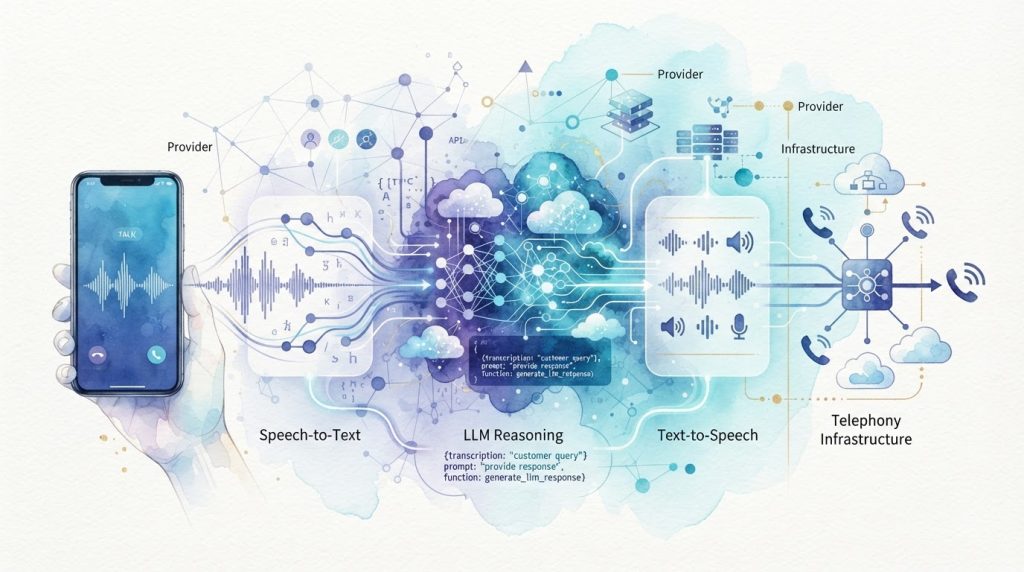
“Vapi gives developers control over the full voice AI stack, from speech recognition to the language model and voice.”
Vapi is a developer platform for building AI voice agents — the kind that can answer a support line, qualify a sales lead, or book an appointment over a real phone call. Rather than stitching together speech recognition, a language model, and text-to-speech yourself, Vapi orchestrates all three into one API. It’s popular with technical teams specifically because it doesn’t lock you into one vendor for any part of the stack. Here’s how it works, what it actually costs once every piece is added up, and who it’s really built for.
TL;DR — Vapi at a Glance
| What it is | Developer platform / API for building voice AI agents on phone calls or in-app |
| Made by | Vapi, founded 2020, Y Combinator W21 batch Confirmed |
| Founders | Jordan Dearsley and Nikhil Gupta |
| Based in | San Francisco |
| Core approach | “Bring your own stack” — mix and match STT, LLM, and TTS providers |
| Latency claim | Sub-500ms in optimal configurations Company claim |
| Base hosting fee | ~$0.05/minute, plus separate provider costs (STT, LLM, TTS, telephony) |
| Free trial | $10 in credit (roughly 150–200 minutes) |
| Best for | Technical teams building custom, high-control voice agents |
Jump to a section
- What is Vapi and who makes it?
- How does Vapi actually build a voice agent?
- What can you build with Vapi?
- What features make Vapi stand out?
- How much does Vapi actually cost?
- Is Vapi good for non-technical teams?
- How does Vapi compare to Retell AI and other alternatives?
- What are the limitations of Vapi?
- FAQ
What is Vapi and who makes it?
Vapi is a developer-first platform for building, testing, and deploying voice AI agents — assistants that can make or receive real phone calls, or run as an embedded live voice conversation inside a web or mobile app. It was founded in 2020 by Jordan Dearsley and Nikhil Gupta, went through Y Combinator’s Winter 2021 batch, and is based in San Francisco with a team of around 50 Confirmed.
The name comes directly from what the product is: every feature is accessible through its API, and that API-first design is the whole pitch. Instead of a closed, one-size-fits-all voice bot, Vapi positions itself as an orchestration layer that lets you plug in whichever speech, language, and voice providers you want at each stage of the conversation. Companies like Ring have moved their entire inbound call volume onto Vapi-built agents, reporting improved CSAT scores after switching from zero to full production in about two weeks Company-published case study.
How does Vapi actually build a voice agent?
A Vapi voice agent runs through three connected stages on every turn of the conversation:
- Listen (Speech-to-Text): Captured audio is sent to a transcription engine — Deepgram, AssemblyAI, Whisper, Azure, or Google — to turn speech into text in real time.
- Think (LLM): That transcript is fed into a prompt and processed by a language model of your choice — OpenAI, Anthropic, Google, or a custom endpoint — which decides how to respond.
- Speak (Text-to-Speech): The model’s reply is converted back into natural-sounding audio through a voice provider such as ElevenLabs, Cartesia, Rime AI, Azure, or Vapi’s own curated voice library.
Vapi’s job is tuning and orchestrating all three stages together — how quickly the assistant responds, how long it waits before speaking, how fast it detects when a caller interrupts — aiming for end-to-end response times as low as 1.9 seconds in typical use and under 500ms in tightly optimized setups Company claim. Telephony connections run through providers like Twilio, Vonage, Plivo, or Telnyx, or a bring-your-own SIP trunk for teams with existing infrastructure.
What can you build with Vapi?
Inbound support
Automate support calls with agents that pull from a knowledge base and escalate to a human when needed.
Outbound sales
Make outbound calls, qualify leads, and schedule appointments using branching conversation logic.
Appointment booking
Handle booking requests, check availability, and confirm appointments with conditional routing.
Healthcare scheduling
Emergency routing and appointment scheduling built to meet HIPAA compliance requirements.
Order & returns support
Order tracking, return processing, and customer support workflows over the phone.
In-app voice
Embed a live voice conversation directly inside a web or mobile app, not just over the phone line.
What features make Vapi stand out?
Model and provider flexibility
Vapi supports a wide range of providers at every stage: OpenAI, Anthropic, and Google for the LLM layer; ElevenLabs, Azure, Cartesia, and others for voice; Deepgram, Azure, and Google for transcription; and Twilio, Vonage, Plivo, Telnyx, or a custom SIP trunk for telephony. That adds up to hundreds of possible configurations, letting teams prioritize cost, speed, or quality differently for different use cases.
Voice and language coverage
Vapi reports support for 100+ languages and accents across its connected TTS providers, with fine-grained control over pitch, tone, speaking speed, and emotional expressiveness so an agent’s voice can match a brand’s personality.
Custom tools and integrations
Beyond built-in actions like booking appointments, an agent can call custom tools connected to external APIs or databases — raising an invoice, checking a CRM record, updating a project system. Vapi also integrates with 40+ apps including HubSpot, Notion, Zapier, and Clay.
Flow Studio, Blocks, and Squads
Flow Studio is a visual, drag-and-drop builder for mapping out conversation logic using modular pieces called Blocks. Squads take that further by letting multiple specialized agents work together — one qualifying leads, another handling scheduling — coordinated as a team rather than one monolithic assistant. Flow Studio helps sketch a conversation path, but complex logic still typically needs custom API calls underneath it Reviewer-reported.
CLI and enterprise infrastructure
A command-line tool brings the full platform into a developer’s terminal, and enterprise customers can deploy in a private VPC. Vapi reports SOC 2 Type II and HIPAA certification, with GDPR compliance also covered Confirmed.
How much does Vapi actually cost?
Vapi’s own hosting fee is only one piece of the total bill. Because of the bring-your-own-stack model, the real cost per minute comes from adding Vapi’s fee to whatever transcription, LLM, and voice providers you’ve connected Third-party cost breakdown:
| Cost component | Typical rate |
|---|---|
| Vapi hosting fee | ~$0.05/minute |
| Transcription (STT) | ~$0.01/minute |
| LLM processing | ~$0.02–$0.20/minute (model-dependent) |
| Voice generation (TTS) | ~$0.04/minute |
| Telephony | ~$0.01/minute |
| Estimated total | ~$0.13–$0.31+/minute |
New accounts get $10 in free credit, roughly 150–200 minutes of testing. Beyond the free tier, Vapi runs on pay-as-you-go pricing for smaller deployments and custom annual Enterprise contracts for larger ones, with one third-party estimate placing typical enterprise contracts around $40,000–$70,000 per year Estimate from a competitor’s review, not officially confirmed. HIPAA compliance reportedly adds a $1,000/month fee on the pay-as-you-go plan. Separately, Vapi has run a startup program offering approved applicants 90,000 free minutes (7,500 per month for 12 months) alongside dedicated Slack support Program details, eligibility applies.
Is Vapi good for non-technical teams?
Not really, at least not without support. Vapi is built for developers: configuring providers, webhooks, and custom tools requires comfort with APIs and code, and while Flow Studio adds a visual layer, it’s a guide for sketching conversation logic rather than a true no-code builder. Teams without in-house engineering capacity typically need outside help to get a production-ready agent running, or may be better served by a more guided, low-code platform built for business users rather than developers.
How does Vapi compare to Retell AI and other alternatives?
Vapi’s closest comparison point is Retell AI, which takes a more packaged, low-code approach with flatter, more transparent per-minute pricing (commonly cited around $0.07+/minute with fewer separate line items). The trade-off runs in the expected direction: Vapi’s bring-your-own-stack model gives more granular control over exactly which STT, LLM, and TTS providers power an agent, at the cost of more setup complexity and less predictable, multi-vendor billing. Broader automation platforms like Zapier or Gumloop sit in an adjacent category — useful for connecting a voice agent’s outputs into other business systems, but not built for real-time voice conversation itself.
| Aspect | Vapi | Retell AI |
|---|---|---|
| Pricing model | Multi-vendor (hosting + STT + LLM + TTS + telephony) | Flatter per-minute rate |
| Setup approach | Developer-first, API-driven | Low-code, faster initial setup |
| Provider flexibility | High — mix and match at each stage | More packaged/opinionated |
| Best fit | Teams with engineering resources wanting full control | Teams wanting speed with less technical overhead |
What are the limitations of Vapi?
- Pricing is genuinely complex. Total cost depends on which providers you choose at each stage, making upfront budgeting harder than a flat per-minute competitor.
- Requires real engineering capacity. Webhooks, custom tools, and multi-provider configuration are not beginner-friendly, even with the visual Flow Studio layer.
- Support is reportedly limited. Some users have described slow response times through email and Discord-based support channels rather than direct human support User-reported.
- Latency depends heavily on your configuration. The sub-500ms figure applies to optimized setups; poorly tuned provider combinations can introduce noticeably higher delays.
- Concurrency limits on lower tiers. Pay-as-you-go plans are commonly reported to cap around 10 concurrent calls, with higher volume requiring an Enterprise agreement.
Frequently Asked Questions
Is Vapi free to use?
New accounts get $10 in free credit, which typically covers about 150–200 minutes of testing before you need to add a payment method for continued use.
How much does Vapi cost per minute?
Vapi’s own hosting fee is about $0.05/minute, but once transcription, LLM, text-to-speech, and telephony provider costs are added, the realistic total lands closer to $0.13–$0.31+ per minute depending on which providers and models you choose.
Do I need to know how to code to use Vapi?
Yes, in practice. Vapi is built API-first for developers, and while it includes a visual flow builder, configuring providers, webhooks, and custom tools requires technical knowledge.
Who founded Vapi?
Vapi was founded in 2020 by Jordan Dearsley and Nikhil Gupta, and went through Y Combinator’s Winter 2021 batch. The company is based in San Francisco.
Is Vapi HIPAA compliant?
Vapi reports SOC 2 Type II and HIPAA certification along with GDPR compliance, though HIPAA compliance reportedly carries an additional monthly fee on pay-as-you-go plans.
What’s the difference between Vapi and Retell AI?
Vapi is a more flexible, developer-first platform that lets you mix and match speech, language, and voice providers, billed across multiple separate costs. Retell AI is more packaged and low-code, with a flatter, more predictable per-minute price.