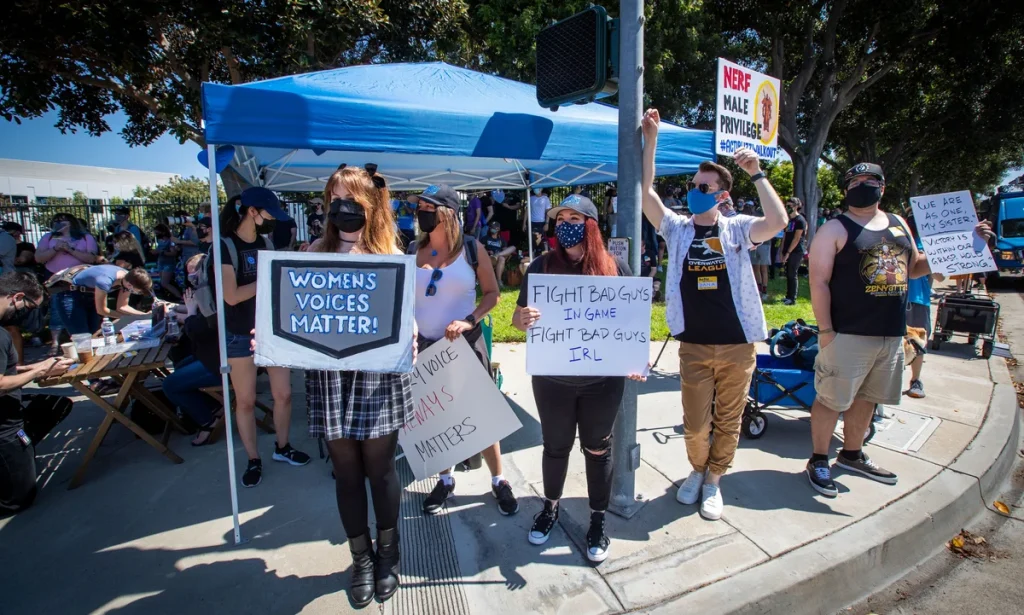
Five years after California sued the company for a “frat boy culture,” a former employee who spent 14 years inside Activision Blizzard has filed a new lawsuit accusing 10 men of harassment, physical assault, and inappropriate conduct. The $54 million settlement was supposed to fix this. It did not.
On September 11, 2026, the Los Angeles Times reported that a former Activision Blizzard employee had filed a lawsuit in Los Angeles Superior Court accusing 10 men of subjecting her to harassment, physical assault, inappropriate touching, and inappropriate comments during her 14-year tenure at the company. She says she reported the conduct to human resources. She says nothing was done. She says she was denied promotions and paid less than male counterparts. She is being represented by Lisa Bloom, the attorney who has built a career representing women in high-profile harassment cases against powerful institutions.
This is not 2021. This is now. And that is the problem.
Five years ago, on July 20, 2021, the California Department of Fair Employment and Housing sued Activision Blizzard, alleging a “pervasive frat boy workplace culture” where women were harassed, discriminated against, and retaliated against for speaking up. The lawsuit described cube crawls, groping, and rape jokes. It triggered walkouts, boycotts, executive resignations, and a $68.7 billion Microsoft acquisition that was almost derailed by the scandal. In December 2023, Activision Blizzard paid approximately $54 million to settle with California’s Civil Rights Department. The sexual harassment claims were withdrawn. The pay discrimination claims were settled. The company promised change.
Less than three years later, a woman who worked there for 14 years says the culture that California documented, the one that cost the company its reputation and its CEO, never actually went away.
The September 11 lawsuit: what we know
The lawsuit, filed in Los Angeles Superior Court and first reported by the Los Angeles Times, comes from a former employee who worked at Activision Blizzard for 14 years. The complaint accuses 10 men of misconduct that spans harassment, physical assault, inappropriate touching, and inappropriate comments. The plaintiff alleges she reported these incidents to human resources and was met with inaction. She further claims she was denied promotions and paid less than male colleagues doing comparable work.
The attorney representing her is Lisa Bloom, whose firm, The Bloom Firm, has handled numerous high-profile harassment and discrimination cases. Bloom’s involvement signals that this is not a minor grievance or a disgruntled ex-employee. It is a serious legal action by a lawyer who does not take losing cases.
The former employee, who said she worked for the company for 14 years, accuses 10 men of subjecting her variously to harassment, physical assault, inappropriate touching and inappropriate comments.
— Los Angeles Times, September 11, 2026The timing is impossible to ignore. Just two days before this lawsuit became public, on September 9, 2026, 1,900 Blizzard Entertainment workers voted to ratify a historic union contract with Microsoft, represented by the Communications Workers of America. The contract guarantees wage increases, workplace flexibility, and grievance procedures. It is a genuine victory for organized labor in games, and it happened at the same studio that is now, 48 hours later, back in court for harassment allegations. The juxtaposition is almost surreal: workers winning formal protections while another worker is suing because the informal protections, the HR reports, the basic human decency, apparently failed her for 14 years.
Activision Blizzard has not yet issued a detailed public response to this specific lawsuit. Based on the company’s history, that response will likely emphasize its commitment to a safe workplace, its post-settlement reforms, and its zero-tolerance policy. What it will be harder for the company to explain is how a 14-year employee could accuse 10 men of misconduct and still feel, upon leaving, that the system had failed her.
The $54 million question: what did the settlement actually change?
On December 15, 2023, the California Civil Rights Department announced that Activision Blizzard had agreed to pay approximately $54 million to resolve the lawsuit the state had filed two and a half years earlier. The bulk of that money, roughly $45 million, was earmarked for direct compensation to women who had been underpaid or denied opportunities at the company. Another $5 million was allocated for additional outreach and relief. The remaining funds covered administrative costs and future compliance monitoring.
Here is what the settlement did not do: it did not require Activision Blizzard to admit to a culture of sexual harassment. In fact, the sexual harassment claims were withdrawn as part of the agreement. The CRD walked back the core allegation that had made headlines worldwide: that Activision Blizzard maintained a “pervasive frat boy workplace culture” where women were subjected to constant harassment. What remained were pay discrimination and promotion bias claims, which, while serious, are not the same thing as acknowledging that men at the company assaulted and harassed their colleagues with impunity.
The settlement’s central bargain: Activision Blizzard paid $54 million, and in exchange, the state of California stopped saying it had a sexual harassment problem. The money compensated victims of pay discrimination. It did not, legally speaking, validate the harassment allegations that had sparked walkouts, congressional scrutiny, and a corporate reckoning. That distinction matters enormously, because it allowed the company to tell investors, employees, and players that the worst claims had been resolved without admission of wrongdoing.
The settlement also included commitments to workplace reforms. Activision Blizzard agreed to hire an internal compliance officer, improve HR processes, enhance pay equity monitoring, and submit to external oversight. These are real measures. They are also the same measures that corporations agree to in virtually every major employment settlement, and they are only as effective as the company’s willingness to enforce them.
What the settlement could not do, because no legal agreement can, is rebuild trust in a culture where women felt unsafe reporting misconduct. If the September 11 lawsuit’s allegations are true, and a 14-year employee reported harassment and assault to HR without meaningful action, then the settlement’s reforms failed at the most basic level. A compliance officer, a pay audit, and a diversity dashboard do not protect a woman from the man sitting next to her. Only a culture that believes women and punishes abusers does that. And that is the thing money cannot buy.
The five-year timeline: from cube crawls to court, again
To understand why this new lawsuit lands with such force, you have to remember how much has supposedly happened since 2021. The timeline is staggering.
| Date | Event | What Was Promised |
|---|---|---|
| July 2021 | California DFEH files lawsuit alleging “frat boy culture,” harassment, discrimination | Nothing yet; the company initially called the allegations “distorted” |
| July 2021 | Employees walk out; players boycott; in-game protests in WoW | Worker demands for third-party audit, end to forced arbitration |
| Sept 2021 | EEOC settlement: $18 million fund for harassment victims | Compensation and policy reforms |
| Oct 2021 | Bobby Kotick tells colleagues he would consider resigning if issues not fixed quickly | Leadership accountability |
| 2022 | Multiple executives resign; Blizzard president J. Allen Brack departs | Removal of leaders who enabled toxic culture |
| Oct 2023 | Microsoft completes $68.7 billion acquisition | Phil Spencer promises culture change and new oversight |
| Dec 2023 | $54 million CRD settlement; harassment claims withdrawn | Pay equity, compliance officer, external monitoring |
| End of 2023 | Bobby Kotick departs as CEO | Removal of the executive most associated with the scandal |
| March 2026 | New lawsuit from current employee alleging discrimination and retaliation | Nothing; the company had already settled |
| Sept 2026 | 1,900 Blizzard workers ratify union contract with Microsoft | Collective bargaining, grievance protections, wage guarantees |
| Sept 11, 2026 | 14-year employee sues, accusing 10 men of harassment and assault | Apparently, nothing had changed enough |
Look at that timeline. Five years. Two major settlements. An acquisition by the second-largest company on Earth. Executive departures. A union contract. And still, a woman who spent 14 years at the company feels the only way to be heard is through a lawsuit accusing 10 men by name.
The problem with corporate reform is that it is always forward-looking. New policies apply to new incidents. Old behaviors are settled, compensated, and legally buried. But the people who lived through the old culture do not disappear when the settlement check clears. They carry the memory of what was tolerated, what was ignored, and who was protected. If this lawsuit describes conduct that happened during the reform era, after the walkouts and the settlements and the promises, then the reforms were theater. If it describes conduct that happened before the reforms but was only now reported, then the reforms arrived too late for the people who needed them most. Either way, the timeline tells a story that Activision Blizzard does not want told: the scandal ended in the headlines before it ended in the workplace.
Microsoft’s acquisition: the culture change that wasn’t
When Microsoft acquired Activision Blizzard for $68.7 billion in October 2023, Xbox chief Phil Spencer sent an internal memo welcoming employees and promising a new chapter. The subtext was clear: the toxic culture that had nearly derailed the acquisition would not survive under Microsoft’s ownership. Bobby Kotick, the CEO who had become the public face of the scandal, was given until the end of 2023 to transition out. New leadership would clean house. New policies would replace old habits. A trillion-dollar technology company would not tolerate what a mid-sized game publisher had normalized.
It was a compelling narrative. It was also, like many acquisition promises, more aspiration than reality.
In the years since the acquisition, Microsoft has faced its own labor reckoning. In July 2026, Microsoft laid off approximately 3,200 gaming division workers across Xbox, Bethesda, and Activision Blizzard, including teams working on Fallout, Elder Scrolls, and Halo. Former Bethesda executive Pete Hines described watching the company get “systematically dismantled” post-acquisition, saying Bethesda was “damaged, abused” under Microsoft’s ownership. The layoffs triggered “Save Our Devs” marches and widespread criticism that Microsoft’s promises of investment had turned into extraction.
This matters for the harassment story because labor is labor. A company that will fire 3,200 people to please shareholders is not a company that has fundamentally reoriented its values toward worker wellbeing. Microsoft’s gaming division is under pressure to justify the Activision acquisition’s enormous cost. That pressure creates incentives to minimize liability, control narratives, and treat workplace complaints as PR problems rather than human problems. The union contract ratified on September 9 is a genuine counterweight to that pressure, but it covers 1,900 Blizzard workers, not the entire Activision Blizzard workforce, and it does not erase the years of alleged inaction that preceded it.
The September 11 lawsuit is, in part, a test of whether Microsoft’s ownership changed anything that mattered. If the plaintiff reported harassment to HR during the Microsoft era and was ignored, then the acquisition’s culture promises were empty. If the conduct happened before Microsoft took over but the plaintiff is only now able to come forward, then the acquisition may have given her the security, financial or emotional, to speak. The lawsuit does not specify exact dates for all alleged incidents, but the 14-year tenure means the conduct spans the pre-scandal, scandal, settlement, and post-acquisition periods. The entire arc of Activision Blizzard’s supposed redemption is contained within her career.
The Kotick legacy: what the former CEO knew and when
No discussion of Activision Blizzard’s harassment crisis is complete without addressing Bobby Kotick, the CEO who led the company from 1991 until the end of 2023 and became the public symbol of its failures. Kotick did not create the toxic culture at Activision Blizzard, but he presided over it, defended it, and according to multiple reports, actively worked to minimize its exposure.
In 2025, Kotick made the extraordinary claim that the harassment lawsuits and employee petitions against the company were “fake.” The ABetterABK worker group responded immediately and forcefully, with members stating that “the executives of our company did not protect us” and that the harassment and discrimination were “real and worsened by leadership’s inaction.” The claim was so brazen that it drew coverage across the industry, serving as a reminder that Kotick’s departure from the CEO role did not represent a change in his personal view of the scandal.
Wall Street Journal reporting documented that Kotick had known about misconduct allegations at the company for years and had personally held back the public release of numbers showing how many employees had been fired or disciplined. According to VG247’s reporting on the Journal’s findings, three dozen employees had been terminated, but the full scope was never disclosed because Kotick prevented it. The EEOC settlement, the CRD settlement, and the executive resignations all happened while Kotick was still in charge. He left with a massive payout and a board statement praising his leadership. The workers who accused the company of failing them got settlements that did not require the company to admit the worst of what they alleged.
The September 11 lawsuit does not name Kotick. It names 10 men who allegedly harassed and assaulted one woman. But the conditions that allowed those 10 men to operate, if the allegations are true, were created by a leadership structure that prioritized liability control over worker safety. Kotick was the apex of that structure. His departure removed a symbol. It did not, by itself, rebuild a culture.
The pattern that won’t die: new lawsuits, same story
The September 11 lawsuit is not an isolated incident. It is part of a pattern of post-settlement allegations that suggests the problem was never just a few bad actors or a single era of mismanagement.
In March 2026, a current Activision Blizzard employee filed a separate lawsuit alleging discrimination, sexual harassment, and retaliation for speaking out. That plaintiff claimed they were punished for reporting misconduct, a particularly damning allegation because retaliation is explicitly illegal and explicitly something the company’s post-settlement reforms were supposed to prevent.
In November 2025, a senior QA employee publicly alleged harassment by company leadership on multiple occasions, reigniting concerns that the culture had not fundamentally changed.
In June 2026, VG247 reported on new findings that Activision had held back “damning numbers” about workplace misconduct, with CEO Kotick personally preventing the disclosure of how many employees had been fired or disciplined for harassment and discrimination.
Each of these incidents, taken alone, could be dismissed as an outlier. Together, they form a drumbeat. The settlement did not end the problem. The acquisition did not end the problem. The executive departures did not end the problem. The only thing that has genuinely changed is that workers now have a union at Blizzard, which means the next woman who is harassed might have a collective bargaining agreement to protect her instead of just an HR department that reports to the same executives who enabled her abuser. That is not nothing. But it is also not justice for the woman who spent 14 years inside a system that allegedly failed her repeatedly.
The player question: what does this mean for the people who keep buying the games?
This is the uncomfortable part. Because if you are reading this, there is a decent chance you bought Call of Duty last year. Or Diablo 4. Or you are planning to buy the next World of Warcraft expansion. And you are probably wondering whether you are supposed to feel bad about that.
The honest answer is: it is complicated, and anyone who tells you otherwise is selling certainty they do not possess.
In July 2021, when the first lawsuit broke, players organized boycotts. World of Warcraft subscribers staged in-game protests. Call of Duty players urged each other to stop buying skins and bundles. The hashtag #ActiBlizzWalkout trended. And then, within months, Diablo 4 became one of the best-selling games of 2023. Call of Duty remained the annual top-seller. World of Warcraft kept releasing expansions. Bobby Kotick himself noted, in a 2022 interview, that the delays of Overwatch 2 and Diablo 4 had affected the stock price more than the abuse scandal.
The delays of Overwatch 2 and Diablo 4 had more of an impact on Activision Blizzard’s share price than the ongoing allegations of abuse and harassment.
— Bobby Kotick, Activision Blizzard CEO, 2022 interview with GamesIndustry.bizLet that sink in. The CEO of a company facing a landmark harassment lawsuit, congressional scrutiny, and employee walkouts looked at his own stock chart and concluded that players cared more about release dates than they did about whether women at his company were safe. And the market proved him right.
This is not a moral failing unique to Activision Blizzard players. It is how consumer capitalism works. The live-service ecosystems we investigated last month are designed to create sunk-cost fallacies that make walking away feel like losing progress. The EA monetization reversals we documented show how publishers test player tolerance and retreat only when the backlash threatens revenue. The Marathon death watch and 2XKO autopsy both illustrate how player investment in brands transcends the companies’ behavior toward the people who make them. Players do not stop loving games because the people who made them were hurt. The attachment is to the product, not the production.
But there are choices within that complexity. You can buy used, depriving the publisher of a new sale. You can wait for deep discounts, reducing the revenue per purchase. You can support the workers directly by amplifying their voices, donating to labor organizations like the CWA, and paying attention to which studios treat their people well. You can choose not to pre-order, not to buy battle passes, and not to participate in the whale economy that funds these companies’ worst impulses. You can recognize that ethical consumption under capitalism is nearly impossible but still try to be less complicit than the default setting.
The workers who walked out in 2021 did not ask players to stop playing their games. They asked players to stand with them. The ABetterABK group has consistently framed the issue as solidarity, not boycott. The union contract ratified on September 9 is a tool those workers built to protect themselves, because the legal system and the corporate HR apparatus did not. Players who want to honor that work should listen to what those workers ask for, which is visibility, support, and pressure on management, not performative guilt about enjoying Call of Duty with friends on a Friday night.
The verdict: what changed, what didn’t, and what happens now
What changed
Some things genuinely did change. Bobby Kotick is gone. A compliance officer exists. Pay equity audits happen. The EEOC and CRD settlements created funds that compensated some victims. The Blizzard union contract is a historic win that gives 1,900 workers collective bargaining power for the first time in the company’s history. External oversight exists where there was none before. These are not trivial developments.
What didn’t change
The culture that allowed harassment to persist, that made HR a liability shield instead of a worker advocate, that promoted men who abused their power and moved women who reported them sideways, does not disappear because a settlement was signed. A woman who worked at the company for 14 years says she reported harassment and assault and nothing was done. That is not a policy problem. That is a people problem, a trust problem, and a power problem. Policies do not fix those. Only accountability does, and accountability requires more than a check and a press release.
What happens now
The lawsuit will proceed through discovery, depositions, and potentially trial. Activision Blizzard will likely seek to settle, as it has in every previous case, because trials create public records and public records create more lawsuits. The company will issue statements about its commitment to safety. Workers will watch to see if the statements match the reality. Players will keep buying the games, because that is what players do, and because the games are designed to be hard to quit.
But the union contract changes the math. For the first time, Blizzard workers have a formal grievance process that does not depend on HR’s willingness to believe them. If the September 11 lawsuit describes conduct that is still happening, the next victim might have a union steward in the room when she reports it. That is not justice for the woman who spent 14 years without one. But it is a wall against the future that did not exist before. And walls, once built, are harder to tear down than settlements are to sign.
The question for Activision Blizzard, for Microsoft, and for the industry is whether that wall gets built everywhere, or whether Blizzard’s union remains an island in a company that has spent five years proving it cannot protect its workers without external force. The Bungie autopsy we published earlier this year showed what happens when a celebrated studio’s internal culture curdles. The Amazon Game Studios exit showed what happens when corporate leadership treats game development as a spreadsheet exercise. Activision Blizzard is bigger than both, more entrenched than both, and more profitable than both. That makes it harder to change. It also makes the cost of failing to change higher, because more people work there, more people play there, and more people are watching.
Frequently Asked Questions
A former Activision Blizzard employee who worked at the company for 14 years filed a lawsuit in Los Angeles Superior Court accusing 10 men of harassment, physical assault, inappropriate touching, and inappropriate comments. The plaintiff, represented by attorney Lisa Bloom, alleges she reported the conduct to human resources and nothing was done. She also claims she was denied promotions and paid less than male counterparts. The lawsuit was first reported by the Los Angeles Times on September 11, 2026.
Yes, but with important caveats. In December 2023, Activision Blizzard paid approximately $54 million to settle with California’s Civil Rights Department. However, the sexual harassment claims were withdrawn as part of the settlement. The agreement resolved pay discrimination and promotion bias claims but did not require the company to admit to a culture of sexual harassment. The settlement included workplace reforms and external oversight, but the new lawsuit suggests those measures were insufficient for at least one long-term employee.
On July 20, 2021, California’s Department of Fair Employment and Housing (now the Civil Rights Department) sued Activision Blizzard, alleging a “pervasive frat boy workplace culture” where women were subjected to sexual harassment, discrimination, and retaliation. The lawsuit described “cube crawls” where male employees drank heavily and harassed female colleagues, groping, unequal pay, and a leadership structure that ignored or minimized complaints. It triggered employee walkouts, player boycotts, and congressional scrutiny.
When Microsoft acquired Activision Blizzard for $68.7 billion in October 2023, Xbox chief Phil Spencer sent an internal memo welcoming employees and promising a new chapter with improved workplace culture and oversight. Bobby Kotick was given until the end of 2023 to transition out as CEO. However, in the years since, Microsoft has faced its own labor criticism, including major layoffs of 3,200 gaming workers in July 2026. Former Bethesda executive Pete Hines described Microsoft as having “damaged” and “abused” Bethesda’s culture post-acquisition.
According to Wall Street Journal reporting, Kotick knew about misconduct allegations at the company for years and personally held back the public release of numbers showing how many employees had been fired or disciplined. In 2025, Kotick claimed the harassment lawsuits and employee petitions were “fake,” a statement that was immediately rejected by worker groups including ABetterABK. Kotick departed as CEO at the end of 2023 with a substantial payout.
On September 9, 2026, just two days before the new harassment lawsuit was reported, 1,900 Blizzard Entertainment workers ratified a historic union contract with Microsoft, represented by the Communications Workers of America (CWA). The contract guarantees wage increases, workplace flexibility, and formal grievance procedures. It is one of the largest union contracts in the video game industry and represents a significant shift in worker power at the studio.
Yes. In March 2026, a current employee filed a lawsuit alleging discrimination, sexual harassment, and retaliation for speaking out. In November 2025, a senior QA employee publicly alleged harassment by leadership on multiple occasions. In June 2026, reports emerged that Activision had held back data about workplace misconduct, with Kotick personally preventing disclosure of disciplinary numbers. These incidents suggest the problem persisted beyond the settlement period.
That is a personal decision, but the historical record suggests boycotts have had limited impact on the company’s bottom line. In 2021, player boycotts and in-game protests did not prevent Diablo 4 or subsequent Call of Duty titles from becoming massive commercial successes. Bobby Kotick himself noted that game delays affected the stock price more than the scandal. Worker groups have generally asked for solidarity and pressure on management rather than performative boycotts. Players who want to engage ethically can support worker organizations, avoid pre-orders and premium monetization, buy used when possible, and amplify worker voices rather than simply abstaining from games they enjoy.
ABetterABK (A Better Activision Blizzard King) is a worker organization formed by Activision Blizzard employees in response to the 2021 harassment scandal. The group has organized walkouts, petitioned for policy changes, and publicly challenged company leadership, including Bobby Kotick’s claim that harassment lawsuits were “fake.” ABetterABK has been a leading voice in advocating for worker protections, third-party audits, and an end to forced arbitration.
The lawsuit will proceed through the California court system. Activision Blizzard will likely file a response denying the allegations or seeking to move the case to arbitration. Discovery will follow, with both sides exchanging evidence and depositions. Given the company’s history, a settlement is possible before trial, as trials create public records that can generate additional litigation. The plaintiff is represented by Lisa Bloom of The Bloom Firm, indicating a serious and well-resourced legal challenge.
In the short term, the scandal contributed to executive departures, delayed the Microsoft acquisition timeline due to regulatory scrutiny, and generated significant negative press. However, the long-term commercial impact was limited. Call of Duty remained a top-selling annual franchise. Diablo 4 was a massive commercial success. World of Warcraft continued releasing expansions. The company’s stock price was more affected by game delays than by the scandal itself, according to Kotick’s own assessment. The business of making games proved more resilient than the ethics of making them.