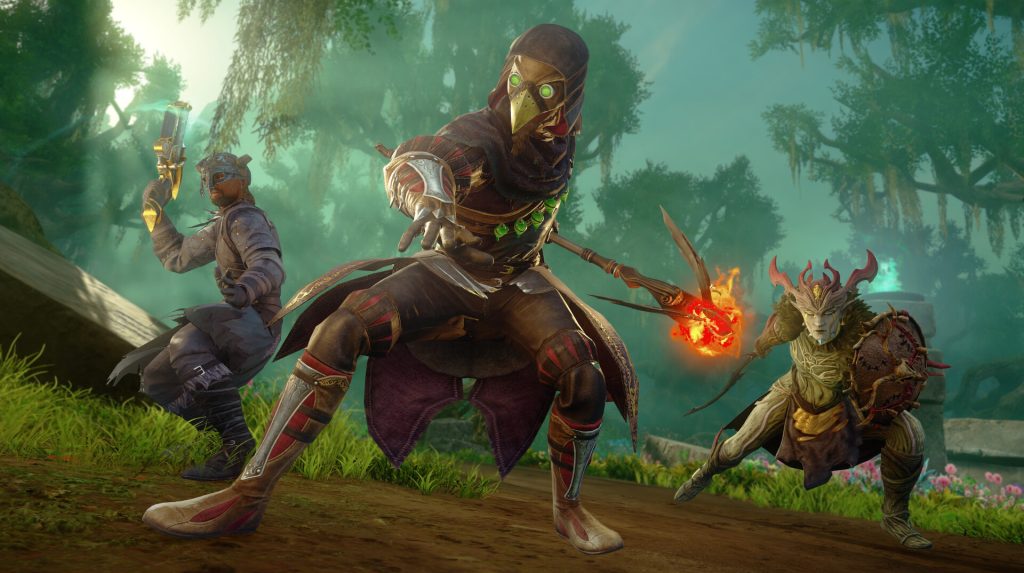
How the richest company in gaming history launched three of the biggest MMORPGs ever seen, watched them all collapse, and finally walked away. The full portfolio autopsy: Breakaway, Crucible, New World, Lost Ark, Throne and Liberty, and the pattern that killed them all.
On August 12, 2026, Amazon Game Studios did something that would have been unthinkable five years ago. In a pair of near-simultaneous announcements, the company declared it was handing Lost Ark back to Smilegate and Throne and Liberty back to NC, effectively exiting the MMORPG market entirely. The only MMORPG Amazon actually owned, New World, had already faded into irrelevance. After a decade, billions of dollars, and some of the most spectacular launch numbers the genre has ever seen, Amazon had nothing left.
This is not a story about bad games. New World peaked at 913,000 concurrent Steam players. Lost Ark hit 1.3 million. Throne and Liberty reached 333,000. Together, they represent three of the biggest MMORPG launches in Steam history. Amazon did not fail because it could not attract players. It failed because it could not keep them. And more importantly, it failed because it kept making the same mistakes across three different games, two different business models, and partnerships with two different Korean studios.
This is the full autopsy of Amazon Game Studios’ MMORPG decade: what they promised, what they shipped, how they monetized, and why they kept killing their own games.
The prehistory: Breakaway and Crucible
Before Amazon ever touched an MMORPG, it had already established a pattern. In 2016, Amazon Game Studios announced a trio of ambitious PC titles built around Twitch integration: New World, Crucible, and Breakaway. The message was clear: Amazon was not dipping a toe into gaming. It was building a platform.
Breakaway was a 4v4 “esport brawler” that Amazon pitched with a live tournament on a 355-foot naval patrol ship. It was cancelled in 2018 before it ever reached a meaningful public release. The team claimed they were “setting a very high bar.” The reality was simpler: the game was not fun enough to justify continued investment.
Crucible was worse. Amazon’s first major original release, a free-to-play third-person shooter, launched in May 2020 to near-total silence. Player counts cratered within weeks. In June, Amazon “un-released” the game, pulling it back into closed beta in a move so bizarre it became industry shorthand for corporate panic. By October, Crucible was dead. It had lasted five months from launch to cancellation, four of them in a state of public beta purgatory.
The pattern begins here: Amazon does not cancel games because they are bad at launch. Amazon cancels games because it does not know what to do with them after launch. The company that can optimize global logistics cannot optimize a live service.
Between Crucible’s death and New World’s launch, Amazon also quietly killed its Western publishing deal for Blue Protocol, the anime MMORPG from Bandai Namco. It was a mercy killing, perhaps, but it was also another data point in a growing trend. Amazon Game Studios was very good at announcing games and very bad at keeping them alive.
Game One: New World and the 913,000-player mirage
New World launched on September 28, 2021, and for one glorious week, it looked like Amazon had finally cracked the code. 913,027 concurrent players on Steam. Over a million at peak across all platforms. Queue times measured in hours. Streamers fighting to get into Aeternum. The game was beautiful, the combat was satisfying, and the territory control system felt genuinely novel. For a moment, it seemed like Amazon had built the first true next-generation MMORPG.
The problems emerged almost immediately. At launch, New World allowed players to duplicate gold through a simple trading post exploit. Endgame content was thin: a handful of expeditions, repetitive elite zones, and a crafting system that funneled everyone into the same material bottlenecks. The PvP territory war system, which was supposed to be the game’s unique selling point, devolved into off-peak timezone captures by the largest guilds. Wars were scheduled at times convenient for the defending company, meaning most players never got to participate in the game’s central competitive feature.
What Amazon promised vs. what players got
| The Promise | The Reality |
|---|---|
| A living, player-driven economy | Gold dupes, inflation spirals, and a broken trading post |
| Meaningful PvP territory control | Wars scheduled by defenders, off-peak captures, elite guild dominance |
| Deep, rewarding crafting | Material bottlenecks and a grind that felt like a second job |
| Rich endgame PvE | Five expeditions and elite zone zergs |
| A world that evolves | Months between meaningful content updates |
The player exodus was brutal and well-documented. Within three months, New World had lost over 75% of its peak concurrent players. By six months, it was below 20,000. The Steam review score settled into “Mixed” territory and never recovered. Amazon tried everything: server merges, new weapons, new zones, a raised level cap, a seasonal model. Nothing moved the needle meaningfully.
The Aeternum relaunch: a second chance squandered
In October 2024, Amazon attempted what is rarely attempted in MMORPGs: a full relaunch. New World: Aeternum was not just an expansion. It was a rebranding, a console port, a mechanical overhaul, and a narrative reset. New voice acting. New storylines. New solo scaling. PlayStation 5 and Xbox Series X/S versions. This was Amazon’s Final Fantasy XIV moment, or so they hoped.
It was not Final Fantasy XIV. Reviews remained stubbornly “Mixed” at 67% positive. Veterans felt betrayed by systems changes that invalidated their years of progress. Console players found a game that still felt like a PC port from 2021. And the fundamental problem, that there was simply not enough compelling content to justify an ongoing subscription to your time, remained unaddressed.
By August 2026, New World: Aeternum sits at roughly 423 concurrent players on Steam with a 24-hour peak of 545. From 913,000 to 545. That is not a decline. That is erasure. The game has lost 99.95% of its peak Steam audience. And unlike Lost Ark or Throne and Liberty, there is no Korean developer waiting to take New World back. It is Amazon’s corpse to bury.
Game Two: Lost Ark and the bot apocalypse
Lost Ark should have been Amazon’s redemption story. Unlike New World, which Amazon developed internally, Lost Ark was a proven product. Smilegate’s action MMORPG had been running successfully in Korea since 2019, refining its systems, building its endgame, and establishing itself as one of the most polished ARPGs ever made. Amazon’s job was not to build the game. It was to publish it in the West, run the servers, manage the community, and keep the bots out.
On February 11, 2022, Lost Ark launched on Steam and hit 1,325,305 concurrent players. It was the second-biggest launch in Steam history at the time, behind only PUBG. The action combat was sensational. The class variety was deep. The horizontal progression systems, collectible hunting, and island exploration gave players hundreds of hours of content before they ever touched the controversial gear honing system. For the first month, it felt like Amazon had finally done something right.
The bot problem
Then the bots arrived. Not dozens. Not hundreds. Millions. Lost Ark’s free-to-play model, its gold-based economy, and its lack of meaningful account verification at launch created the perfect environment for automated farming. Bots filled every starting zone. They clogged dungeon queues. They flooded the auction house with illegally obtained gold, crashing prices for legitimate players and inflating the cost of everything that mattered.
Amazon’s response was slow, then inadequate, then farcical. In March 2022, the company banned “over a million” accounts. The bot population barely dipped. In 2023, another wave of bans hit inactive accounts, some belonging to legitimate players who had simply taken a break. The community was outraged. By March 2025, Amazon was issuing statements about “recent ban waves” that had removed hundreds of thousands more accounts. In March 2026, Amazon acknowledged the “frustration within the community” and announced it had permanently banned “several million” bot accounts over the game’s lifetime.
Lost Ark still has a bot problem, publisher Amazon Games has admitted. In a blog post acknowledging the continued issue and the ongoing “frustration within the community” it said it had felt too, Amazon announced it had permanently banned “several million accounts.”
— Eurogamer, March 2026, four years after launchThink about that timeline. Four years. Several million bans. And bots were still a problem significant enough that Amazon had to publicly acknowledge it in a farewell-adjacent blog post. This is not a technical failure. It is a operational failure so comprehensive it becomes a moral one. When your players cannot log into a starting city without wading through armies of identical berserkers auto-running the same path for four years, you are telling those players that their experience does not matter as much as your margin.
Monetization and the honing wall
The bot problem was compounded by Lost Ark’s monetization, which Amazon inherited from Smilegate but was responsible for communicating and contextualizing to a Western audience. The gear honing system, which required players to spend gold and materials to upgrade equipment with a chance to fail, was controversial in Korea and became radioactive in the West. Players who had enjoyed hundreds of hours of horizontal content suddenly hit a vertical wall where progression slowed to a crawl without either extreme grinding or real-money purchases.
Amazon’s communication around this was consistently poor. When the Western version launched without certain quality-of-life features present in the Korean client, players accused Amazon of deliberately creating a more grind-heavy experience to drive microtransaction sales. Whether this was true or not, the perception took hold. And in free-to-play games, perception is the economy.
By August 2026, Lost Ark’s Steam concurrent count averages around 5,300 with a 24-hour peak of roughly 6,700. From 1.3 million. That is a 99.5% collapse. And the final indignity: Amazon announced it is handing Western operations back to Smilegate in early 2027 and merging the remaining servers down to just five. Five servers for a game that once had 1.3 million concurrent players. The symbolism is almost too perfect.
Game Three: Throne and Liberty and the pay-to-win trap
Throne and Liberty launched on October 1, 2024, and once again, the numbers were extraordinary. 333,393 concurrent players on Steam at peak. NC’s Unreal Engine-powered MMORPG was gorgeous, ambitious, and positioned as the spiritual successor to Lineage. Amazon had learned from Lost Ark, surely. This time, the publisher would get it right.
It did not. Within four months, Throne and Liberty had lost roughly 90% of its players. By July 2025, it was down 95%. By August 2026, the game hovers around 5,000 concurrent players with a 24-hour peak of roughly 7,000. The Steam reviews sit at 68% “Mixed,” with recent reviews dipping into truly negative territory.
What went wrong?
The problems were different from Lost Ark’s but no less fatal. Where Lost Ark was killed by bots and a progression wall, Throne and Liberty was strangled by its own monetization and systems design. The game was aggressively free-to-play on the surface and punishingly pay-to-advance at its core. The Rune system, which allowed players to enhance gear through randomized upgrades, became a focal point of community rage. Daily contracts felt like a checklist rather than an adventure. Guild schedules became mandatory rather than optional. The game asked for your time, your money, and your social availability, and offered diminishing returns on all three.
Throne and Liberty’s Core Complaints
- Aggressive pay-to-win mechanics: The Rune system and enhancement model heavily favored paying players.
- Excessive gear grind: Progression felt unrewarding and time-gated rather than skill-based.
- Repetitive daily loops: Contracts became a chore checklist instead of engaging content.
- Guild-enforced schedules: PvP and siege content required rigid time commitments.
- Hollow world design: Gorgeous visuals could not disguise shallow systems.
- Server cuts without cheaters: Cost-cutting measures removed servers, harming legitimate players.
Amazon’s handling of the Western version compounded these issues. The publisher cut servers in early 2026 in a cost-saving measure that disproportionately affected PlayStation 5 players. The community felt, with justification, that Amazon was managing decline rather than investing in recovery. When a publisher starts removing infrastructure from a one-year-old MMORPG, players understand exactly what message is being sent.
On August 12, 2026, Amazon announced that Throne and Liberty would transition to NC by the end of Q4 2026. The announcement was polite, corporate, and utterly damning. Amazon had given up on its newest MMORPG before it had even reached its second anniversary.
The August 12, 2026 announcement: Amazon’s quiet surrender
The dual announcements on August 12 were masterpieces of corporate euphemism. Lost Ark’s blog post spoke of “transitioning live service operations” after “nearly five years of shared adventures.” Throne and Liberty’s announcement described a “transition from Amazon Game Studios to NC by end of Q4 2026.” Neither post used the words “failure,” “exit,” or “giving up.” But the message was unmistakable.
Amazon Game Studios, the division that Jeff Bezos reportedly told to “win at games,” had lost every MMORPG it ever touched. New World: dead. Lost Ark: handed back. Throne and Liberty: handed back. Blue Protocol: cancelled before launch. The only remaining question was whether Amazon would try a different genre or finally admit that live-service game publishing might not be something you can solve with AWS infrastructure and A/B testing.
Amazon has just ghosted its MMOs in its latest move to give up on gaming.
— Destructoid, August 12, 2026The timing was particularly brutal for Lost Ark players. Amazon’s announcement came alongside news of a final server merge down to five total servers. Players who had stayed loyal through years of bot plagues, ban waves, and monetization controversies were now being told that their publisher was leaving before their game was. Smilegate taking over may ultimately be better for the Western version, but the manner of the handoff, announced in the same breath as server consolidation, felt less like a transition and more like a retreat.
What is the pattern? Three games, one failure mode
Amazon’s MMORPG collapse is not a story about three unlucky games. It is a story about one company that never learned how to operate live services at the human level. The pattern is consistent across New World, Lost Ark, and Throne and Liberty:
1. Amazon treats launch as the finish line, not the starting line
All three games had extraordinary launches. Amazon is exceptional at marketing, platform placement, and generating day-one buzz. What it cannot do is sustain. New World’s endgame was empty within weeks. Lost Ark’s bot problem was allowed to fester for years. Throne and Liberty’s monetization was not adjusted despite months of community feedback. In each case, the post-launch operation was an afterthought.
2. Amazon does not solve problems, it manages their optics
Consider the bot issue. Amazon did not ignore it. The company issued ban waves, posted updates, and acknowledged “frustration.” But it never solved it. The same bots, the same gold farmers, the same auction house manipulation continued for four years because Amazon’s approach was reactive and public-facing rather than structural. When your anti-bot strategy is measured in press releases rather than player experience, you are not running a live service. You are running a PR campaign with a game attached.
3. Amazon’s monetization philosophy alienates its core audience
New World was buy-to-play with a cash shop that felt increasingly necessary as the economy broke. Lost Ark was free-to-play with a honing system that pushed players toward real-money solutions at endgame. Throne and Liberty was free-to-play with a Rune enhancement system widely described as pay-to-win. In all three cases, the monetization model created friction between what players wanted to do and what the game allowed them to do without paying. The richest company in the world kept making players feel like they were being squeezed.
4. Amazon’s corporate culture is incompatible with MMORPG community management
MMORPGs are not products. They are relationships. They require publishers to listen, adapt, apologize, and occasionally sacrifice short-term revenue for long-term trust. Amazon’s corporate culture, optimized for efficiency metrics and quarterly targets, struggles with the messy, emotional, unpredictable reality of community management. When Lost Ark players screamed about bots for four years, Amazon responded with the pace of a company that had other priorities. Because it did. Amazon Game Studios was never important enough to Amazon to get the resources and attention that live services demand.
5. Amazon overestimates its own competence
This is the deepest pattern. Amazon believed that its technical infrastructure, its data analytics, and its platform power would translate into gaming success. They did not. Running a global e-commerce platform and running a live-service MMORPG require different skills, different patience, and different values. Amazon’s assumption that it could apply its general corporate excellence to a specialized creative industry led directly to a decade of failures.
The full Amazon Game Studios graveyard
| Game | Status | What Happened |
|---|---|---|
| Breakaway | Cancelled 2018 | Esport brawler cancelled before meaningful release |
| Crucible | Cancelled 2020 | “Un-released” after 1 month, killed after 5 months |
| New World | Effectively dead | 913K peak to ~400 current; Aeternum relaunch failed |
| Blue Protocol | Cancelled (West) | Western publishing deal killed before launch |
| Lost Ark | Handed back 2027 | 1.3M peak to ~5K current; bot plague; 5 servers remain |
| Throne and Liberty | Handed back Q4 2026 | 333K peak to ~5K current; pay-to-win backlash |
That is six major gaming initiatives across eight years. Zero enduring successes. One internal development that collapsed. Two Korean partnerships that ended in retreat. One cancelled Western localization. And one shooter so mishandled it became a verb in game development circles: “to Crucible” something is to panic-un-release it.
What happens now?
For the games themselves, the future is mixed. Smilegate taking direct control of Lost Ark’s Western operations may actually improve things. The Korean developer understands its own game better than Amazon ever did, and without a publisher middleman, decisions about content pacing, monetization, and bot prevention may happen faster and more effectively. NC taking over Throne and Liberty similarly removes a layer of corporate abstraction. Whether either game can recover from years of damage is uncertain, but the handoff is not inherently bad for players.
For Amazon, the question is whether it learns or repeats. The company still operates games. It still has resources that dwarf almost any other publisher. But its track record suggests a fundamental mismatch between Amazon’s corporate DNA and the requirements of live-service gaming. You cannot A/B test community trust. You cannot machine-learn your way out of a bot apocalypse. You cannot optimize a relationship.
The tragedy of Amazon’s MMORPG decade is that the company had everything it needed to succeed except the one thing that mattered: the willingness to treat players as humans rather than metrics. New World, Lost Ark, and Throne and Liberty did not die because they were bad games. They died because their publisher kept making the same mistake, over and over, across three different titles, two different business models, and nearly a decade of opportunities to learn.
For players looking for MMORPGs that are actually being cared for by their publishers, the landscape is not as bleak as Amazon’s exit suggests. Games like Final Fantasy XIV, Guild Wars 2, and Old School RuneScape continue to demonstrate that the genre works when the relationship between developer and community is treated as sacred. If you want to understand how other live-service games succeed and fail in the current market, our breakdown of Marathon’s collapse traces a similar pattern in the extraction shooter space, while our best games to play this month highlights titles that respect your time. For a broader look at how gaming businesses actually sustain themselves, see our analysis of how esports teams make money and what separates sustainable models from burning piles of player goodwill.
Frequently Asked Questions
Yes. As of August 2026, Amazon Game Studios has effectively exited the MMORPG genre. New World is functionally dead with under 500 concurrent players. Lost Ark is being handed back to Smilegate in early 2027. Throne and Liberty is transitioning to NC by Q4 2026. No new MMORPGs have been announced, and Amazon has cancelled its Western localization of Blue Protocol.
New World peaked at 913,027 concurrent players on Steam on October 3, 2021, shortly after its September 28 launch. It was one of the largest MMORPG launches in Steam history. As of August 2026, the game averages roughly 400-500 concurrent players on Steam, representing a decline of approximately 99.95%.
Lost Ark suffered from a catastrophic and persistent bot problem that Amazon never fully solved despite banning “several million” accounts over four years. The bot epidemic crashed the in-game economy, inflated prices, and made the starting experience miserable. Additionally, the gear honing progression system created a wall at endgame that many players found too grindy without real-money purchases. By August 2026, the game has fallen from 1.3 million peak concurrent players to roughly 5,000-7,000.
Many players and reviewers have described Throne and Liberty as pay-to-win or heavily pay-to-advance. The Rune enhancement system, gear upgrade mechanics, and monetization model have been widely criticized for giving significant advantages to paying players. Steam reviews cite “aggressive pay-to-win mechanics” and “deceptive cost structure” as primary complaints. The game holds a 68% “Mixed” rating on Steam.
Crucible was Amazon’s first major PC game, a free-to-play third-person shooter launched in May 2020. After player counts collapsed within weeks, Amazon “un-released” the game in June 2020, pulling it back into closed beta. It was permanently cancelled in October 2020, just five months after launch. The term “to Crucible something” has since become industry shorthand for panic-un-releasing a failed live service.
No. Lost Ark is not shutting down. Smilegate is taking over Western publishing and live operations in early 2027. The game is undergoing a final server merge down to five total servers before the transition. Smilegate has been running the Korean version successfully since 2019 and will continue operating the global version after Amazon exits.
New World: Aeternum was Amazon’s October 2024 relaunch of New World, featuring a console port to PlayStation 5 and Xbox Series X/S, new story content with voice acting, solo scaling, mechanical overhauls, and a full rebranding. It was intended to be Amazon’s Final Fantasy XIV-style comeback story. Despite the massive investment, reviews remained “Mixed” and player counts continued declining. By mid-2026, the game had fallen below 1,000 concurrent players.
No. Amazon Game Studios was the Western publisher for both games, not the developer. Lost Ark was developed by Smilegate RPG, a Korean studio. Throne and Liberty was developed by NC (formerly NCSOFT) and FirstSpark Games. Amazon’s role was publishing, localization, server infrastructure, community management, and live operations in Western territories. New World was the only MMORPG Amazon developed internally.
Multiple factors contribute to Amazon’s gaming failures: a corporate culture optimized for efficiency metrics rather than community relationships; treating game launches as endpoints rather than beginnings of live services; reactive problem management focused on optics rather than structural solutions; monetization strategies that alienate core audiences; and a fundamental mismatch between Amazon’s general corporate excellence and the specialized, patient, human-centered work required to sustain live-service games.
Despite Amazon’s exit, the MMORPG genre remains vibrant. Final Fantasy XIV continues to set the standard for narrative-driven MMORPGs with consistent content updates. Guild Wars 2 maintains a healthy player base with its buy-to-play model and regular expansions. Old School RuneScape has proven that player-driven development can sustain a game for decades. For players seeking alternatives to Amazon’s failed titles, our guide to the best games to play this month includes active, well-supported MMORPGs and other multiplayer experiences.
No. Amazon Game Studios still operates other titles and maintains its game development divisions. The company also owns Twitch, which remains the dominant game streaming platform, and Amazon Luna, its cloud gaming service. However, Amazon’s track record with internally developed and published games is now one of the worst in the industry, with zero enduring successes from a decade of high-budget attempts. Whether Amazon continues investing in game development after this MMORPG retreat remains to be seen.