“Promethean AI is less a ‘make me a game’ tool and more like a tireless junior environment artist that can populate entire virtual worlds from an existing asset library.”
What is Promethean AI?
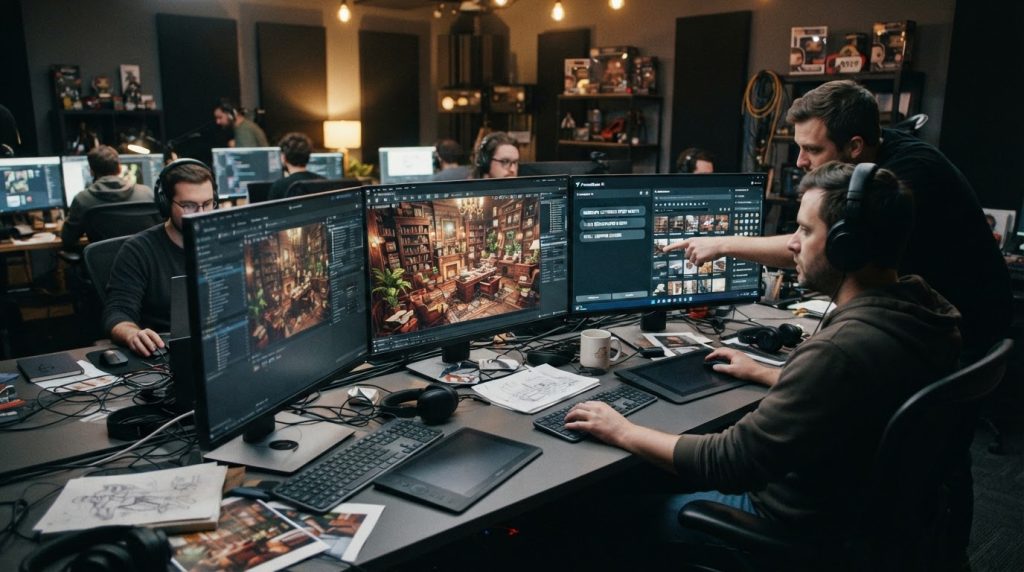
Promethean AI is an AI assistant built for professional 3D artists, level designers, and game studios who need to populate large virtual environments quickly. Instead of generating brand-new 3D models from a text prompt the way an image generator would, it works with a team’s existing library of assets — models, textures, materials, and reference images — and uses natural language commands to arrange them into full scenes. Tell it to build “a cluttered 90s teenager’s bedroom” and it will pull matching assets from your library and lay them out with realistic placement, lighting, and shadows.
It’s easiest to think of it less as a “make me a game” tool and more like a very fast, very tireless junior environment artist who already knows where everything in the asset library lives.
Who made Promethean AI, and can it be trusted?
Promethean AI was founded in 2018 by Andrew Maximov, a former Technical Art Director at Naughty Dog who worked on the Uncharted series. That background matters for credibility: the tool was built by someone who spent years doing the exact manual environment-building work it’s designed to speed up, not by a general-purpose AI startup bolting game features onto an existing model.
The company has also positioned itself unusually among AI art tools — it says it served as a technical advisor for artists in the well-known class-action lawsuits against major text-to-image AI companies, and it markets itself explicitly as artist-first rather than “prompt-to-asset.” The platform has support from the Disney Accelerator program and lists PlayStation Studios among its enterprise users, according to the company’s own site and coverage in outlets like GamesBeat and Game Developer.
How does Promethean AI actually work?
The workflow is built around three core ideas: it reads your existing asset library, it lets you describe scenes in plain language, and it never asks you to upload your files to its own servers.
- Point it at your assets. You drag a folder of 3D models, materials, or reference images into Promethean AI’s Source File or Inspiration mode, and it builds a searchable metadata library around them — without moving or storing the actual files.
- Describe the scene. Using natural language commands (typed or spoken), you ask for a type of environment — a room, a landscape, a specific mood or era — and the AI selects and arranges matching assets from your library.
- Refine live. You can keep adding, removing, or repositioning objects with more commands, and the tool recalculates placement, shadows, and physical alignment automatically as the scene changes.
- Export into your engine. The finished layout gets used directly inside your existing 3D editor rather than living in a separate app.
What can you actually build with it?
Promethean AI is aimed at environment and world-building work rather than character art, code, or gameplay systems. Typical use cases include populating interior scenes (rooms, shops, apartments), dressing exterior environments and landscapes, building out background or pre-visualization sets for film and animation, and rapid architectural visualization mockups. It’s also used in outsourcing pipelines, where studios need to keep visual consistency across assets produced by many different outsourced artists.
It is not designed to generate an entire playable game from scratch, write gameplay logic, or replace a level designer’s decisions about pacing and player flow — it accelerates the asset-placement grind that sits underneath that creative work.
Which game engines does Promethean AI support?
According to Promethean AI’s own FAQ, its primary and most complete integration is with Unreal Engine. It also provides open-source plugins for Unity, 3ds Max, Maya, and Blender, though the company notes that not every version of every editor has been fully tested, and studios with custom pipelines can modify the plugin code themselves. If your studio runs an older or heavily customized version of one of these editors, it’s worth checking compatibility directly with Promethean AI before committing.
Is Promethean AI free to use?
Is Promethean AI only for professional studios?
Mostly, yes — this is one of the biggest things to understand before trying it. Promethean AI is explicitly positioned as a professional tool for artists who already have an asset library and a 3D pipeline, not a beginner-friendly “type a sentence, get a finished game” platform. The company is upfront that it’s “not for prompt artists.” If you’re a total beginner with zero 3D assets and no engine experience, tools built around instant asset generation or no-code game creation will get you a playable result faster. Promethean AI shines once you already have real production assets and need to place a lot of them, fast.
How does Promethean AI compare to other AI game art tools?
| Tool | What it actually does | Best for |
|---|---|---|
| Promethean AI | Arranges existing 3D assets into full scenes using natural language | Studios & artists with an established asset library |
| Meshy | Generates new 3D models from text or image prompts | Creating brand-new individual assets |
| Sloyd | Generates game-ready 3D models procedurally in seconds | Fast, lightweight asset creation for indie projects |
| Hyper3D Rodin | Text/image-to-3D model generation with high surface detail | Higher-fidelity single-asset generation |
| Inworld AI | AI-driven NPC dialogue and character behavior | Character conversation systems, not environments |
The short version: Meshy, Sloyd, and Hyper3D Rodin create individual 3D objects. Promethean AI does something different — it takes objects you already have and builds entire environments out of them. Many studios actually use tools like these together: generate individual assets with one tool, then let Promethean AI place them at scale.
Where it wins
- Built by an actual veteran environment artist, not a generic AI startup
- Keeps your assets and files private — nothing is uploaded to Promethean’s servers
- Deep Unreal Engine integration, plus plugins for other major 3D tools
- Genuinely speeds up the most repetitive part of environment art
- Trusted by named enterprise studios, including PlayStation Studios
Where to be cautious
- Not beginner-friendly — you need existing 3D assets and pipeline knowledge
- Pricing isn’t public, so budgeting requires reaching out directly
- Non-Unreal integrations are less mature and may need testing on your setup
- Won’t generate gameplay, code, or brand-new characters — environment only
Is my data safe with Promethean AI?
This is one area where Promethean AI is more specific than most AI tools. Per its own FAQ, the company states it does not upload, store, or train on your asset files in any form — it builds a local metadata library around files that stay on your own infrastructure or shared storage (a shared folder, Dropbox, or your own database/S3 setup). For studios worried about intellectual property leaking into a third-party AI training set, that’s a meaningfully different privacy model than cloud-based generative tools that process your uploads on their own servers.
Frequently Asked Questions
Does Promethean AI create new 3D models?
No. It arranges and places assets you already own or have imported — it doesn’t generate brand-new 3D models from scratch the way tools like Meshy or Sloyd do. Many teams use it alongside a model-generation tool.
What game engines work with Promethean AI?
Unreal Engine is the primary, most fully supported integration. Open-source plugins are also available for Unity, 3ds Max, Maya, and Blender, though testing coverage varies by editor version.
Can indie developers use Promethean AI?
It’s technically possible, but the tool is built with professional pipelines in mind and assumes you already have a 3D asset library and engine experience. Solo indie devs without existing assets may get more immediate value from a beginner-friendly generation tool first.
Is Promethean AI free?
Promethean AI does not list public pricing tiers — plans are quote-based. Check the official Promethean AI pricing page for current details before assuming a specific cost.
Who founded Promethean AI?
Andrew Maximov, a former Technical Art Director at Naughty Dog who worked on the Uncharted series, founded Promethean AI in 2018 in Los Angeles.
Does Promethean AI upload my game assets to the cloud?
According to Promethean AI’s own FAQ, no — it never uploads, stores, or trains on your asset files, and instead builds a metadata library while your files stay on your own storage.