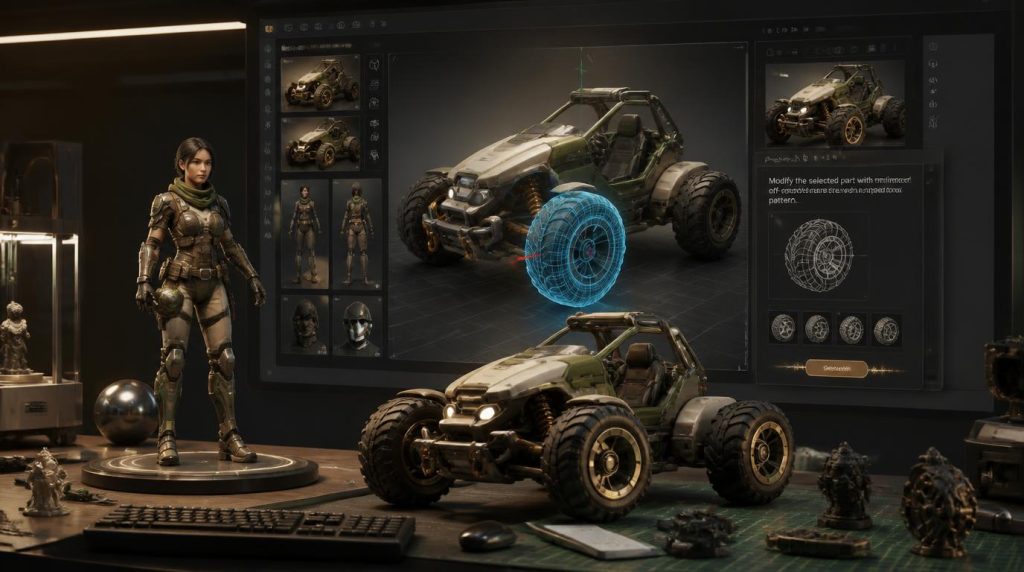
“We are building a 3D foundation model that can generate high-quality 3D assets from a single image.”
— Deemos Tech / Hyper3D
Hyper3D Rodin is the AI 3D model generator built by Deemos Tech, and it’s one of the heavier-hitting names in the space — backed by ByteDance and Meituan, used internally by teams at Amazon and Unity, and now on its second major model generation. It turns text prompts or photos into production-ready, quad-topology 3D assets with PBR textures, and its latest release adds something few competitors offer yet: editing an existing 3D model just by typing what you want changed. Here’s the full picture.
TL;DR — Hyper3D Rodin at a Glance
| What it is | AI text-to-3D and image-to-3D generator with native model editing |
| Made by | Deemos Tech, founded 2020 Confirmed |
| Current model | Rodin Gen-2 (10B parameters, BANG architecture), released October 2025 |
| Standout feature | Rodin Gen-2 Edit (“3D Nano Banana”) — edit existing models via text prompts |
| Export formats | Quad-topology mesh + PBR textures, compatible with Unity, Unreal, Blender |
| Free trial | 7 days |
| Paid plans | Creator ~$30/mo · Business ~$120/mo · Education ~$15/mo · Enterprise custom |
| Notable backers/clients | ByteDance, Meituan (investors); Amazon, Unity, Bambu Lab (clients) |
Jump to a section
- What is Hyper3D Rodin and who makes it?
- How does Rodin generate 3D models?
- What is Rodin Gen-2 Edit (“3D Nano Banana”)?
- What can you create with Hyper3D Rodin?
- How much does Hyper3D Rodin cost?
- Is Hyper3D Rodin good for game development?
- How does Hyper3D Rodin compare to Tripo 3D and Sloyd?
- What are the limitations of Hyper3D Rodin?
- FAQ
What is Hyper3D Rodin and who makes it?
Hyper3D Rodin is the flagship AI 3D generation product from Deemos Tech, a company founded in 2020 by Wu Di, Zhang Qixuan, Zhang Longwen, and Zeng Chuxiao, originally spinning out of research at ShanghaiTech University before establishing its commercial base in Los Angeles Confirmed. The name nods to sculptor Auguste Rodin — fitting, since the platform’s whole premise is sculpting finished 3D forms out of a text description or a flat image.
Deemos raised a Series A round led by Meituan’s DragonBall fund and ByteDance, with Sequoia China’s seed fund and MiraclePlus also participating, and the company has reported reaching $1 million in annual recurring revenue within 45 days of Rodin’s initial launch Company-reported. Listed clients and partners include Amazon, ByteDance, Unity, and 3D-printer maker Bambu Lab.
How does Rodin generate 3D models?
Rodin accepts either a text prompt or a reference image (including multi-view photo sets for more accurate reconstructions) and outputs a mesh directly, rather than assembling one from a diffusion-generated point cloud the way some earlier AI 3D tools did. The current generation, Rodin Gen-2, launched in October 2025 and scaled the underlying model to 10 billion parameters using what Deemos calls its BANG architecture, aimed specifically at improving geometry quality and scalability for demanding production use Confirmed.
The earlier Gen-1.5 release (April 2025) was already built to directly output quadrilateral mesh topology and PBR (physically based rendering) materials in one pass, addressing common AI-mesh problems like thin-face errors and soft edges that usually require manual cleanup Confirmed. Gen-2 builds on that same quad-mesh, PBR-first foundation at greater scale.
What is Rodin Gen-2 Edit (“3D Nano Banana”)?
Launched in March 2026, Rodin Gen-2 Edit — nicknamed “3D Nano Banana” by Deemos — lets you upload any existing 3D model and modify it using plain-language text prompts instead of manual sculpting Confirmed. The workflow is a simple two-step process: drag a box around the part of the model you want to change, then describe the change in text.
Deemos has demonstrated three broad edit types with the tool: structural edits (reshaping a vehicle’s overall silhouette), part-level edits (adding or swapping specific components like accessories), and fine detail edits (engravings, labels, and other localized surface changes). A normal-baking option preserves fine surface detail so lightweight, real-time-ready meshes don’t lose high-frequency detail during editing, and a one-click decomposition tool can split an edited model back into separate parts.
What can you create with Hyper3D Rodin?
Game assets
Characters, props, and environment pieces with clean quad topology, built for direct use in Unity and Unreal Engine.
3D printing
A dedicated Image-to-STL converter turns a photo directly into a print-ready file, supporting PNG, JPG, BMP, SVG, and TIFF inputs.
VFX & film previs
Fast concept-to-3D blocking for scenes and props ahead of a full production pipeline.
Product visualization
Turn a product photo into a textured 3D model for e-commerce or marketing use.
VR / AR / metaverse
Production-ready assets aimed at the scale and quality demands of virtual world building.
Iterative editing
Rodin Gen-2 Edit lets you refine an already-generated (or uploaded) model without starting a new generation from scratch.
How much does Hyper3D Rodin cost?
New users get a 7-day free trial before choosing a paid plan. Reported pricing sits across four tiers Company-reported, may have shifted with Gen-2:
| Plan | Price | Monthly credits | Best for |
|---|---|---|---|
| Education | ~$15/mo | 30 credits | Students, educators |
| Creator | ~$30/mo | 30 credits | Individual creators |
| Business | ~$120/mo | 208 credits | Commercial / studio use |
| Enterprise | Custom | Custom | Large organizations |
Rodin is also accessible pay-per-generation through third-party inference platforms such as fal.ai, where a single generation is billed at roughly $0.40, useful for developers who want to test the API without committing to a subscription. As always with credit-based AI tools, confirm current pricing directly on Hyper3D’s site, since tiers and credit allowances shift as new model generations roll out.
Is Hyper3D Rodin good for game development?
Yes — quad-topology output and native PBR materials are exactly what a real-time engine pipeline wants, and Rodin’s outputs are built to be compatible with Unity, Unreal Engine, and Blender without a heavy retopology pass. Unity is listed among Deemos’ collaborators, which lines up with that focus. The addition of Rodin Gen-2 Edit is particularly useful for game teams: rather than regenerating an entire asset because one prop needs a different silhouette or an extra detail, you can point at the specific area and describe the change, which fits an iterative game-dev workflow better than a pure regenerate-and-hope approach.
How does Hyper3D Rodin compare to Tripo 3D and Sloyd?
All three sit in the AI 3D generation category but take different technical routes. Tripo focuses heavily on clean quad topology specifically tuned for game engines with a lighter, faster generation model. Sloyd skips AI diffusion entirely in favor of artist-built procedural templates edited through sliders. Rodin leans into raw model scale and native mesh quality — its Gen-2 architecture is one of the larger parameter counts in the category — plus it’s currently ahead on post-generation editing with Gen-2 Edit, a capability Tripo and Sloyd don’t yet match in the same form. For a closer look at the other two, see our Tripo 3D review.
| Aspect | Hyper3D Rodin | Tripo 3D | Sloyd |
|---|---|---|---|
| Generation method | Native 3D diffusion (BANG architecture) | 3D diffusion | Procedural templates + AI |
| Post-gen editing | Text-prompt editing (Gen-2 Edit) | Limited / regenerate | Real-time sliders |
| Output topology | Native quad mesh | Quad mesh (Smart Mesh) | Clean quad, template-based |
| 3D printing tools | Dedicated Image-to-STL | Segmentation + STL export | STL export |
| Entry price | ~$15–30/mo | $19.90/mo | Not publicly listed |
What are the limitations of Hyper3D Rodin?
- Pricing isn’t cheap at the top end. The Business tier runs around $120/month, noticeably higher than entry plans from Tripo or Meshy.
- Credit-based generation still applies. Unlike Sloyd’s slider-based parametric editing, standard Rodin generations consume credits per attempt, though Gen-2 Edit softens this for refinement work specifically.
- Newer editing feature, still maturing. Gen-2 Edit only launched in March 2026, so community documentation and third-party tutorials are thinner than for the core generation tools.
- Large model, real compute cost. A 10-billion-parameter model generally means generation isn’t instant; expect it to run comparably to, or slightly slower than, lighter competing tools depending on settings.
Frequently Asked Questions
Who makes Hyper3D Rodin?
Hyper3D Rodin is developed by Deemos Tech, a generative AI company founded in 2020, originally spun out of ShanghaiTech University research and now based in Los Angeles.
What is Rodin Gen-2?
Rodin Gen-2 is Deemos’ next-generation 3D model, launched in October 2025, scaled to 10 billion parameters using a new architecture called BANG, built for higher-quality, more scalable 3D asset generation.
Can you edit a 3D model after generating it in Rodin?
Yes. Rodin Gen-2 Edit, also called “3D Nano Banana,” lets you select a region of an existing model and describe changes in text, which the AI then applies directly to the mesh.
Is Hyper3D Rodin free to use?
New users get a 7-day free trial. After that, it moves to a paid credit-based subscription, with plans reportedly starting around $15/month for education users and $30/month for individual creators.
Does Hyper3D Rodin work with Unity and Blender?
Yes, Rodin’s quad-mesh, PBR-textured output is built to be compatible with Unity, Unreal Engine, and Blender, and Unity is listed among Deemos’ collaborators.
Can Rodin convert images directly into 3D-printable files?
Yes — Hyper3D includes a dedicated Image-to-STL converter that turns a 2D photo into a print-ready 3D file, supporting common image formats like PNG, JPG, and SVG.