“We are building the next generation of 3D content creation tools, enabling anyone to create game-ready 3D assets.”
— Andreas Edesberg, Sloyd co-founder
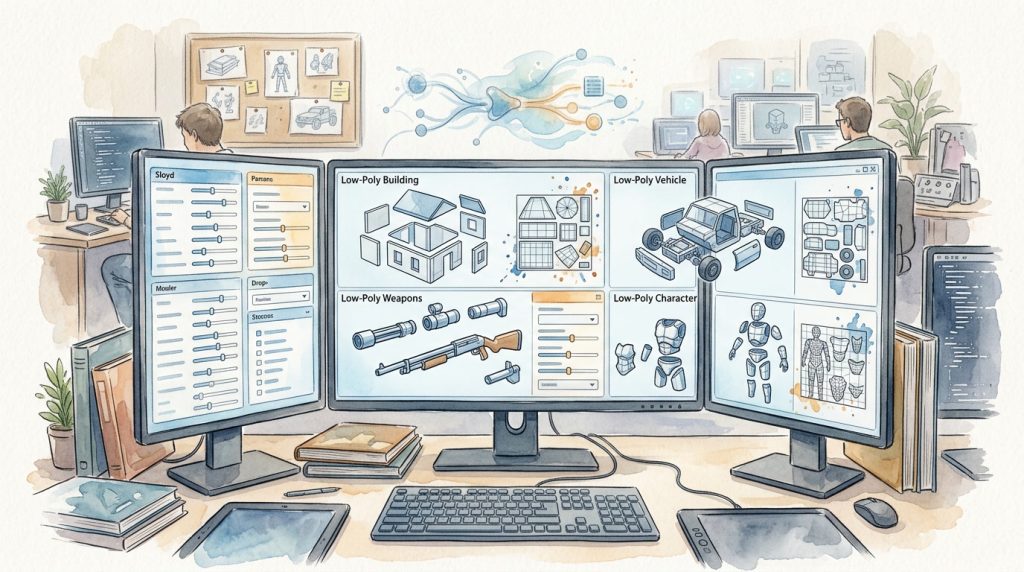
Sloyd is a Norwegian AI 3D model generator that skips the diffusion-model route most of its competitors use. Instead, it builds every asset from artist-made procedural templates that AI then customizes on the fly — which means faster generation, cleaner topology out of the box, and zero copyright ambiguity, since nothing is trained on scraped internet models. Here’s how it actually works, what it’s good for, and where its template-based approach hits a ceiling.
TL;DR — Sloyd at a Glance
| What it is | Hybrid procedural + AI 3D asset generator (not diffusion-based) |
| Made by | Sloyd AS, founded 2021 in Oslo, Norway Confirmed |
| Core approach | In-house parametric templates (“generators”) customized by AI and sliders |
| Inputs | Text prompts, reference images, slider-based manual tweaking |
| Export formats | GLB, FBX, OBJ, STL, PLY |
| Rigging | Automatic, one-click auto-rigging for characters and creatures |
| IP / commercial use | All template assets built in-house — no scraped-dataset copyright risk Confirmed |
| Best for | Game props, buildings, vehicles, runtime/procedural generation, VR |
Jump to a section
- What is Sloyd and how is it different from other AI 3D tools?
- How does Sloyd’s generation process actually work?
- What can you build with Sloyd?
- What features does Sloyd offer?
- How much does Sloyd cost?
- Is Sloyd good for game development?
- How does Sloyd compare to Tripo 3D and Meshy?
- What are the limitations of Sloyd?
- FAQ
What is Sloyd and how is it different from other AI 3D tools?
Sloyd is a web-based 3D asset generator founded in 2021 by Andreas Edesberg in Oslo, Norway Confirmed. Most AI 3D generators on the market today — Tripo, Meshy, Hunyuan3D — run on diffusion models trained on large 3D datasets. Sloyd deliberately does not. It uses what the company calls a hybrid procedural-and-parametric approach: artists build modular templates (“generators”) for object types like chairs, buildings, weapons, or vehicles, and the AI layer customizes those templates in response to a text prompt or image, rather than generating raw geometry from scratch.
According to co-founder Andreas Edesberg, this design choice traces back to a 2017 idea for games where content is generated in real time as you play — something that wasn’t feasible with diffusion-based generation at the time Founder claim. That runtime-generation goal still shapes the product today.
How does Sloyd’s generation process actually work?
A Sloyd generation starts from one of three entry points: a text prompt, an uploaded reference image, or picking a template directly from the library and adjusting it by hand. Whichever route you take, the output lands in the same parametric system — every part of the model (length, width, material, individual components) stays adjustable through sliders after generation, so refining a result doesn’t mean re-rolling the whole model and burning another generation.
Because each asset comes from a structured template rather than raw AI-guessed geometry, the mesh arrives with a clean, logically organized UV map by default — according to the company, roof surfaces are mapped as roofs rather than scattered across the texture sheet, which makes manual texture edits far more predictable than with typical diffusion-generated meshes Company claim.
What can you build with Sloyd?
Game props & environments
Buildings, furniture, vehicles, weapons, and hard-surface props built for direct use in real-time engines.
Characters & creatures
Generated models come with automatic rigging, ready to animate without a manual pass in Blender or Maya.
3D printing
Export as STL or OBJ for printable figurines and objects straight from the parametric editor.
Runtime / procedural generation
Lightweight, optimized geometry suited to generating content live inside a game or VR session, not just offline.
UGC platforms
Built to let non-artists produce large volumes of consistent, on-brand assets without a traditional modeling pipeline.
Rapid prototyping
Block out level geometry or concept props in seconds to test an idea before committing to hand-built assets.
What features does Sloyd offer?
Parametric slider editing
Every generated model exposes sliders for its adjustable parameters — swap a part, stretch a dimension, change a material — with the mesh updating in real time. This is the core thing that separates Sloyd from prompt-and-pray diffusion tools: iteration happens through direct manipulation, not repeated regeneration.
One-click auto-rigging and animation
Character and creature templates come pre-rigged. Described motion (walk, run, idle, fly) can be applied through prompts, with the parametric skeleton adjusting joint placement and articulation via sliders after the fact.
AI texturing and retexturing
Typed material descriptions (“scratched sci-fi metal,” “worn leather”) generate matching textures on the clean, pre-organized UV map, with textures scaling automatically as the underlying geometry changes.
Template library (“Generators”)
Sloyd’s asset library spans dozens of object categories, from architecture to props to characters, each one a fully customizable generator rather than a static download.
Multi-format export
Finished models export to GLB, FBX, OBJ, STL, or PLY, covering standard game-engine, DCC, and 3D-printing workflows.
How much does Sloyd cost?
Sloyd offers a free tier to try the generator and template library, with paid plans required for full commercial use and higher-volume generation. Sloyd does not publish detailed tier pricing on major third-party listing sites Not publicly listed — some resellers advertise paid access as “unlimited generation” with no per-model credit cost, since regenerating a parametric model via sliders doesn’t consume a new generation the way a diffusion re-roll would. For exact current plan pricing, check Sloyd’s own site directly before budgeting, since figures move and aren’t consistently mirrored across review sites.
Is Sloyd good for game development?
This is Sloyd’s home turf. The company built the tool specifically for game-ready output: assets are engine-optimized from the start, avoid the messy triangulated topology that plagues a lot of AI-generated meshes, and export directly to GLB, FBX, and OBJ for Unity, Unreal Engine, and other real-time engines. Sloyd has run community game jams built entirely around generating assets with the tool, and its integrations lean toward developers who want to slot generation directly into a production pipeline rather than hand-finish every asset in a DCC tool afterward.
The real-time generation angle is also worth flagging separately from asset creation: because Sloyd’s models are lightweight and procedural rather than dense diffusion output, the company has demonstrated live, in-session asset generation — useful for procedurally generated levels or VR environments built on the fly Company claim.
How does Sloyd compare to Tripo 3D and Meshy?
The easiest way to think about this category is by generation method. Tripo and Meshy both use diffusion models to generate freeform geometry from a prompt or image — more visually flexible for organic, one-off shapes, but the output can need retopology and carries more uncertain training-data provenance. Sloyd trades some of that freeform flexibility for structure: templates guarantee clean topology and UV maps every time, editing happens via sliders instead of regeneration, and there’s no scraped-dataset IP question. For a look at how the diffusion-based approach performs, see our full Tripo 3D review.
| Aspect | Sloyd | Tripo / Meshy (diffusion-based) |
|---|---|---|
| Generation method | Procedural templates + AI | AI diffusion from prompt/image |
| Editing after generation | Real-time sliders, no re-generation | Usually requires a new generation |
| Topology / UVs | Clean and structured by default | Variable, sometimes needs cleanup |
| Freeform / organic shapes | Limited to template categories | Broad, near-unlimited variety |
| IP provenance | In-house artist-built templates | Trained on large 3D datasets |
What are the limitations of Sloyd?
- Bounded by its template library. If Sloyd doesn’t have a generator category close to what you need, you can’t just prompt your way to something entirely novel the way you can with a diffusion tool.
- Less suited to organic, one-off character concept art. The parametric approach shines for hard-surface, structured objects (buildings, vehicles, props) more than highly unique organic creatures.
- Pricing isn’t transparent up front. Without clear published tiers on third-party listing sites, evaluating cost against competitors takes an extra step of checking Sloyd’s site directly.
- Smaller ecosystem than the diffusion-model leaders. Tripo and Meshy currently have broader plugin support and community size; Sloyd’s tooling is more focused and Unity/game-dev-centric.
Frequently Asked Questions
Is Sloyd free to use?
Yes, Sloyd offers a free tier to explore its templates and generation tools. Full commercial use and higher-volume generation require a paid plan.
Does Sloyd use diffusion models like Tripo or Meshy?
No. Sloyd uses a hybrid procedural-and-parametric system built on artist-made templates that AI customizes, rather than generating raw geometry from a diffusion model.
What file formats does Sloyd export?
GLB, FBX, OBJ, STL, and PLY, covering game engines, DCC software, and 3D printing.
Can Sloyd models be used commercially without copyright risk?
Sloyd states all template assets are built in-house by its own artists rather than trained on scraped 3D datasets, which the company positions as removing the copyright ambiguity some diffusion-based generators carry.
Is Sloyd good for making game-ready assets?
Yes — game-ready output is Sloyd’s core focus, with clean topology, automatic UV maps, and direct export to Unity- and Unreal-compatible formats.
Who founded Sloyd?
Sloyd was founded in 2021 by Andreas Edesberg and is headquartered in Oslo, Norway.