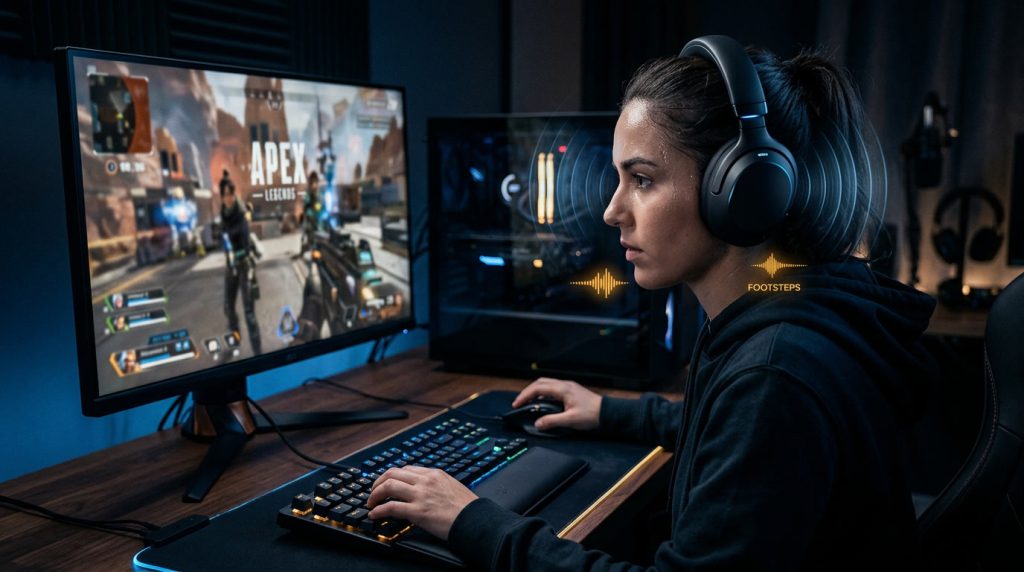
A PC fan whining under your desk and a real, live noise-cancelling headset are not the same problem — but for gamers, they get solved the same way. The right pair of noise cancelling headphones for gaming can mute the hum of your setup without swallowing the one sound that actually matters mid-match: a footstep behind you.
Here’s how Active Noise Cancellation actually works in a gaming context, when it helps versus when it gets in the way of positional audio, and which current headsets back up their ANC claims with real testing rather than marketing copy.
Quick comparison: the best noise-cancelling gaming headsets right now
| Headset | Connectivity | ANC Level | Battery (ANC On) | Best For |
|---|---|---|---|---|
| SteelSeries Arctis Nova Pro Wireless | 2.4GHz + BT simultaneous | Strong (4-mic hybrid) | ~22h per battery, hot-swappable | Best Overall |
| SteelSeries Arctis Nova Elite | 2.4GHz + BT simultaneous | Best-in-class | Hot-swap dual battery | Best ANC / Premium |
| Sony INZONE H9 (H9 II) | 2.4GHz + BT simultaneous | Very strong | ~32h | Best Competitive / Lightweight |
| Turtle Beach Stealth 700 Gen 3 | 2.4GHz, multi-platform | Moderate, adjustable | Console-typical, varies | Best Console Multi-Platform |
| Corsair Virtuoso RGB Wireless | 2.4GHz + BT | Moderate | Long, comfort-tuned | Best Comfort / Marathon Sessions |
Pricing and exact battery figures shift with sales and regional listings — treat this as a starting shortlist, not a live price feed, and check the retailer page for your region before buying.
How does ANC work for gamers — do you actually need it?
Active Noise Cancellation uses microphones on the earcups to sample ambient sound in real time, then generates an inverted “anti-noise” waveform that neutralizes it before it reaches your ear. It’s most effective against constant, low-frequency sound: a PC fan spinning, an air conditioner, road noise, the hum of a shared living room. It’s far less effective against sudden, sharp, high-frequency sound — a door slamming, a dog barking, someone talking right next to you.
What ANC actually cancels vs. what it leaves alone
That frequency split is exactly why ANC and passive isolation are meant to work together, not compete. Passive isolation — a dense earpad seal, closed-back earcup design, and enough clamping force to physically block sound — handles the mid-to-high range that ANC mostly ignores. Leatherette earpads seal tighter but run hot on long sessions; breathable mesh or hybrid fabric pads stay cooler but let slightly more sound in. Most well-reviewed 2026 headsets combine light-to-moderate clamping force with hybrid ANC to cover both ranges at once.
So do you need ANC?
If you game in a shared room, a dorm, near a loud PC, or you travel and want one headset for flights and matches, yes — ANC earns its keep. If you already game in a quiet, dedicated space with a well-cooled PC, passive isolation alone from a solid closed-back headset may be all you need, and you can put that budget toward a better driver or microphone instead.
Does ANC affect spatial audio and footstep detection?
This is the real concern for competitive players, and it’s a fair one — early ANC implementations in gaming headsets did add a faint “processed” quality to the sound. On modern hybrid ANC headsets (4-mic feedback/feedforward systems like the ones in the Nova Pro Wireless and INZONE H9), that coloration is minimal, and it’s dwarfed by a bigger factor: wireless latency.
In practice: ANC processing itself adds negligible delay on a well-engineered headset. The connection type is what actually matters for footstep timing in titles like CS2, Valorant, and Marvel Rivals. That’s the real argument for a 2.4GHz dongle over Bluetooth for the game audio itself — reserve Bluetooth for the secondary stream (Discord on your phone, background music) rather than your primary game feed.
If a headset offers a low-latency 2.4GHz mode and a standard Bluetooth mode, always route your actual game audio through 2.4GHz. Save Bluetooth for calls or music layered on top — several current headsets support both bands running at the same time for exactly this split.
Top features to look for in a noise-cancelling gaming headset
Recommended EQ tuning tips for gaming with ANC on
ANC’s low-frequency processing can occasionally soften the crispness of high-frequency directional cues. A few adjustments in your headset’s companion software compensate for that without fighting the ANC itself:
| Frequency Range | Adjustment | Why |
|---|---|---|
| Sub-bass (20–80Hz) | Slight cut | This is where explosions and rumble live — pulling it back a little stops it from masking quieter cues. |
| Low-mid (200–500Hz) | Neutral to slight cut | Reduces muddiness that can build up under ANC processing. |
| Presence (2–5kHz) | Boost | This range carries footstep transients and reload/gunshot cues — boosting it keeps them forward in the mix. |
| Brilliance (6–10kHz) | Slight boost | Sharpens directional cues like glass breaks and distant footsteps without adding harshness. |
Most gaming-focused software (Sonar, INZONE Hub, or the equivalent) ships with a “competitive” or “esports” preset that applies roughly this curve automatically — a good starting point before manually tweaking sliders.
Frequently asked questions about noise-cancelling gaming headphones
Does noise cancellation hurt footstep audio in competitive games?
Modern hybrid ANC on well-engineered headsets has minimal impact on directional cues. Wireless latency from the connection type — Bluetooth versus a dedicated 2.4GHz dongle — has a far bigger effect on how “in time” footsteps feel than the ANC processing itself.
Is 2.4GHz or Bluetooth better for gaming audio?
2.4GHz dongles typically run under 20ms of latency, while standard Bluetooth ranges roughly 40–200ms depending on the codec. For competitive play, route your main game audio through 2.4GHz and reserve Bluetooth for calls or music.
What’s the difference between ANC and a noise-cancelling microphone?
Earcup ANC blocks ambient noise from reaching your ears. A noise-cancelling or AI-suppressed microphone cleans up your outgoing voice so your team or Discord call doesn’t hear your keyboard, fans, or room noise. A headset can be strong at one and average at the other.
Do I need ANC if I already play in a quiet room?
Not necessarily. A closed-back headset with good passive isolation — dense earpads, a solid seal, and moderate clamping force — may cover your needs, freeing up budget for a better driver or microphone instead of ANC hardware.
Does ANC drain battery faster on wireless gaming headsets?
Yes. Active Noise Cancellation is one of the larger battery draws on a wireless headset, so always compare the manufacturer’s ANC-on battery figure rather than the ANC-off best case when judging real-world runtime.
Keep exploring on LemonLama
- VR hardware companies — for readers comparing gaming hardware makers beyond headsets
Editorial note: LemonLama’s sitemap doesn’t yet have a dedicated audio/headset hardware hub, so this is the one genuinely relevant internal match available. A “gaming hardware reviews” category would give future headset, mouse, and keyboard content proper linking targets.