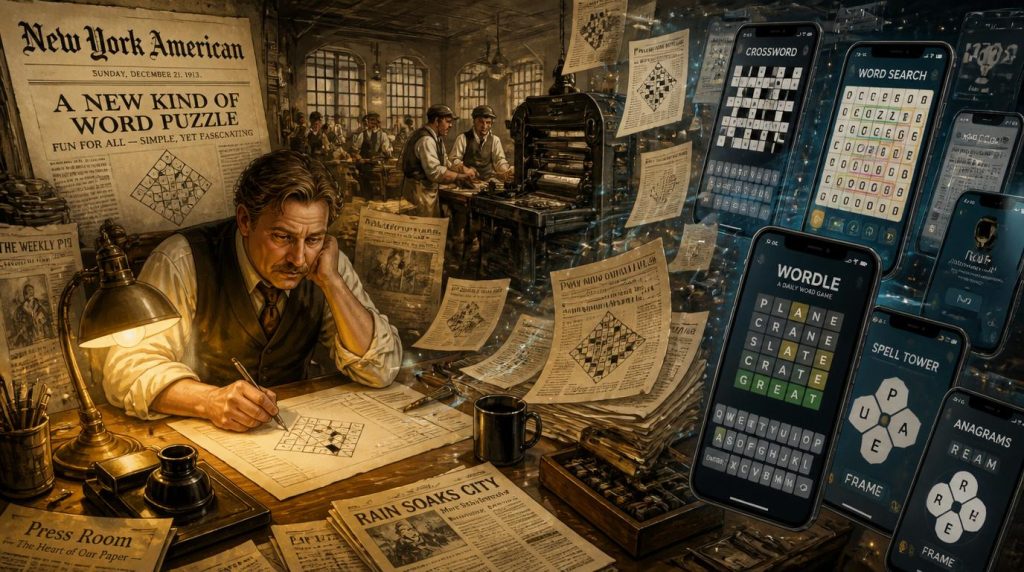
Somewhere between the coffee pot and the front door, crossword puzzles have become one of those rare habits almost nobody questions. Newspapers still print them in the corner of the page nobody wants to give up, phones buzz with daily streaks, and word-game apps sit permanently on home screens next to the weather widget. It’s a ritual so ordinary that hardly anyone stops to ask where the grid itself came from.
That’s exactly what this article sets out to fix. We’re going to walk through the strange, almost accidental story of the man behind it all — the original inventor of the crossword puzzle — and how one filler assignment for a Christmas newspaper supplement turned into a habit shared by hundreds of millions of people a century later.
Here’s where we’re headed: who Arthur Wynne actually was before he became a household footnote, the exact mechanics of the December 1913 puzzle that started it, the typo that accidentally renamed his invention, and how a century of history of word games led directly from his newsroom desk to the browser-based puzzle hubs people use today. Along the way, we’ll dig into the full first crossword puzzle history — not just the highlight reel — and the Arthur Wynne crossword details most retellings skip entirely.
Section 01The Man Behind the Grid: Who Was Arthur Wynne?
Long before anyone called him a word puzzle pioneer, Arthur Wynne was just another British transplant trying to make it in American newspapers. Born in Liverpool in 1871 to a newspaper editor father, Wynne emigrated to the United States in 1891 at nineteen years old, landing in Pittsburgh. He wasn’t an instant success — by his own account he was fired from nearly every paper in the city before finally settling in at the Pittsburgh Press, where he spent years learning the trade while also playing second violin in the Pittsburgh Symphony Orchestra.
Eventually he made his way to New York and the New York World, a paper under Joseph Pulitzer known for splashy, sensational journalism. By 1913, Wynne was running the “Fun” supplement — the section responsible for jokes, games, and anything that could keep readers entertained on a Sunday. It was a job that constantly demanded new material, and that demand is really the origin story here. Anyone digging into first crossword puzzle history eventually lands on the same detail: Wynne didn’t set out to invent a global pastime. He was simply an editor with blank space to fill and a deadline that wasn’t moving — which makes the Arthur Wynne crossword origin story less about genius and more about deadline pressure.
Wynne had already been building word squares, rebuses, and hidden-word puzzles for the Fun section for two years by 1913. The Christmas puzzle wasn’t his first game — it was the one where he finally pushed the format past its limits, and it’s the reason he’s remembered today as the inventor of the crossword puzzle.
He drew on a childhood memory of a game called “Magic Squares,” where words are arranged so they read identically across and down, and possibly on the ancient Latin “Sator Square,” a five-word palindrome puzzle. Combine that inherited structure with a career spent trimming copy to fit tight newspaper columns, and you get someone perfectly suited to the New York World word cross puzzle that was about to change the history of word games for good — and to earn its creator lasting recognition as the inventor of the crossword puzzle, however unplanned that recognition turned out to be.
Section 02December 21, 1913: The Birth of the “Word-Cross”
The puzzle that ran in the Fun supplement on December 21, 1913, looked almost nothing like the crosswords in a modern paper. Wynne built a numbered, diamond-shaped grid measuring roughly 11 by 11 squares, with a hollow, unused center — a shape closer to a woven word-square than the dense black-and-white blocks people recognize today. There were no internal black squares at all; the diamond outline itself did the work of containing the words.
He seeded the very center with F-U-N as the first “across” entry — a small wink at the section it was built for — then filled the rest of the diamond with 32 numbered clues split between across and down. Some of those clues have not aged gracefully. One asked solvers for a four-letter word for part of the head (FACE); another wanted the fiber of the gomuti palm (DOH). Wynne, apparently aware of how brutal his own puzzle could be, reportedly used the clue “what this puzzle is” for the answer HARD.
- Grid shape: diamond, not square — a direct descendant of the “Magic Squares” format Wynne remembered from childhood.
- No black squares: the outline of the diamond itself defined where words could and couldn’t go.
- Original title: “FUN’S Word-Cross Puzzle,” printed as filler with zero fanfare.
- Patent attempt: Wynne tried to patent the format; the World’s business managers refused to cover the cost, calling it a passing fad.
None of this reads like the launch of a cultural institution, and that’s precisely the point. Every deep dive into Arthur Wynne crossword history circles back to the same irony — the invention that outlived its own newspaper was treated, at the time, as disposable holiday filler. It’s a strange way for the inventor of the crossword puzzle to make his mark, buried in a section nobody expected to matter, and a strange footnote in first crossword puzzle history more broadly.
Section 03From Mistake to Masterpiece: How “Word-Cross” Became “Cross-Word”
The name everyone uses today wasn’t the one Wynne actually gave it. For a few weeks after the debut, the World kept running the puzzle as “Word-Cross.” Then a typesetter, whether through habit or plain error, printed it as “Cross-Word” instead. Nobody corrected it. Readers didn’t seem to notice or care, the World kept the new name, and within a matter of weeks the two words had permanently swapped places — eventually collapsing into the single word we use now.
That accident landed at almost the perfect moment. The puzzle’s rapid climb overlapped with the outbrreak of World War I, and the New York World word cross feature became something readers actively sought out as a small, controllable distraction from front-page headlines that kept getting worse. Other newspapers noticed the reader engagement and started running their own versions. By the early 1920s, what had started as one editor’s holiday filler had become one of the most widely copied features in American print, tracing an evolution of crosswords that moved from a single Sunday supplement to a coast-to-coast habit in under a decade.
Wynne’s diamond-shaped “Word-Cross” debuts in the New York World’s Fun section on December 21.
A typesetting slip renames it “Cross-Word.” Wartime readers adopt it as a daily escape; other papers start copying the format.
Simon & Schuster publishes the first dedicated crossword puzzle book — with a free pencil attached — and sells well over 100,000 copies.
The New York Times, once dismissive of the format, launches its own crossword — reasoning that readers need a distraction during wartime blackouts.
Wynne himself moved on from the World in the early 1920s, eventually working on King Features Syndicate material under Margaret Petherbridge Farrar, the editor who would go on to shape the modern American-style grid with black squares and symmetrical patterns. Whatever changed about the format after he left, the credit for the original spark stays firmly with Arthur Wynne crossword history, not with anyone who refined it later.
Section 04The Lasting Legacy: From Newsprint to NYT Games
It’s worth sitting with how strange this trajectory actually is. A game invented to plug a hole in a holiday newspaper supplement went on to outlast the paper that published it — the World folded in 1931 — and eventually became the backbone of an entire games division at one of the most influential newsrooms in the world. The inventor of the crossword puzzle never saw any of that; he was gone from the format entirely by the time it reached its cultural peak, a detail that rarely makes it into shorter versions of first crossword puzzle history.
What’s changed since 1913 is mostly the packaging, not the core idea. Classic newspaper puzzles relied on print runs and a pencil; today’s puzzle culture runs through apps, timed leaderboards, and browser-based hubs that let people solve on a lunch break instead of over morning coffee. The appetite for a well-designed grid clearly hasn’t gone anywhere — if anything, the format that once needed a typo to get its name has proven remarkably durable. Word games built on Wynne’s original interlocking logic now sit right alongside browser favorites like the games covered in our guide to the best free browser and unblocked A-Z games, and the daily-puzzle format he popularized clearly influenced the kind of viral word games we broke down in our look at why Shoofly broke the internet in NYT Connections.
Every daily word-game app chasing a “streak” mechanic today is, structurally, still running Wynne’s 1913 idea: a grid, a set of clues, and the small dopamine hit of filling in the last blank square.
It’s a useful reminder that gaming culture doesn’t only move forward through consoles and graphics cards — sometimes the biggest evolution of crosswords-style shift is just a format finding a new delivery method decades later. The same pattern shows up across gaming history more broadly, which is part of why we’ve traced similar shifts in our piece on the evolution of point-and-click games — another genre that started clunky and mechanical before quietly becoming a staple. And for players who gravitate toward that same low-friction, anywhere-anytime puzzle style, our roundup of the best Poki games for mobile and browser players is a solid next stop.
Wrap-UpQuick Facts Summary
The Short Version
- Arthur Wynne, a Liverpool-born New York World editor, published the first crossword puzzle on December 21, 1913, as filler for the paper’s Christmas “Fun” supplement.
- The original grid was diamond-shaped with a hollow center and no black squares, titled “Word-Cross.”
- A typesetting error a few weeks later flipped the name to “Cross-Word,” which eventually became today’s single word.
- The World’s management refused to fund a patent, dismissing it as a short-lived fad — a decision that let the format spread freely to other papers.
- By 1924, Simon & Schuster’s first crossword book was a runaway bestseller; by 1942, even the once-skeptical New York Times had launched its own puzzle.
Ask most people who invented crosswords and they’ll shrug — but the direct line from Wynne’s cramped 1913 diamond grid to the word-game apps on modern phones is one of the cleaner throughlines in first crossword puzzle history. A single deadline-driven idea, dismissed by its own publisher, quietly became one of the most repeated formats in the entire history of word games. The original New York World word cross puzzle and the broader evolution of crosswords that followed it prove the same point: the best Arthur Wynne crossword story is really a story about how little the core idea needed to change. Not bad for a puzzle nobody originally planned to keep.