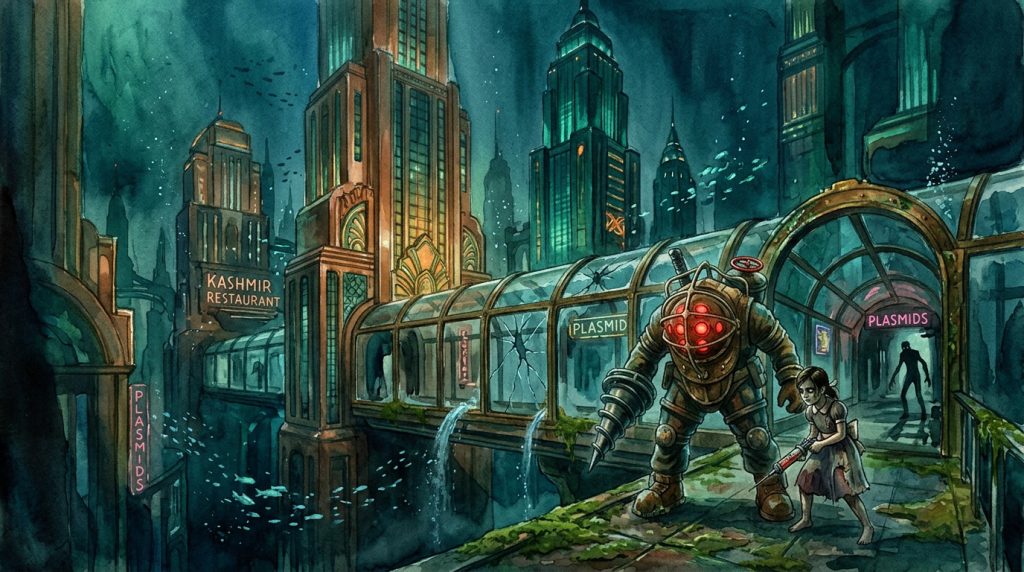
You step off the bathysphere. The art deco walls of Rapture rise around you, water pouring through cracked glass, a crooner’s voice drifting from a busted radio somewhere in the dark. And then something screams — a sound that is human enough to make your skin crawl, yet wrong enough to make you back against the wall. We can all agree: that opening hour of BioShock is terrifying. But does that make BioShock a horror game at its core? Stick around — because by the end of this piece, you’ll have a definitive, properly argued answer.
Few games in modern history have sparked as much genre debate as BioShock. Released in 2007 by Irrational Games, it arrived wrapped in an atmosphere so oppressive and dread-soaked that reviewers and players instinctively reached for the word “horror.” Yet the moment you load up a plasmid, freeze a Splicer solid, and blow them into shards with a shotgun, something feels decidedly un-horror about the whole affair. The truth, as ever, is more interesting than either camp admits.
This is a deep dive into BioShock’s DNA — its setting, sound, enemies, and mechanics — to answer the question once and for all: is this a horror game wearing an immersive-sim costume, or an immersive sim haunted by horror’s ghost?
Rapture: The Architecture of Dread
Horror begins with place. The Overlook Hotel. Raccoon City. The USG Ishimura. And then there is Rapture — a city built at the bottom of the Atlantic Ocean by a man who believed he was above God, and paid accordingly. The atmosphere of Rapture is the single most powerful horror instrument in BioShock’s kit, and it operates on several levels simultaneously.
Claustrophobia by design
Rapture is an enclosed system — you cannot go up, you cannot go outside, and the ocean is constantly reminding you of that fact. Cracked porthole windows, the groan of hull pressure, corridors that narrow unexpectedly: the environmental design engineers a persistent low-level anxiety that never fully releases. Compare this to the open Wisconsin farmlands of a Resident Evil Village or the industrial sprawl of Dead Space’s ship sections — those spaces breathe. Rapture does not breathe. It seeps.
Beauty rotting in real time
Art Deco was chosen deliberately: it is a style built on the promise of a glittering future. Every ruined mosaic, every blood-smeared neon sign advertising “Ryan Industries,” every toppled grand piano in a flooded ballroom, represents a utopian dream curdling into nightmare. This is the horror of hubris made architectural — and it hits differently than any jump scare.
The flooded Medical Pavilion level uses refracted light from water pools to animate shadows on the walls — an entirely environmental form of unease that no scripted scare sequence could replicate. The game’s environmental storytelling, via audio diaries scattered throughout, layers tragedy upon tragedy until Rapture feels genuinely haunted by history.
Why BioShock Frightens: The Sound of Rapture
If you want to understand why BioShock is genuinely scary — turn off the lights and put on headphones. The answer lives entirely in the audio design.
Ambient noise as psychological weapon
BioShock’s sound team, under Garry Schyman’s musical direction, built an audio landscape that operates below conscious awareness. Dripping water. Structural creaks. The distant, wet cough of a Splicer you haven’t spotted yet. These sounds are layered so that silence itself becomes threatening — because you learn, very quickly, that silence precedes attack.
Radio transmissions: a voice in the dark
The crackle of Andrew Ryan’s radio addresses, delivered in measured, cultured tones as you wade through the wreckage of his empire, is uniquely unsettling. It is the voice of an absent antagonist — someone who shaped everything you see but is never where you need him to be. This technique, borrowed from literary horror more than from game design, creates a paranoid relationship with authority that no monster could replicate.
Jump scares — used sparingly and intentionally
BioShock does deploy jump scares, but they are architectural rather than scripted. Splicers crawling through vents, a figure dropping from a ceiling you’d forgotten to watch — these work because the ambient design has already wound you tight. The scare is the release of pressure the sound design built up over the previous ten minutes. That is skilled horror craft.
“The most frightening thing in Rapture isn’t any single monster. It’s the voice on the radio telling you everything is under control.”
Splicers, Big Daddies, and the Ethics of Terror
Horror games traditionally make you powerless. Your enemy is unkillable, or nearly so. You run, you hide, you survive. BioShock breaks this contract — and that is exactly where the genre debate gets complicated.
The Splicers: humanity’s worst mirror
The Splicers are not monsters in the traditional sense. They are people — former residents of Rapture who consumed ADAM, the game’s gene-altering substance, until they lost their minds and their humanity. They mutter to themselves, they clutch babies that aren’t there, they sing fragments of songs from the world above. This gives them something Necromorphs and Ganados lack: pathos. The horror of a Splicer isn’t that it wants to kill you — it’s that it used to be someone who wanted to live here, in this dream city, in peace.
Little Sisters and Big Daddies: the moral weight of horror
Few horror games ask you to make genuinely difficult moral choices in the middle of terror. BioShock’s Little Sisters — the small girls who harvest ADAM from corpses, protected by the lumbering, armored Big Daddies — represent a mechanic of psychological horror rather than physical fear. You can harvest them (kill them for resources) or rescue them (sacrifice immediate gain). The Big Daddy battle that precedes this choice is brutally hard by design: the game wants you to feel the cost of that decision in your hands before you make it.
This is moral horror. The kind that Resident Evil never attempted and Dead Space only briefly flirted with.
But then — the plasmids
Here is where BioShock complicates its own horror credentials. The moment you have Incinerate!, Electro Bolt, and a well-upgraded shotgun, the power dynamic shifts permanently in your favor. Horror games protect their dread by keeping you weak. BioShock actively wants you to feel powerful — that is the point of the plasmid system, thematically and mechanically. You become what you feared. The irony is intentional but it does dissolve the sustained helplessness that defines the genre.
BioShock vs. Classic Horror: A Genre Comparison
To properly classify BioShock’s genre, we need to stack it against the genre’s established benchmarks.
- Power fantasy via plasmids & upgrades
- Environmental horror (setting, audio)
- Psychological & moral dread
- Strong narrative-driven pacing
- Player agency over fear level
- Immersive sim mechanics throughout
- Sustained helplessness by design
- Resource scarcity as core tension
- Enemy design built to disorient
- Body horror as primary language
- Minimal narrative agency
- Classic survival horror structure
- Inventory management = controlled panic
- Puzzle-solving under threat
- Fixed or semi-fixed cameras (early entries)
- Escalating monster roster
- Limited ammo by design philosophy
- Horror as genre backbone, not accent
The pattern that emerges is clear. In Dead Space and classic Resident Evil, horror is the structural spine — every mechanical decision (save points, ammo count, enemy speed) is built to sustain dread. In BioShock, horror is the wallpaper on an immersive sim frame. Beautiful, essential, memorable wallpaper — but wallpaper nonetheless. Remove the horror aesthetics from Dead Space and you have nothing. Remove them from BioShock and you still have a fully functional first-person shooter with RPG elements and a fascinating world.
That distinction matters. It’s not a criticism — it is a classification.
If you’re curious how immersive-sim design has evolved across generations, our overview of point-and-click game evolution traces the roots of player-driven narrative that BioShock later absorbed. And if you’re looking for games that capture that same co-operative tension with friends, check out our picks for the best multiplayer games available right now.
BioShock Is a Horror-Inflected Immersive Sim — and That’s Why It’s a Masterpiece
BioShock is not a horror game in the structural sense. It does not sustain the helplessness, resource scarcity, or mechanical vulnerability that define the genre. You will not cower for long in Rapture — you will eventually electrocute, freeze, and incinerate your way through it with considerable satisfaction.
But BioShock uses horror more intelligently than most pure horror titles. Its environmental design, sound architecture, enemy characterization, and moral mechanics all draw from horror’s deepest wells. The atmosphere of Rapture is genuinely among the most affecting in gaming history. And the reason BioShock frightens — when it does — is rooted in literary and cinematic horror tradition rather than cheap mechanics.
The correct genre label is: Immersive Sim / First-Person Shooter with profound horror elements. Classify it as pure horror and you diminish what makes it unique. Dismiss its horror credentials entirely and you miss half the game’s soul. Rapture was never just a shooting gallery. It was always, first, a ghost story told in neon and salt water.
Looking to explore more games that blur genre boundaries? Our 2-player co-op games guide includes titles that share BioShock’s taste for narrative-driven design, and our PC troubleshooting guide is on hand if Rapture refuses to load on your rig.