A single playthrough of Pokémon Legends Z-A takes most trainers somewhere between 20 and 30 hours. That’s genuinely how long it takes to see the credits — but it’s also barely enough time to understand what kind of game this actually is. We kept playing well past the story, deep into the Infinite Z-A Royale, the Mega Dimension DLC, and full competitive team prep, and the picture that emerged at the 200-hour mark looked very different from the one most reviews describe. Here’s what changes, what doesn’t, and whether the long game is worth playing.
What does Pokémon Legends Z-A feel like in the first 20 hours?
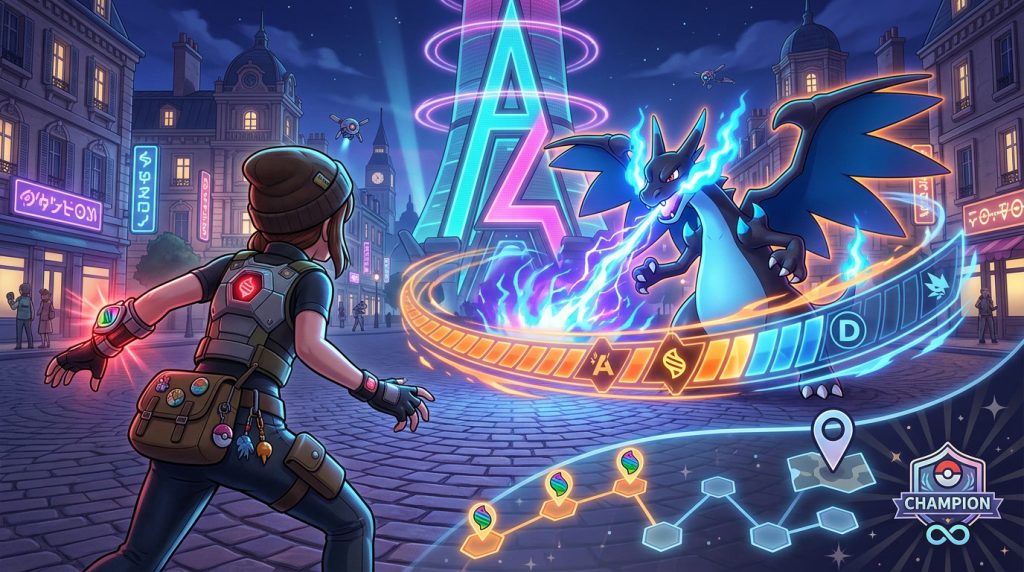
The opening stretch of Pokémon Legends Z-A is almost entirely about learning a new combat rhythm. Instead of the turn-based system the series has used for nearly three decades, battles now play out in real time: every move sits on its own cooldown timer, and positioning around the battlefield matters as much as type matchups. It’s a genuinely big structural change for the franchise, and the first few hours are spent just getting your hands used to it.
Unlike Pokémon Legends: Arceus, which sent players out into open wilderness, Z-A keeps you inside a single setting — Lumiose City, the capital from Pokémon X and Y. Early on that feels dense and busy in a good way, with fast travel, hidden items, and side missions packed into every district. The story revolves around the Z-A Royale, a nightly tournament where you battle your way up the ranks toward a rival showdown, and the tutorial pacing at the very start is noticeably slow, something several reviewers flagged as the game’s weakest opening stretch.
What changes once you reach the postgame loop?
This is where the “first 20 hours” version of Pokémon Legends Z-A and the 200-hour version start to diverge. Once the credits roll, the story missions hand off to the Infinite Z-A Royale, a repeatable version of the nightly tournament that swaps promotion matches for reward battles. Winning your first Infinite Royale match unlocks a new questline tied to catching the Kalos legendary trio — Xerneas, Yveltal, and Zygarde — and clearing enough of it opens Wild Zone 20 at the center of the city, home to both the game’s starter trio and the Kanto starters.
Reaching 15 wins in the Infinite Royale is also the only way to earn Floettite, the Mega Stone for Eternal Flower Floette. None of this exists in a normal single playthrough — it’s the layer that only shows up once you decide to keep going after the story ends, and it reframes the campaign as more of an extended tutorial for this loop than the full game itself.
How does the real-time battle system hold up after 200 hours?
The cooldown-based combat is the part of Pokémon Legends Z-A that ages the most differently with extended play. In the first few hours it feels novel just because it’s new. By hour 200, its strengths and its rough edges are both much clearer. On the plus side, timing and movement genuinely change how familiar moves behave — Detect and Protect, for example, now have different cooldown lengths rather than functioning identically, which opens up real strategic decisions that turn-based Pokémon never had.
On the rough side, the stealth-attack mechanic used to open Z-A Royale battles doesn’t hold up well to repetition. It’s meant to reward sneaking up on a trainer for a free hit, but detection can feel inconsistent even after hundreds of encounters, occasionally flipping the advantage to the opponent on hits that looked clean. It’s a minor annoyance in a single playthrough; over a long postgame grind through repeated Royale matches, it becomes one of the more noticeable seams in an otherwise strong new system.
What does the Mega Dimension DLC add for long-term players?
The Mega Dimension expansion is aimed squarely at players who’ve already finished the main story, and it’s the single biggest addition for anyone chasing a 200-hour run. It opens up Hyperspace Lumiose, an alternate version of the city where Pokémon can be temporarily boosted past the usual level 100 cap by feeding them treats from a new character, the donut chef Ansha. New Mega Evolutions are added on top of the roster the base game already expanded, including a new Mega for Baxcalibur tied to the game’s ranked-battle season structure.
It’s also the part of the game that draws the most mixed reaction from players deep into it. The core loop of repeatedly clearing Hyperspace encounters can start to feel like a grind once the novelty wears off, and several long-term players and reviewers have pointed out that this content might have worked better folded into the base game rather than sold separately after launch.
What holds up at 200 hours
- Real-time cooldown combat still feels distinct from every past Pokémon game
- Mega Evolution roster and Infinite Royale give genuine reasons to keep playing
- Zygarde’s multi-stage fight is a real skill test, not padding
What wears thin
- Lumiose City is the only setting in the entire game, base and DLC included
- Stealth-attack detection stays inconsistent no matter how many hours you put in
- Hyperspace grinding in Mega Dimension can feel repetitive past the first few sessions
Is competitive prep worth the grind at this point?
If you’re playing Pokémon Legends Z-A toward ranked battles rather than just the story, the postgame is really where the game starts. The Judge function returns after the credits, letting you check a Pokémon’s IVs across all six stats, and Bottle Caps farmed through the Justice Dojo are used for Hyper Training — the fastest way to get a team genuinely ready for PvP. Most of that farming happens naturally while running Infinite Royale matches, so the postgame grind and the competitive grind end up overlapping rather than being two separate tasks.
Ranked battles are also structured in seasons, with new Mega Stones — for Mega Greninja, Mega Delphox, and Mega Chesnaught among them — tied to specific season milestones rather than available from day one. That means part of the “200 hour” experience is simply patience: some of what you’re working toward literally hadn’t unlocked yet for early players.
Is 200 hours in Pokémon Legends Z-A actually worth it?
For a single playthrough, Pokémon Legends Z-A is a tight, well-paced 20-to-30-hour game with the biggest battle system change the series has made in years. For a 200-hour commitment, the honest answer is: worth it if you like the Infinite Royale loop and competitive team building, less so if you were hoping for a bigger world to explore. The confinement to a single city, which barely registers in a first playthrough, becomes the thing long-term players bring up most often once the postgame content runs its course. The combat system is strong enough to carry that limitation for most of the journey — but it can’t fully hide it by hour 200.
- Pokémon Legends Z-A Season 14 Guide — for players tracking ranked-season Mega Stone rewards specifically.
FAQ: Pokémon Legends Z-A after 200 hours
How long does it take to beat Pokémon Legends Z-A?
Most players finish the main story in roughly 20 to 30 hours. The postgame, including the Infinite Z-A Royale and Mega Dimension DLC, adds well beyond that for players who keep going.
Is Pokémon Legends Z-A open world?
No. Unlike Pokémon Legends: Arceus, Z-A takes place entirely within Lumiose City. There’s no wider region to explore, which is one of the most common long-term criticisms of the game.
What happens after you beat Pokémon Legends Z-A?
The Infinite Z-A Royale unlocks, along with quests to catch Xerneas, Yveltal, and Zygarde, access to Wild Zone 20, and the Judge function for checking Pokémon IVs.
Is the Mega Dimension DLC worth buying?
It adds new Mega Evolutions and a new Hyperspace Lumiose area with over-leveling mechanics, but the core loop can feel repetitive after extended play. It’s aimed at players who’ve already finished the base game.
Does Pokémon Legends Z-A have real-time combat?
Yes. It replaces the series’ traditional turn-based battles with a cooldown-based real-time system where positioning and move timing matter, a first for the mainline Pokémon franchise.
Sourcing confidence: postgame and DLC mechanics are drawn from official patch notes and multiple independent outlets that verified content after launch; player-experience claims (grind pacing, stealth detection consistency) reflect aggregated critic and community accounts collected after extended play rather than a single source.